
Acute bronchitis pathophysiology
Editor-In-Chief: C. Michael Gibson, M.S., M.D. [1]Associate Editor(s)-in-Chief: Seyedmahdi Pahlavani, M.D. [2]
Overview
The pathologic process starts with the inoculation of tracheobranchial epithelium with invading organism, which leads to inflammation, thickening and increased mucus production.
Pathophysiology
Pathogenesis
- The causative agent is transmitted through the large and medium size airway tracts.[1]
- Following transmission, the agent inoculates the tracheobronchial epithelium.
- This process leads to inflammation, thickening, and increased mucus production in the airways compared to normal bronchi as shown below:
-
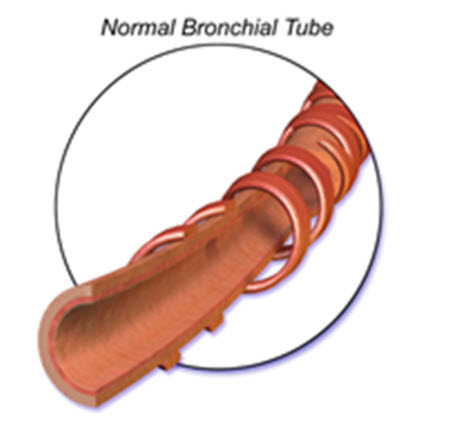 Normal Bronchi
 -
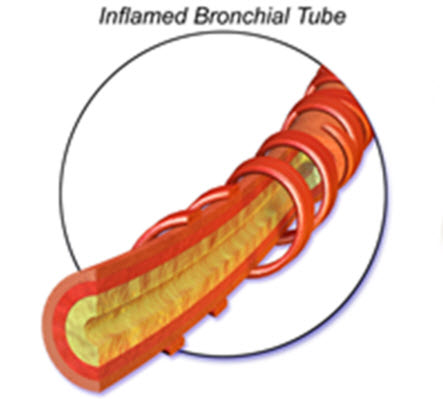 Inflamed Bronchi


Microscopy
- On microscopic analysis, epithelial-cell desquamation and denuding of the airway to the level of the basement membrane, in association with the presence of a lymphocytic cellular infiltrate, have been demonstrated.[2]
References
- ↑ Gonzales R, Sande MA (2000). “Uncomplicated acute bronchitis”. Ann. Intern. Med. 133 (12): 981–91. PMID 11119400.
- ↑ WALSH JJ, DIETLEIN LF, LOW FN, BURCH GE, MOGABGAB WJ (1961). “Bronchotracheal response in human influenza. Type A, Asian strain, as studied by light and electron microscopic examination of bronchoscopic biopsies”. Arch. Intern. Med. 108: 376–88. PMID 13782910.
© 2026 MyEClinic – IFTM Institut für Telematik in der Medizin GmbH