
Angioimmunoblastic T-cell lymphoma pathophysiology
Editor-In-Chief: C. Michael Gibson, M.S., M.D. [7]; Associate Editor(s)-in-Chief: Raviteja Guddeti, M.B.B.S. [8] Sowminya Arikapudi, M.B,B.S. [9]
Overview
Clonal T-cell receptor and immunoglobulin gene rearrangements are involved in the pathogenesis of angioimmunoblastic T-cell lymphoma. On gross pathology, aborization and proliferation of high endothelial venules are characteristic findings of angioimmunoblastic T-cell lymphoma. On microscopic histopathological analysis, CD4+ T-cells, CD8+ T-cells, and polyclonal plasma cells are characteristic findings of angioimmunoblastic T-cell lymphoma.
Genetics
- Clonal T-cell receptor gene rearrangements are detected in 75% of the cases.[1]
- immunoglobin gene rearrangements are detected in 10% of the cases.[2]
- The Epstein–Barr virus (EBV) is observed in the majority of cases, where the virus has been found in both reactive B-cells (that comprise part of the polymorphous infiltrate) and the neoplastic T-cells.[3][4][5]
- Trisomy 3, trisomy 5, and +X are the most frequent chromosomal abnormalities found in cases.[6][7]
Gross Pathology
A classic morphological finding is the aborization and proliferation of high endothelial venules.[4]
Microscopic Pathology
- Angioimmunoblastic T-cell lymphoma typically has the phenotype of a mixture of CD4+ and CD8+ T-cells, with a CD4:CD8 ratio greater than unity.
- Polyclonal plasma cells, lymphocytes, eosinophils, histiocytes, blast-like B-cells, and CD21+ follicular dendritic cells are also seen.[4]
- Due to the systemic nature of this disease, neoplastic cells can be found in lymph nodes, liver, spleen, skin, and bone marrow.
- Hyperplastic germinal centers and Reed-Sternberg cells can also be seen.[8][9]
Gallery
-
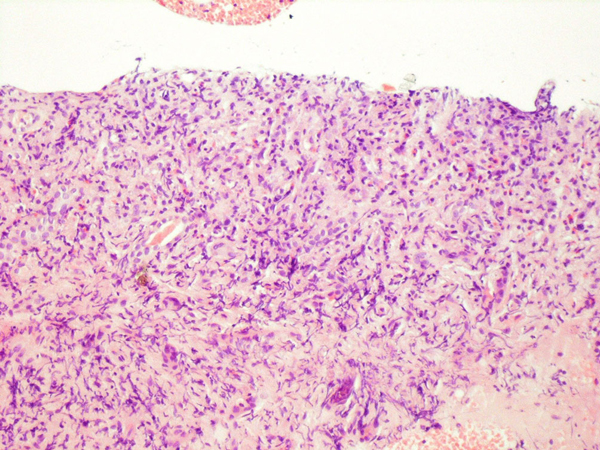 A kidney biopsy showing effacement of the renal structure by diffuse leukocytic infiltrate, represented mostly by elongated cells with marked artifactual changes.<ref name = casereport>Angioimmunoblastic T-cell lymphoma presenting as giant kidneys: a case report
 -
![A biopsy of an inguinal lymph node was remarkable for obliteration of the node architecture.[10]](https://www.wikidoc.org/images/6/63/Angioimmunoblastic_T-cell_lymphoma_Biopsy_2.jpg) A biopsy of an inguinal lymph node was remarkable for obliteration of the node architecture.[10]
A biopsy of an inguinal lymph node was remarkable for obliteration of the node architecture.[10] -
![The paracortical area was infiltrated by cells that were positive for CD3 and CD4.[10]](https://www.wikidoc.org/images/3/3a/Angioimmunoblastic_T-cell_lymphoma_Biopsy_3.jpg) The paracortical area was infiltrated by cells that were positive for CD3 and CD4.[10]
The paracortical area was infiltrated by cells that were positive for CD3 and CD4.[10]

![A biopsy of an inguinal lymph node was remarkable for obliteration of the node architecture.[10]](https://www.wikidoc.org/index.php/File%3AAngioimmunoblastic_T-cell_lymphoma_Biopsy_2.jpg)
![The paracortical area was infiltrated by cells that were positive for CD3 and CD4.[10]](https://www.wikidoc.org/index.php/File%3AAngioimmunoblastic_T-cell_lymphoma_Biopsy_3.jpg)
References
- ↑ [1] Feller AC, Griesser H, Schilling CV, Wacker HH, Dallenbach F, Bartels H, Kuse R, Mak TW, Lennert K. “Clonal gene rearrangement patterns correlate with immunophenotype and clinical parameters in patients with angioimmunoblastic lymphadenopathy.” Am J Pathol. 1988 Dec;133(3):549-56. PMID: 2849301
- ↑ [2] Lipford EH, Smith HR, Pittaluga S, Jaffe ES, Steinberg AD, Cossman J. “Clonality of angioimmunoblastic lymphadenopathy and implications for its evolution to malignant lymphoma.” J Clin Invest. 1987 Feb;79(2):637-42. PMID: 3805286
- ↑ Weiss LM, Jaffe ES, Liu XF, Chen YY, Shibata D, Medeiros LJ (April 1992). “Detection and localization of Epstein-Barr viral genomes in angioimmunoblastic lymphadenopathy and angioimmunoblastic lymphadenopathy-like lymphoma”. Blood. 79 (7): 1789–95. PMID 1373088.
- ↑ 4.0 4.1 4.2 Swerdlow, S.H.; Campo, E.; Harris, N.L.; Jaffe, E.S.; Pileri, S.A.; Stein, H.; Thiele, J.; Vardiman, J.W (2008). “11 Mature T- and NK-cell neoplasms: Angioimmunoblastic T-cell lymphoma”. WHO Classification of Tumours of Haematopoietic and Lymphoid Tissues. IARC WHO Classification of Tumours. 2 (4th ed.). IARC. ISBN 9283224310.
- ↑ Anagnostopoulos I, Hummel M, Finn T; et al. (October 1992). “Heterogeneous Epstein-Barr virus infection patterns in peripheral T-cell lymphoma of angioimmunoblastic lymphadenopathy type”. Blood. 80 (7): 1804–12. PMID 1327284.
- ↑ [3] Kaneko Y, Maseki N, Sakurai M, Takayama S, Nanba K, Kikuchi M, Frizzera G. “Characteristic karyotypic pattern in T-cell lymphoproliferative disorders with reactive “angioimmunoblastic lymphadenopathy with dysproteinemia-type” features.” Blood. 1988 Aug;72(2):413-21. PMID: 3261178
- ↑ [4] Schlegelberger B, Zhang Y, Weber-Matthiesen K, Grote W. “Detection of aberrant clones in nearly all cases of angioimmunoblastic lymphadenopathy with dysproteinemia-type T-cell lymphoma by combined interphase and metaphase cytogenetics.” Blood. 1994 Oct 15;84(8):2640-8. PMID: 7919378
- ↑ [5] Quintanilla-Martinez L, Fend F, Moguel LR, Spilove L, Beaty MW, Kingma DW, Raffeld M, Jaffe ES. “Peripheral T-cell lymphoma with Reed-Sternberg-like cells of B-cell phenotype and genotype associated with Epstein-Barr virus infection.” Am J Surg Pathol. 1999 Oct;23(10):1233-40. PMID: 10524524
- ↑ [6] Ree HJ, Kadin ME, Kikuchi M, Ko YH, Go JH, Suzumiya J, Kim DS. “Angioimmunoblastic lymphoma (AILD-type T-cell lymphoma) with hyperplastic germinal centers.” Am J Surg Pathol. 1998 Jun;22(6):643-55. PMID: 9630171
- ↑ 10.0 10.1 Angioimmunoblastic T-cell lymphoma presenting as giant kidneys: a case report http://www.jmedicalcasereports.com/content/3/1/9258 Accessed on November,25 2015
© 2026 MyEClinic – IFTM Institut für Telematik in der Medizin GmbH