
Balantidium coli
Editor-In-Chief: C. Michael Gibson, M.S., M.D. [1]; Associate Editor(s)-in-Chief: Tamar Sifri [2]
Overview
Balantidium coli is a species of ciliate protozoan. This parasite is the only member of this family known to be pathogenic to humans. Hosts include pigs, wild boars, rats, primates (including humans), horses, cattle and guinea pigs. Infection is transmitted within or between these species by fecal-oral transmission. Pigs are the most significant reservoir hosts, though they show few if any symptoms.
Cysts are the infective stage, responsible for transmission of balantidiasis. The host usually acquires cysts through ingestion of contaminated food or water. Following ingestion, excystation occurs in the small intestine, and the trophozoites colonize the large intestine. Both cysts and trophozoites are identifiable by a large, “sausage shaped” macronucleus.

The trophozoites reside in the lumen of the large intestine, where they replicate by transverse binary fission, during which conjugation may occur. Some trophozoites invade the wall of the colon using proteolytic enzymes and multiply; some of these return to the lumen. In the lumen Trophozoites may disintegrate or undergo encystation. Encystation is trigerred by dehydration of the intestinal contents and usually occurs in the distal large intestine, but may also occur outside of the host in feces. Symptoms can be local due to involvement of the intestinal mucosa, or systemic in nature and include diarrhea. Balantidiasis can be treated with carbarsone, tetracycline, or diiodohydroxyquin.
Geographic distribution
B. coli can be found worldwide. Pigs are a reservoir. Infection of people occurs more frequently in areas where pigs comingle with people, including the Philippines, Mexico, South America, and Papua New Guinea.
Less than 1% of the human population is infected worldwide.
Life Cycle
Cysts are the parasite stage responsible for transmission of balantidiasis (1). The host most often acquires the cyst through ingestion of contaminated food or water (2). Following ingestion, excystation occurs in the small intestine, and the trophozoites colonize the large intestine (3). The trophozoites reside in the lumen of the large intestine of humans and animals, where they replicate by binary fission, during which conjugation may occur (4). Trophozoites undergo encystation to produce infective cysts (5). Some trophozoites invade the wall of the colon and multiply. Some return to the lumen and disintegrate. Mature cysts are passed with feces (1).
-
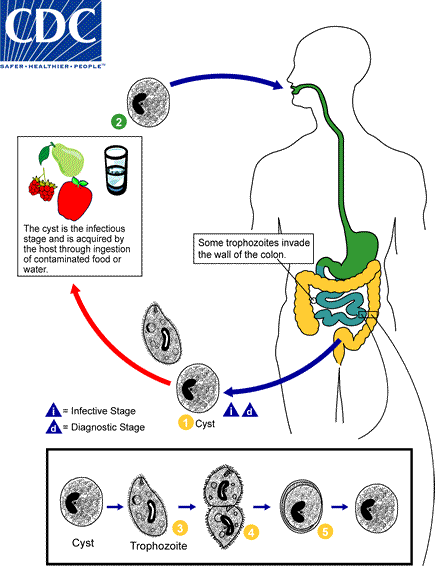 Life Cycle of Balatidium coli
Adapted from CDC

Treatment
Antimicrobial Regimen
- Balantidium coli treatment[1]
- Adult dosage:
- Preferred regimen: Metronidazole 750 mg PO tid for 5 days, Tetracycline 500 mg PO qid for 10 days
- Alternative regimen: Iodoquinol 650 mg PO tid for a 20-days
- Pediatric dosage:
- Preferred regimen: Metronidazole 35-50 mg/kg/day PO in three doses (maximum dosage: 2 g) for 5 days, Tetracycline 40 mg/kg/dose PO in four doses for 10 days.
- Alternative regimen: Iodoquinol 40 mg/kg/dose PO in three doses for 20 days AND Doxycycline.
- Note: Nitazoxanide, a broad-spectrum antiparasitic and antihelminthic drug, may be another treatment for balantidiosis.
References
- ↑ Schuster FL, Ramirez-Avila L (2008). “Current world status of Balantidium coli”. Clin Microbiol Rev. 21 (4): 626–38. doi:10.1128/CMR.00021-08. PMC 2570149. PMID 18854484.
© 2026 MyEClinic – IFTM Institut für Telematik in der Medizin GmbH