
Chickenpox epidemiology and demographics
Editor-In-Chief: C. Michael Gibson, M.S., M.D. [1]; Associate Editor(s)-in-Chief: Aravind Reddy Kothagadi M.B.B.S[2]
Overview
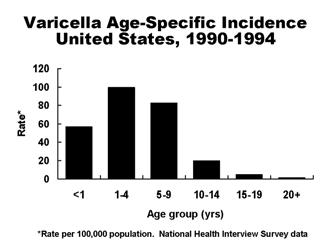
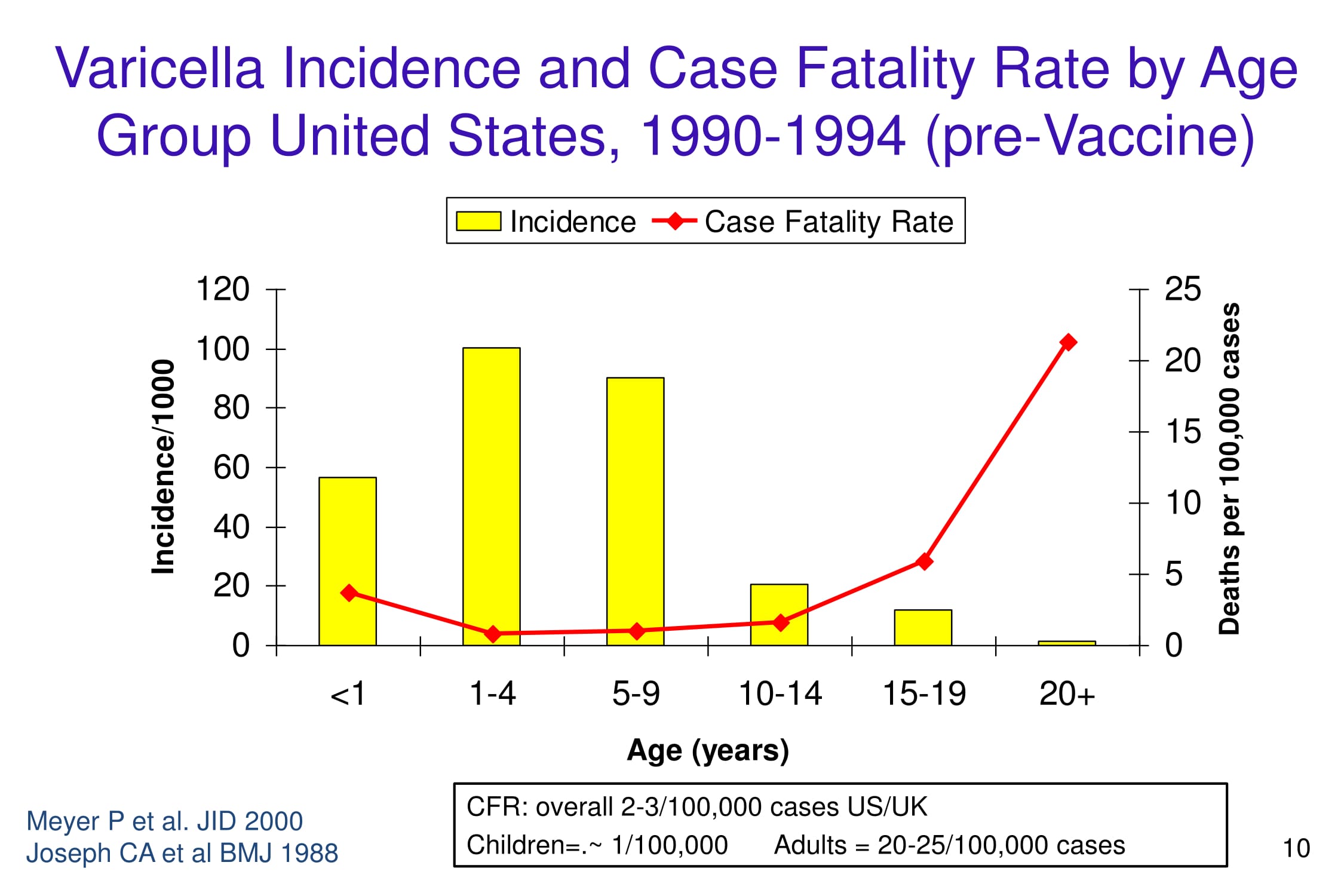
The incidence of chickenpox varies among various age groups. Varicella commonly affects children less than 10 years of age with the highest incidence among children 1-4 years of age. The incidence of chickenpox for children between 0 to 4 years of age is 5234 per 100,000 individuals. Between the years 1990-1994, the case fatality rate of chickenpox in the US/UK was 2-3 per 100,000 individuals. In developed countries, chickenpox causes around 3 deaths per 100,000 individuals.
Epidemiology
Incidence
The incidence of chickenpox varies among various age groups. The incidence rates per 100,000 persons in each age group were as follow:
- For age groups 0 to 4 years 5234 per 100,000 individuals
- For age groups 5 to 9 years 4132 per 100,000 individuals
- For age groups 10 to 14 years 1404 per 100,000 individuals
- For age groups 15 to 19 years 610 per 100,000 individuals
- For age groups >20 years 175 per 100,000 individuals
The rates of incidence of chickenpox declines for older age groups.[1]

Case Fatality Rate
Between the years 1990-1994, case fatality rate in the US/UK is 2-3 per 100,000.
- The case fatality rate among children was 1 per 100,000.
- In 2008 the case fatality rate in Brazil estimated case fatality rate is 4 per 100,000. [2]
- In 2000 the case fatality rate in Guinea Bissau was approximately 129 per 100,000 cases, 50 times higher than US/UK.
- In 1970, the case fatality rate in India among adults was 52 per 100,000 cases, 20 times higher than US/UK.
- Worldwide, the case fatality rate among adults was 20-25 per 100,000. [2]

Demographics
Age
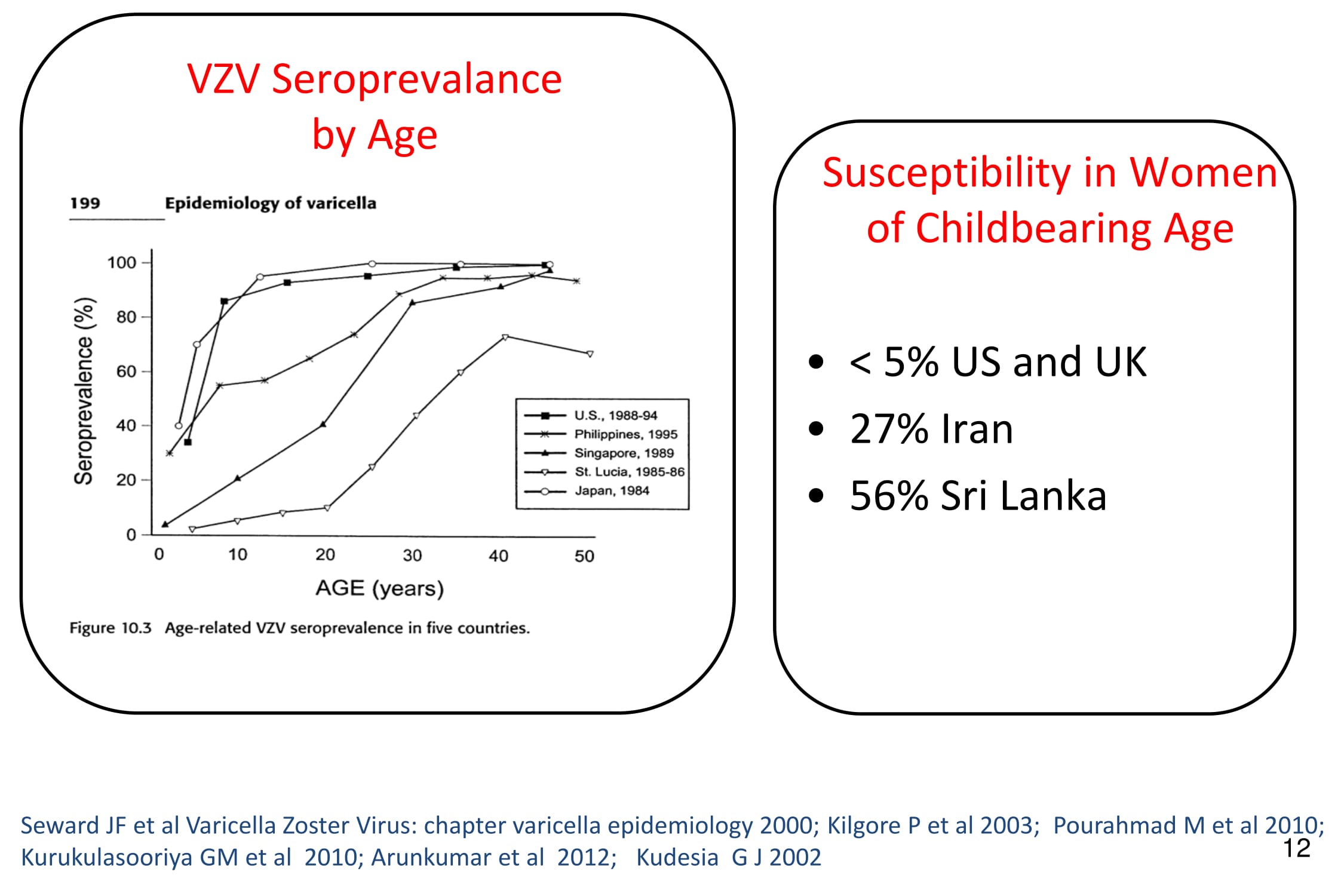
- The prevalence of chicken pox decreases with age.
- Varicella commonly affects children less than 10 years of age with the highest incidence among children 1-4 years of age.


Gender
- The prevalence and incidence of chickenpox generally do not vary by gender.
- Chickenpox is more prevalent in females between the ages of 15 – 24 as compared to males.[3]
Race
- There is no racial predilection for chickenpox.
Developed Countries
The epidemiology and demographics of chickenpox in developed countries are as follows:[2]
- Incidence
- 1500 – 1600 per 100,000 persons per year
- Case-fatality rate
- 3 deaths per 100,000 cases
Gallery
-
-
-
-
-
-
![Varicella cases and states reporting, United States, 1972-1996. From Public Health Image Library (PHIL). [4]](https://www.wikidoc.org/images/2/26/Chickenpox40.jpeg) Varicella cases and states reporting, United States, 1972-1996. From Public Health Image Library (PHIL). [4]
Varicella cases and states reporting, United States, 1972-1996. From Public Health Image Library (PHIL). [4]

![Varicella cases and states reporting, United States, 1972-1996. From Public Health Image Library (PHIL). [4]](https://www.wikidoc.org/index.php/File%3AChickenpox40.jpeg)
References
- ↑ Choo PW, Donahue JG, Manson JE, Platt R (1995). “The epidemiology of varicella and its complications”. J. Infect. Dis. 172 (3): 706–12. PMID 7658062.
- ↑ 2.0 2.1 2.2 “www.who.int” (PDF).
- ↑ Fleming DM, Cross KW, Cobb WA, Chapman RS (2004). “Gender difference in the incidence of shingles”. Epidemiol. Infect. 132 (1): 1–5. PMC 2870070. PMID 14979582.
- ↑ “Public Health Image Library (PHIL)”.
© 2026 MyEClinic – IFTM Institut für Telematik in der Medizin GmbH