
Congenital rubella syndrome physical examination
Editor-In-Chief: C. Michael Gibson, M.S., M.D. [1]; Associate Editor(s)-in-Chief: Dima Nimri, M.D. [2]
Overview
Congenital rubella syndrome affects multiple organ systems. The classic triad of congenital rubella syndrome consists of cataracts, sensorineural hearing loss and patent ductus arteriosus (PDA). However, many other findings are evident on physical examination, including low birth weight, skin lesions, and hepatosplenomegaly.[1][2][3][4][5]
Physical Examination
Congenital rubella syndrome affects multiple organ systems. The classic triad of congenital rubella syndrome consists of cataracts, sensorineural hearing loss, and patent ductus arteriosus (PDA). However, many other findings are evident on physical examination and these include:[1][2][3][4][5][6][7][8][9]
| Organ System | Findings | Suggestive of | ||
|---|---|---|---|---|
| General Appearance | Low birth weight | |||
| Skin | Skin lesions of several sizes (petechiae and purpura) | Thrombocytopenic purpura | ||
| Yellow discoloration of the skin and mucous membranes | Obstructive jaundice | |||
| Eyes | Clouding of the corneas | Cataracts | ||
| Congenital glaucoma | ||||
| Pigmentary retinopathy | ||||
| Yellow discoloration of the sclera | Obstructive jaundice | |||
| Ears | Sensorineural hearing loss | |||
| Heart | Holosystolic murmur, best heard at the left lower sternal border | Ventricular septal defect (VSD) | ||
| Continuous, machinery murmur, best heard at the left infraclavicular area | Patent ductus arteriosus (PDA) | |||
|
Coarctation of the aorta | |||
| Pulmonary artery stenosis | ||||
| Abdomen | Hepatosplenomegaly (HSM) | |||
| Neurological | Small head circumference | Microcephaly | ||
| Seizures, irritability, bulging anterior fontanelle | Encephalitis | |||
-
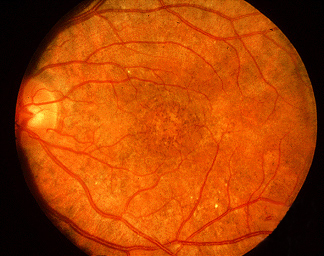 “Salt and pepper” retinopathy is the most common ocular manifestation of CRS. – By Jonathan Trobe, M.D. – University of Michigan Kellogg Eye Center – http://www.kellogg.umich.edu/theeyeshaveit/congenital/retinopathy.html, CC BY 3.0, https://commons.wikimedia.org/w/index.php?curid=16115881
 -
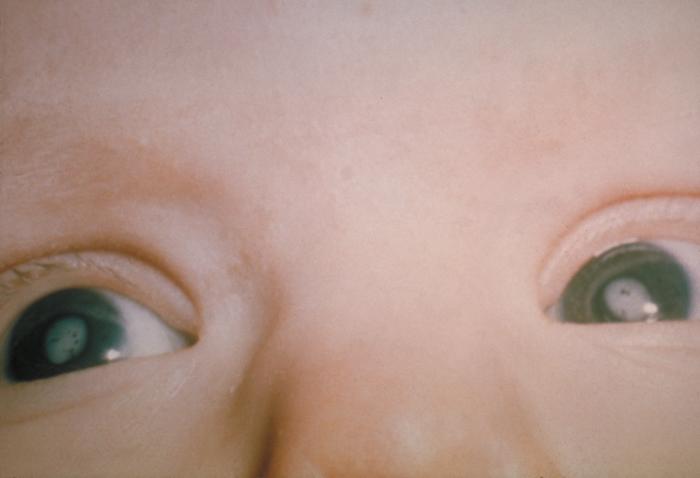 A child with congenital cataracts as a consequence of CRS. – By CDC – PHIL, Center for Disease Control (CDC) — ID# 713, Public Domain, https://commons.wikimedia.org/w/index.php?curid=12841764
 -
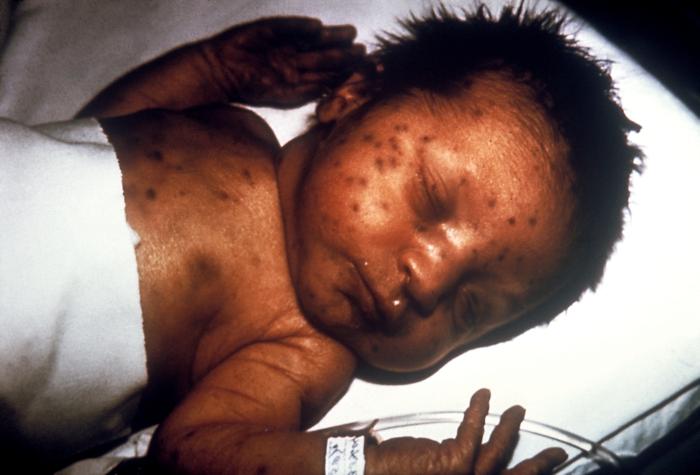 “Blueberry muffin” skin lesions, indicative of CRS. – By http://phil.cdc.gov/phil_images/20030724/28/PHIL_4284_lores.jpg, Public Domain, https://commons.wikimedia.org/w/index.php?curid=821959


References
- ↑ 1.0 1.1 De Santis M, Cavaliere AF, Straface G, Caruso A (2006). “Rubella infection in pregnancy”. Reprod. Toxicol. 21 (4): 390–8. doi:10.1016/j.reprotox.2005.01.014. PMID 16580940.
- ↑ 2.0 2.1 Lambert N, Strebel P, Orenstein W, Icenogle J, Poland GA (2015). “Rubella”. Lancet. 385 (9984): 2297–307. doi:10.1016/S0140-6736(14)60539-0. PMC 4514442. PMID 25576992.
- ↑ 3.0 3.1 Ajij M, Nangia S, Dubey BS (2014). “Congenital rubella syndrome with blueberry muffin lesions and extensive metaphysitis”. J Clin Diagn Res. 8 (12): PD03–4. doi:10.7860/JCDR/2014/10271.5293. PMC 4316306. PMID 25654000.
- ↑ 4.0 4.1 Bullens D, Smets K, Vanhaesebrouck P (2000). “Congenital rubella syndrome after maternal reinfection”. Clin Pediatr (Phila). 39 (2): 113–6. PMID 10696549.
- ↑ 5.0 5.1 Yazigi A, De Pecoulas AE, Vauloup-Fellous C, Grangeot-Keros L, Ayoubi JM, Picone O (2017). “Fetal and neonatal abnormalities due to congenital rubella syndrome: a review of literature”. J. Matern. Fetal. Neonatal. Med. 30 (3): 274–278. doi:10.3109/14767058.2016.1169526. PMID 27002428.
- ↑ Cooper LZ (1985). “The history and medical consequences of rubella”. Rev. Infect. Dis. 7 Suppl 1: S2–10. PMID 3890105.
- ↑ Banatvala JE, Brown DW (2004). “Rubella”. Lancet. 363 (9415): 1127–37. doi:10.1016/S0140-6736(04)15897-2. PMID 15064032.
- ↑ Cooper LZ, Krugman S (1967). “Clinical manifestations of postnatal and congenital rubella”. Arch. Ophthalmol. 77 (4): 434–9. PMID 4164540.
- ↑ Cooper LZ, Ziring PR, Ockerse AB, Fedun BA, Kiely B, Krugman S (1969). “Rubella. Clinical manifestations and management”. Am. J. Dis. Child. 118 (1): 18–29. PMID 5815335.
© 2026 MyEClinic – IFTM Institut für Telematik in der Medizin GmbH