
Cryoglobulinemia physical examination
Editor-In-Chief: C. Michael Gibson, M.S., M.D. [1]; Associate Editor(s)-in-Chief: Feham Tariq, MD [2]
Overview
Physical examination of patients with cryoglobulinemia is usually remarkable for: purpura, arthralgia, and acrocyanosis. Type I cryoglobulinemia predominantly affects the kidney, skin and bone marrow whereas mixed CG (types II and III) predominantly involves the skin and peripheral nervous system. The various signs that appear are most commonly due to underlying hyperviscosity and thrombosis.
Physical Examination
Physical examination of patients with cryoglobulinemia is usually remarkable for: purpura, arthralgia, and acrocyanosis. Type I cryoglobulinemia predominantly affects the kidney, skin and bone marrow whereas mixed CG (types II and III) predominantly involves the skin and peripheral nervous system.
Appearance of the Patient
Patients with cryoglobulinemia usually appear normal. Clinical manifestations that appear vary according to the type of cryoglobulinemia. The various signs that appear are most commonly due to underlying hyperviscosity and thrombosis.
Vital Signs
Vital signs in patients with cryoglobulinemia are normal.
Skin
The cutaneous manifestations associated with cryoglobulinemia are as follows:[1][2][3]
- Leukocytoclastic vasculitis
- Raynauds phenomenon
- Livedo reticularis
- Palpable purpura
- Digital ischemia
- Acrocyanosis
- Hyperkeratotic spicules in cold-exposed areas
- Cold induced urticaria
HEENT
- Nystagmus
- Retinal hemorrhage
Neck
Lungs
- Pulmonary examination of patients with cryopglobulinemia is postive for the following findings:[4][5]
- Shortness of breath
- Cough
- Reduction in forced expiratory flow rates
- Pleural effusion findings
Heart
- Cardiovascular examination of patients with cryoglobulinemia is usually normal.
Abdomen
Back
- Back examination of patients with cryoglobulinemia is usually normal.
Genitourinary
- Hematuria as a result of membranoproliferative glomerulonephritis.[6][7]
Neuromuscular
Extremities
Extremities examination of patients with cryoglobulinemia usually have the following findings:[8]
- Digital ischemia/gangrene
- Fasciculations in the upper/lower extremity
- Joint involvement most commonly in knees, ankles, proximal interphalangeal joints.
- Peripheral neuropathy
| Physical examination findings according to the type of cryoglobulinemia | ||
|---|---|---|
| Type 1 | Type 2 | Type 3 |
| Gangrene | Joint abnormalities | Purpura |
| Acrocyanosis | Membranoproliferative glomerulonephritis | |
Gallery
-
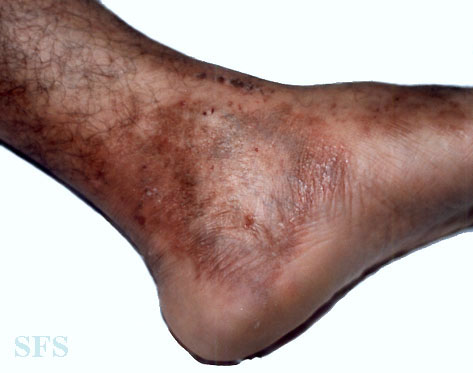 Atrophie Blanche. Adapted from Dermatology Atlas.<ref name=”Dermatology Atlas”>{{Cite
 -
 Atrophie Blanche. Adapted from Dermatology Atlas.<ref name=”Dermatology Atlas”>{{Cite
 -
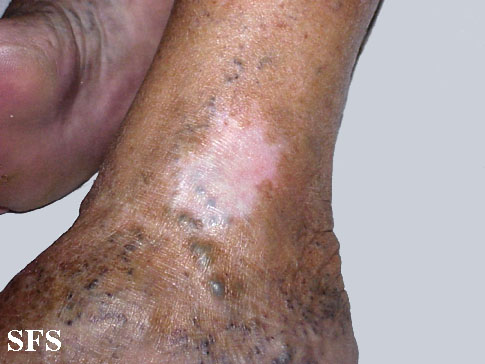 Atrophie Blanche. Adapted from Dermatology Atlas.<ref name=”Dermatology Atlas”>{{Cite
 -
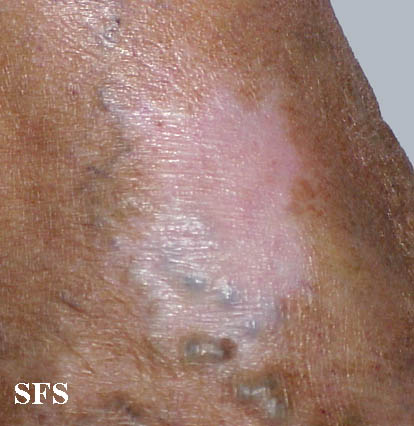 Atrophie Blanche. Adapted from Dermatology Atlas.<ref name=”Dermatology Atlas”>{{Cite
 -
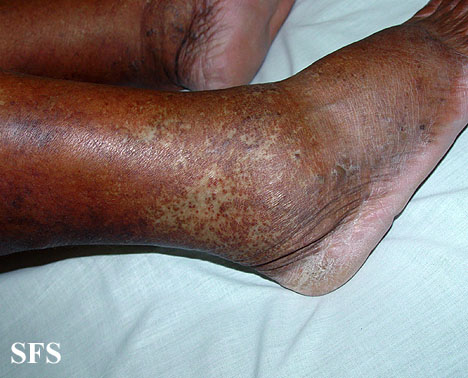 Atrophie Blanche. Adapted from Dermatology Atlas.<ref name=”Dermatology Atlas”>{{Cite
 -
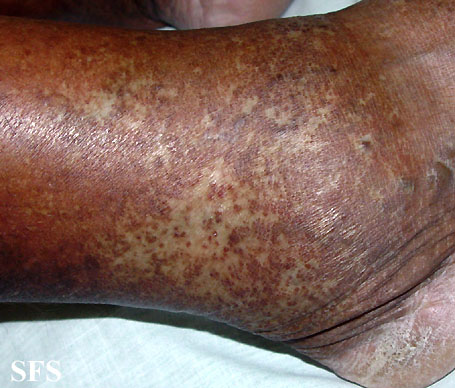 Atrophie Blanche. Adapted from Dermatology Atlas.<ref name=”Dermatology Atlas”>{{Cite
 -
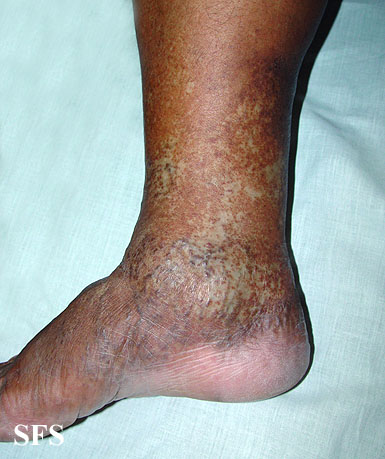 Atrophie Blanche. Adapted from Dermatology Atlas.<ref name=”Dermatology Atlas”>{{Cite
 -
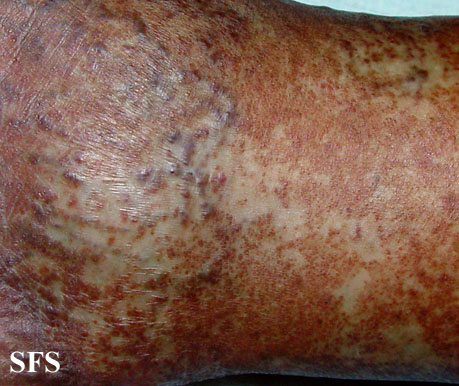 Atrophie Blanche. Adapted from Dermatology Atlas.<ref name=”Dermatology Atlas”>{{Cite


References
- ↑ Monti G, Galli M, Invernizzi F, Pioltelli P, Saccardo F, Monteverde A; et al. (1995). “Cryoglobulinaemias: a multi-centre study of the early clinical and laboratory manifestations of primary and secondary disease. GISC. Italian Group for the Study of Cryoglobulinaemias”. QJM. 88 (2): 115–26. PMID 7704562.
- ↑ Gorevic PD, Kassab HJ, Levo Y, Kohn R, Meltzer M, Prose P; et al. (1980). “Mixed cryoglobulinemia: clinical aspects and long-term follow-up of 40 patients”. Am J Med. 69 (2): 287–308. PMID 6996482.
- ↑ Cohen SJ, Pittelkow MR, Su WP (1991). “Cutaneous manifestations of cryoglobulinemia: clinical and histopathologic study of seventy-two patients”. J Am Acad Dermatol. 25 (1 Pt 1): 21–7. PMID 1880249.
- ↑ Bombardieri S, Paoletti P, Ferri C, Di Munno O, Fornal E, Giuntini C (1979). “Lung involvement in essential mixed cryoglobulinemia”. Am J Med. 66 (5): 748–56. PMID 443251.
- ↑ Viegi G, Fornai E, Ferri C, Di Munno O, Begliomini E, Vitali C; et al. (1989). “Lung function in essential mixed cryoglobulinemia: a short-term follow-up”. Clin Rheumatol. 8 (3): 331–8. PMID 2805608.
- ↑ Brouet JC, Clauvel JP, Danon F, Klein M, Seligmann M (1974). “Biologic and clinical significance of cryoglobulins. A report of 86 cases”. Am J Med. 57 (5): 775–88. PMID 4216269.
- ↑ Tarantino A, Campise M, Banfi G, Confalonieri R, Bucci A, Montoli A; et al. (1995). “Long-term predictors of survival in essential mixed cryoglobulinemic glomerulonephritis”. Kidney Int. 47 (2): 618–23. PMID 7723249.
- ↑ Montagnino G (1988). “Reappraisal of the clinical expression of mixed cryoglobulinemia”. Springer Semin Immunopathol. 10 (1): 1–19. PMID 3046019.
© 2026 MyEClinic – IFTM Institut für Telematik in der Medizin GmbH