
Diastasis recti
Editor-In-Chief: C. Michael Gibson, M.S., M.D. [1]
Overview
Diastasis recti is a disorder defined as a separation of the rectus abdominis muscle into right and left halves. [2]
Epidemiology
- Normally, the two sides of the muscle are joined at the linea alba at the midline. Diastasis of this muscle occurs principally in two populations: newborns and pregnant women.
- In the newborn, the rectus abdominis is not fully developed and may not be sealed together at midline. Diastasis recti is more common in premature and African American newborns.
- In pregnant or postpartum women, the defect is caused by the stretching of the rectus abdominis by the growing uterus.
- It is more common in multiparous women due to repeated episodes of stretching. When the defect occurs during pregnancy, the uterus can sometimes be seen bulging through the abdominal wall beneath the skin. [3]
Clinical presentation
A diastasis recti appears as a ridge running down the midline of the abdomen from the xiphoid process to the umbilicus. It becomes more prominent with straining and may disappear when the abdominal muscles are relaxed. The medial borders of the right and left halves of the muscle may be palpated during relaxation. [4]
Diagnosis
The condition can be diagnosed by physical exam, and a ventral hernia may be ruled out using ultrasound.
Treatment
No treatment is necessary for women while they are still pregnant. Complications include development of an umbilical or ventral hernia in children, which is rare and can be corrected with surgery. [5]
(Images courtesy of Charlie Goldberg, M.D., UCSD School of Medicine and VA Medical Center, San Diego, California)
-
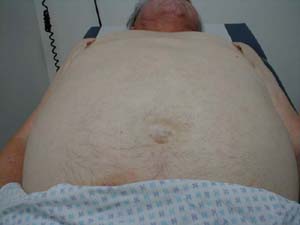 Separation of rectus abdominus muscles which occasionally occurs in older patients and or those with weakening of the abdominal musculature.
 -
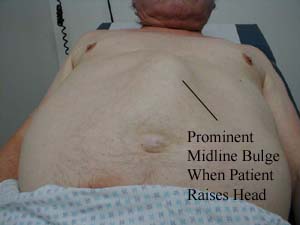 The midline hernia can be made more apparent by any maneuver that increases intra-abdominal pressure as demonstrated above.


References
- MedlinePlus Medical Encyclopedia: Diastasis Recti
- University of Pennsylvania Health System Encyclopedia: Diastasis Recti
Template:Skin and subcutaneous tissue symptoms and signs Template:Nervous and musculoskeletal system symptoms and signs Template:Urinary system symptoms and signs Template:Cognition, perception, emotional state and behaviour symptoms and signs Template:Speech and voice symptoms and signs Template:General symptoms and signs
© 2026 MyEClinic – IFTM Institut für Telematik in der Medizin GmbH