
Kimura disease
Editor-In-Chief: C. Michael Gibson, M.S., M.D. [1]; Associate Editor(s)-In-Chief: Lakshmi Gopalakrishnan, M.B.B.S. [2]
Overview
Kimura disease is a benign, rare, chronic inflammatory disorder. Its primary symptoms include: subdermal lesions present in the head or neck and is associated with painless unilateral cervical lymph nodes inflammation.
Historical Perspective
The first known report of Kimura disease was from China in 1937, when Kimm and Szeto identified seven cases of the condition.[1]
It first received its name in 1948 when Kimura and others noted a change in the surrounding blood vessels and referred to it as unusual granulation combined with hyperplastic changes in lymphoid tissue.[2]
Pathophysiology
The pathophysiology of Kimura Disease remains unknown, although an allergic reaction, trauma, and/or autoimmune process have all been implicated as possible etiology.
The disease is manifested by an abnormal proliferation of lymphoid follicles and vascular endothelium. Peripheral eosinophilia and the presence of eosinophils in the inflammatory infiltrate suggest that Kimura Disease may be an hypersensitivity reaction. Some evidence has indicated that TH2 lymphocytes may also play a role, but further investigation is needed.
Kimura Disease is generally limited to the skin, lymph nodes, and salivary glands, but patients presenting with nephrotic syndrome have also been reported. The basis of this possible association is unclear.
Epidemiology & Demographics
Kimura Disease is predominantly seen in males of Asian descent. The disease has rarely been reported in the United States. On an international level, the prevalence of the disease is not known.
Cause
The cause of Kimura disease remains unknown. Allergic reaction or an alteration of immune regulation or persistent antigenic stimulation following arthropod bites and parasitic or candidal infection have been postulated. However, none of these theories have been substantiated till date.
Treatment
Medical Therapy
- Observation if the lesions are neither symptomatic nor disfiguring.
- Intralesional or oral steroids may be indicated to reduce the size of the nodules but seldom result in cure.
- Cyclosporine has been reported to induce remission in patients with Kimura Disease. However, recurrence of the lesion have been observed on discontinuation of the therapy.
- Cetirizine is an effective agent in treating the symptoms of Kimura’s disease. Cetirizine’s properties of being effective both in the treatment of pruritus and as an anti-inflammatory agent make it suitable for the treatment of the pruritus associated with these lesions.[3]
Supportive data
In a 2005 study, the American College of Rheumatology conducted treatments initially using prednisone, followed by steroid dosages and azathioprine, omeprazole, calcium and vitamin D supplements over the course of two years.[3] The skin condition of the patient began to improve and the skin lesions lessened. However, there were symptoms of cushingoid and hirsutism observed before the patient was removed from the courses of steroids and placed on 10 mg/day of cetirizine to prevent skin lesions; an agent suitable for the treatment of pruritus associated with such lesions. Asymptomatically, the patient’s skin lesions disappeared after treatment with cetirizine, blood eosinophil counts became normal, corticosteroid effects were resolved, and a remission began within a period of two months. It is also thought that the inhibition of eosinophils may be the key to treatment of Kimura’s disease due to the role of eosinophils, rather than other cells with regards to the lesions of the skin.
Radiotherapy
Radiotherapy has been used to treat recurrent or persistent lesions. However, considering the benign nature of this disease, radiation should be considered only in cases of recurrent, disfiguring lesions.
Surgery
Surgery has been considered the mainstay of therapy. However, recurrence after surgery is common.
Physical examination
-
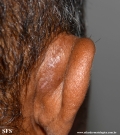 Kimura Disease.
With permission from the Dermatology Atlas

References
- ↑ Kimm HT, Szeto C (1937). “Eosinophilic hyperplastic lymphogranuloma, comparison with Mikulicz’s disease”. Proc Chin Med Soc: p. 329.
- ↑ Kimura T, Yoshimura S, Ishikawa E (1948). “On the unusual granulation combined with hyperplastic changes of lymphatic tissues”. Trans Soc Pathol Jpn: pp. 179–180.
- ↑ 3.0 3.1 Ben-Chetrit E, Amir G, Shalit M (2005). “Cetirizine: An effective agent in Kimura’s disease”. Arthritis and Rheumatism. 53 (1): 117–8. doi:10.1002/art.20908. PMID 15696573. Retrieved 2012-04-25. Unknown parameter
|month=ignored (help)
© 2026 MyEClinic – IFTM Institut für Telematik in der Medizin GmbH