
Pisiform bone
Please Take Over This Page and Apply to be Editor-In-Chief for this topic: There can be one or more than one Editor-In-Chief. You may also apply to be an Associate Editor-In-Chief of one of the subtopics below. Please mail us [1] to indicate your interest in serving either as an Editor-In-Chief of the entire topic or as an Associate Editor-In-Chief for a subtopic. Please be sure to attach your CV and or biographical sketch.
Overview
The pisiform bone (also called pisiform or lentiform bone) is a small knobbly, pea-shaped wrist bone.
The pisiform bone is found in the proximal row of the carpus. It is located where the ulna (inner bone of the forearm) joins the carpus (wrist). It articulates only with the triquetral.
It is a sesamoid bone.
The pisiform bone may be known by its small size, and by its presenting a single articular facet. It is situated on a plane anterior to the other carpal bones and is spheroidal in form.
The etymology derives from the Latin pīsum which means “pea.”
Surfaces
Its dorsal surface presents a smooth, oval facet, for articulation with the triangular: this facet approaches the superior, but not the inferior border of the bone.
The volar surface is rounded and rough, and gives attachment to the transverse carpal ligament, and to the Flexor carpi ulnaris and Abductor digiti quinti.
The lateral and medial surfaces are also rough, the former being concave, the latter usually convex.
See also
Additional images
-
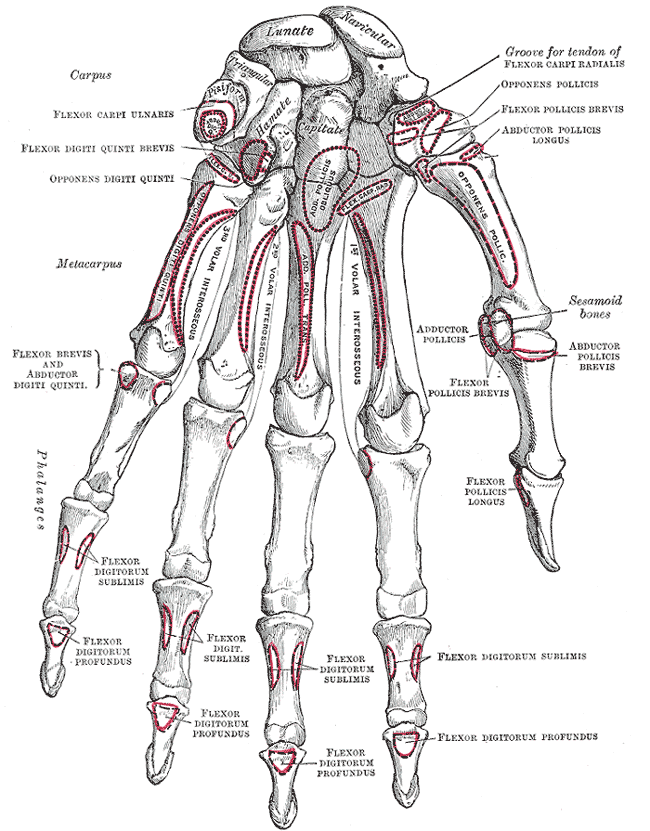 Bones of the left hand. Volar surface.
 -
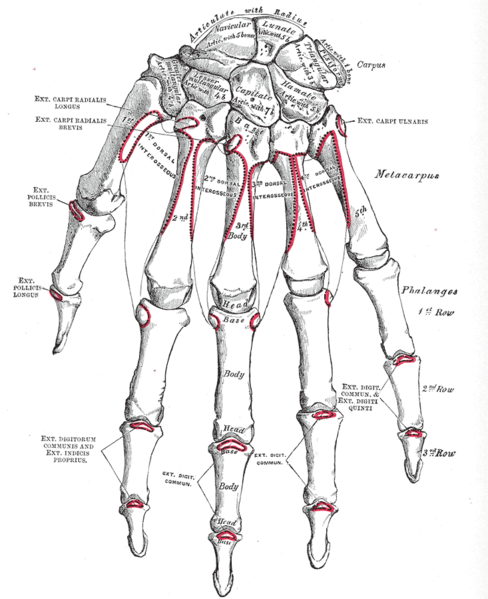 Bones of the left hand. Dorsal surface.
 -
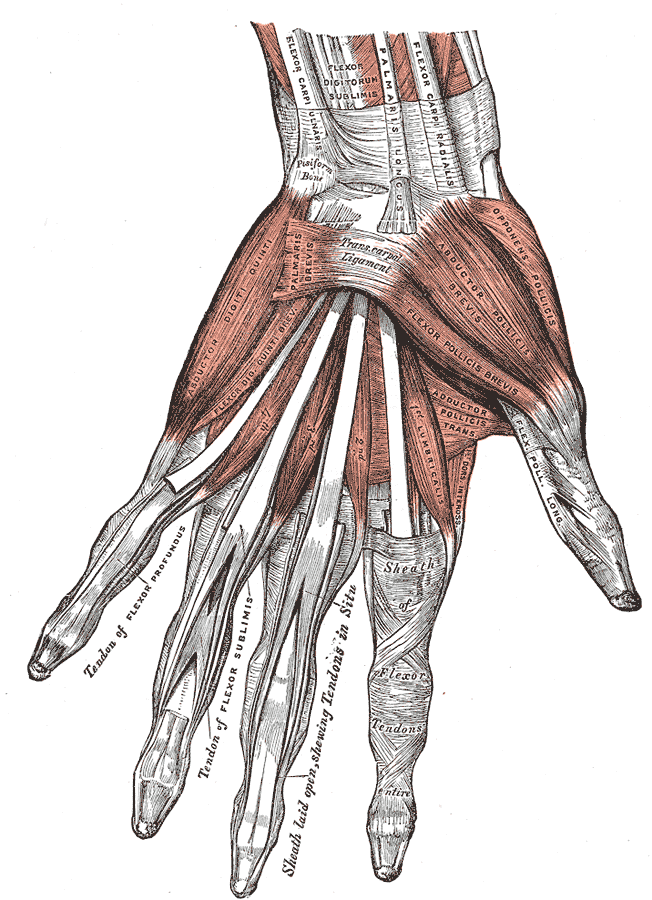 The muscles of the left hand. Palmar surface.


External links
- Template:ViennaCrossSection
- Template:DartmouthAnatomy
- Template:KansasHandKinesiology
- Illustration at ntu.edu.tw
© 2026 MyEClinic – IFTM Institut für Telematik in der Medizin GmbH