
Precordial examination
Editor-In-Chief: C. Michael Gibson, M.S., M.D. [1]
Please Take Over This Page and Apply to be Editor-In-Chief for this topic: There can be one or more than one Editor-In-Chief. You may also apply to be an Associate Editor-In-Chief of one of the subtopics below. Please mail us [2] to indicate your interest in serving either as an Editor-In-Chief of the entire topic or as an Associate Editor-In-Chief for a subtopic. Please be sure to attach your CV and or biographical sketch.
In medicine, the precordial exam, also cardiac exam, is performed as part of a physical examination, or when a patient presents with chest pain suggestive of a cardiovascular pathology.
The exam includes several parts:
- position / lighting / draping
- inspection
- palpation
- auscultation
Position / Lighting / Draping
Position – patient should be supine and the bed or examination table should be at a 45 degree angle. The patient’s hands should remain at her sides with her head resting on a pillow.
Lighting – adjusted so that it is ideal.
Draping – the chest should be fully exposed.
Inspection
Patient should be examined for
- Masses
- Scars
- Lesions
- Signs of trauma and previous surgery (e.g. median sternotomy)
- Precordial bulge
- Visible apex beat
- Increased jugular venous pressure (JVP)
Palpation
The valve area are palpated for abnormal pulsations (known as thrills) and precordial movements (known as heaves). Heaves are best felt with the heel of the hand at the sternal border.
The point of apex beat is typically in the fifth intercostal space and 1cm medial to the mid-clavicular line. It should be described by the following characteristics (which can be remember with the mnemonic SALID:
- S – Size – Is it larger than one interspace?
- A – Amplitude – Is it weak?
- L – Location – Is it in the fifth intercostal space at the mid-clavicular line?
- I – Impulse – Is it monophasic or biphasic?
- D – Duration – Is it abnormally sustained?
The best to describe apex beat is the point that has the most lateral and most inferior of apex pulsation.
-
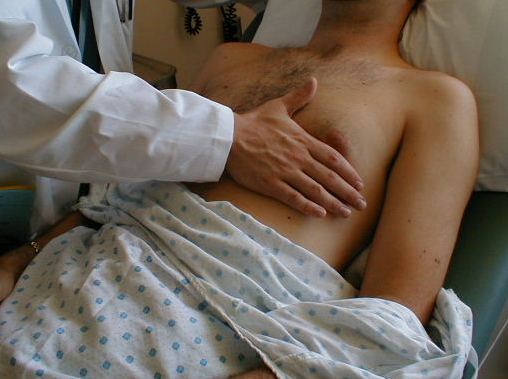 Palpation of the Precordium.
(Image courtesy of Charlie Goldberg, M.D., UCSD School of Medicine and VA Medical Center, San Diego, California)

Auscultation
One should comment on
- S1 and S2 – if the splitting is abnormal or louder than usual. Should sound like [lub-dub lub-dub]
and the presence of
- S3 – think Kentucky – the emphasis and timing of the syllables in the word Kentucky is similar to the pattern of sounds in a precordial S3. Some examiners can hear these sounds better by listening for a [T-lub dub] sound.
- S4 – think Tennessee – the emphasis and timing of the syllables in the word Tennessee is similar to the pattern of sounds in a precordial S4. Some examiners can hear these sounds better by listening for a [lub-de-dub] sound.
- If S4 S1 S2 S3 were all present it would sound like [T-lub-de-dub] Also known as a gallop rhythm
- diastolic murmurs (e.g. aortic insufficiency, mitral stenosis)
- systolic murmurs (e.g. aortic stenosis, mitral regurgitation)
- pericardial rub (suggestive of pericarditis)
-
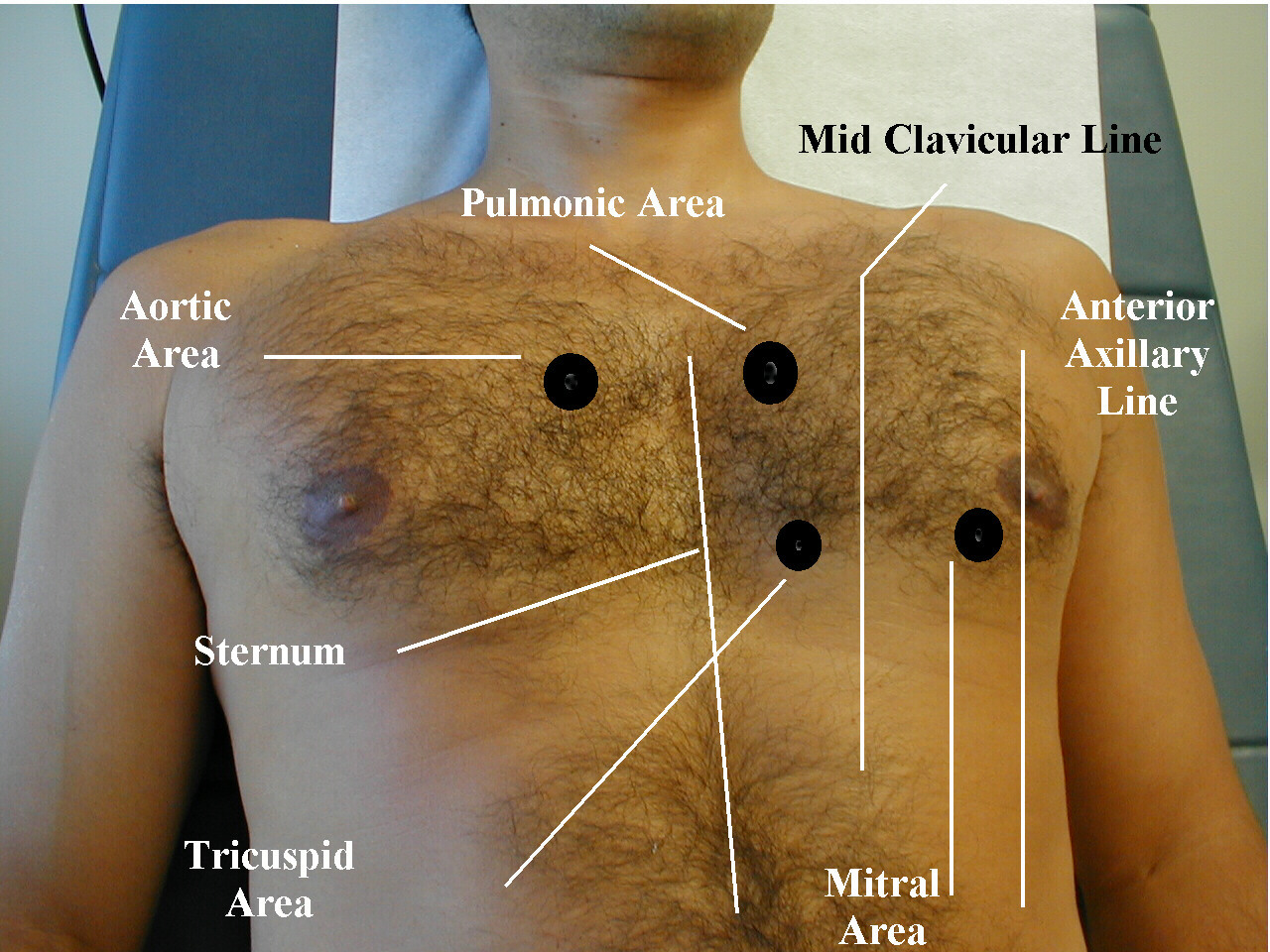 Auscultation of the Heart.
(Image courtesy of Charlie Goldberg, M.D., UCSD School of Medicine and VA Medical Center, San Diego, California) -
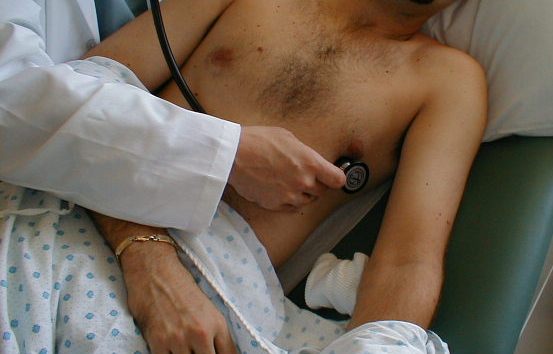 Listening for Extra Heart Sounds.
(Image courtesy of Charlie Goldberg, M.D., UCSD School of Medicine and VA Medical Center, San Diego, California)


Video: Examination of Cardiovascular System
{{#ev:youtube|dp5m2tXHDmA}}
See also
© 2026 MyEClinic – IFTM Institut für Telematik in der Medizin GmbH