

Health Dictionary
Reliable, easy-to-read patient information on common medical conditions — written in plain language, free of jargon, and grounded in current evidence. Browse the most frequent diagnoses, understand what they mean for everyday life, and learn which steps and questions help you have a focused conversation with your doctor.
ATC code H01
Introduction
A section of the Anatomical Therapeutic Chemical Classification System.
H Systemic hormonal preparations, excluding sex hormones and insulins
H01A Anterior pituitary lobe hormones and analogues
H01A Anterior pituitary lobe hormones and analogues
- H01AA01 Corticotropin
- H01AA02 Tetracosactide
H01AB Thyrotropin
- H01AB01 Thyrotropin
H01AC Somatropin and somatropin agonists
- H01AC01 Somatropin
- H01AC02 Somatrem
- H01AC03 Mecasermin
- H01AC04 Sermorelin
H01AX Other anterior pituitary lobe hormones and analogues
- H01AX01 Pegvisomant
The anterior pituitary (also called the adenohypophysis, from Greek adeno, “gland”; hypo, “under”; physis, “growth”; hence, glandular undergrowth) comprises the anterior lobe of the pituitary gland and is part of the endocrine system. Unlike the posterior lobe, the anterior lobe is genuinely glandular, hence the root adeno in its name.
Under the influence of the hypothalamus, the anterior pituitary produces and secretes several peptide hormones that regulate many physiological processes including stress, growth, and reproduction.
Regions
The term “pars distalis” is sometimes used as a synonym for the the anterior pituitary, but this is not quite correct. The anterior pituitary is usually divided into three regions:
- pars distalis (“distal part”) – the majority of the anterior pituitary
- pars tuberalis (“tubular part”) – a sheath extending up from the pars distalis and wrapping around the pituitary stalk
- pars intermedia (“intermediate part”) – sits between the bulk of the anterior pituitary and the posterior pituitary and is often very small in humans
The function of the tuberalis is not well characterized, and most of the rest of this article refers primarily to the distalis.
Embryology
Unlike the posterior pituitary (pars nervosa), which originates from neural ectoderm, the anterior pituitary arises from an invagination of the oral mucosa called Rathke’s pouch (which is itself ectoderm derived).
This differentiation is exhibited by the fact that while the posterior pituitary merely secretes those hormones produced in the hypothalamus (ADH and oxytocin), the anterior pituitary actually produces its hormones, while being under control of the hypothalamus as to when they should be secreted.
Major hormones secreted
| Hormone | Other names | Symbol(s) | Secretory cells (staining type) | Target | Effect |
|---|---|---|---|---|---|
| Adrenocorticotropic hormone | Corticotropin | ACTH | Corticotrophs (basophil) | Adrenal gland | Secretion of glucocorticoids |
| Endorphins | – | – | – | – | Inhibit perception of pain |
| Follicle-stimulating hormone | – | FSH | Gonadotrophs (basophil) | Ovaries, Testes | Growth of reproductive system |
| Growth hormone | Somatotropin | GH, STH | Somatotrophs (acidophil) | Liver, adipose tissue | Promotes growth; lipid & carbohydrate metabolism |
| Luteinizing hormone (females), Interstitial Cell Stimulating Hormone (males) | Lutropin | LH, ICSH | Gonadotrophs (basophil) | Ovaries, Testes | Sex hormone production |
| Prolactin | – | PRL | Lactotrophs, also known as Mammotrophs (acidophil) | Ovaries, mammary glands | Secretion of estrogens/progesterone; milk production |
| Thyroid-stimulating hormone | Thyrotropin | TSH | Thyrotrophs (basophil) | Thyroid gland | Secretion of thyroid hormones |
A useful acronym for the hormones secreted by the anterior pituitary is ‘FLAT PEG’ (FSH, LH, ACTH, TSH, Prolactin, Endorphins, GH).
Hypothalamic releasing and release-inhibiting factors
Hormone secretion from the anterior pituitary gland is regulated by hormones secreted by the hypothalamus. Neuroendocrine neurons in the hypothalamus project axons to the median eminence, at the base of the brain. At this site, these neurons can release substances into small blood vessels that travel directly to the anterior pituitary gland (the hypothalamo-hypophysial portal vessels).
| Name | Other Names | Abbreviations | Location | Function |
|---|---|---|---|---|
| Corticotropin-releasing hormone | Corticotropin-releasing factor, Corticoliberin | CRH, CRF | parvocellular neuroendocrine neurons in the paraventricular nucleus | with vasopressin, stimulates secretion of ACTH |
| Dopamine | Prolactin-inhibiting hormone | DA, PIH | neuroendocrine neurons of the arcuate nucleus | inhibits secretion of prolactin |
| Gonadotropin-releasing hormone | Luteinising-hormone releasing hormone | GnRH, LHRH | neuroendocrine neurons in the medial preoptic and arcuate nuclei | stimulates secretion of LH and FSH |
| Growth hormone-releasing hormone | Growth-hormone-releasing factor, somatocrinin | GHRH, GHRF, GRF | arcuate nucleus neuroendocrine neurons | stimulates secretion of growth hormone |
| Somatostatin | Growth hormone-inhibiting hormone, Somatotropin release-inhibiting factor | SS, GHIH, SRIF | neuroendocrine neurons of the periventricular nucleus | inhibits secretion of growth hormone |
| Thyrotropin-releasing hormone | Thyrotropin-releasing factor, Thyroliberin, Protirelin | TRH, TRF | parvocellular neuroendocrine neurons in the paraventricular and anterior hypothalamic nuclei | stimulates secretion of TSH |
| Vasopressin | Arginine vasopressin, Antidiuretic hormone, Argipressin | AVP, ADH | parvocellular neuroendocrine neurons in the paraventricular nucleus | with Corticotropin-releasing hormone, stimulates secretion of ACTH |
Additional images
-
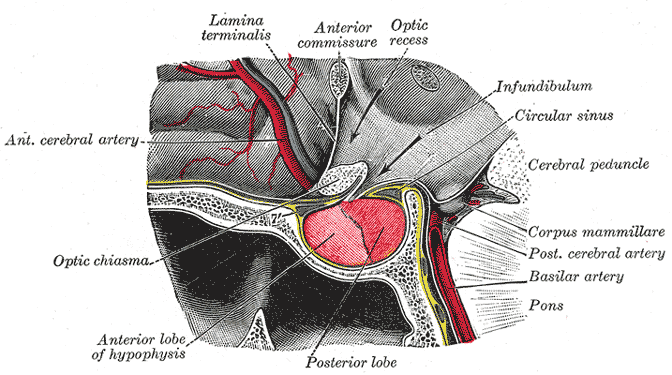 The anterior pituitary is the anterior, glandular lobe of the pituitary gland.
 -


See also
External links
- Histology image: 14002loa – Histology Learning System at Boston University
- Embryology at unc.edu
Template:Pituitary gland Template:Diencephalon Template:Pituitary and hypothalamic hormones and analogues fi:Adenohypofyysi
Editor-In-Chief: C. Michael Gibson, M.S., M.D. [1] Phone:617-632-7753
H01B Posterior pituitary lobe hormones
H01B Posterior pituitary lobe hormones
H01BA Vasopressin and analogues
- H01BA01 Vasopressin
- H01BA02 Desmopressin
- H01BA03 Lypressin
- H01BA04 Terlipressin
- H01BA05 Ornipressin
- H01BA06 Argipressin
H01BB Oxytocin and analogues
- H01BB01 Demoxytocin
- H01BB02 Oxytocin
- H01BB03 Carbetocin
H01C Hypothalamic hormones
H01C Hypothalamic hormones
H01CA Gonadotropin-releasing hormones
- H01CA01 Gonadorelin
- H01CA02 Nafarelin
- H01CA03 Histrelin
H01CB Antigrowth hormone
- H01CB01 Somatostatin
- H01CB02 Octreotide
- H01CB03 Lanreotide
H01CC Anti-gonadotropin-releasing hormones
- H01CC01 Ganirelix
- H01CC02 Cetrorelix
hu:ATC H01 – Hipofízis-hormonok, hipotalamusz-hormonok és analógjaik
th:ATC รหัส H01