

Health Dictionary
Reliable, easy-to-read patient information on common medical conditions — written in plain language, free of jargon, and grounded in current evidence. Browse the most frequent diagnoses, understand what they mean for everyday life, and learn which steps and questions help you have a focused conversation with your doctor.
Acanthocytes
Introduction
Acanthocyte is a general term meaning ‘spiny cell’. AKA “spur cell” in more severe cases
- In human biology and medicine, the term refers to pathological red blood cells, which are coarse and irregularly crenelated resembling many-pointed stars. They are seen on blood films in, among others, lipid abnormalities, liver disease, chorea acanthocytosis, McLeod syndrome and several inherited neurological disorders, such as neuroacanthocytosis.
- In veterinary medicine, Acanthocytosis may be seen in dogs with liver disease or hemangiosarcoma.
- In mycology, the term also refers to stellate cells found on the hyphae of fungi of the genus Stropharia. Recent work, published in 2006, on those of Stropharia rugosoannulata has shown them to have nematode-killing properties.[1]
-
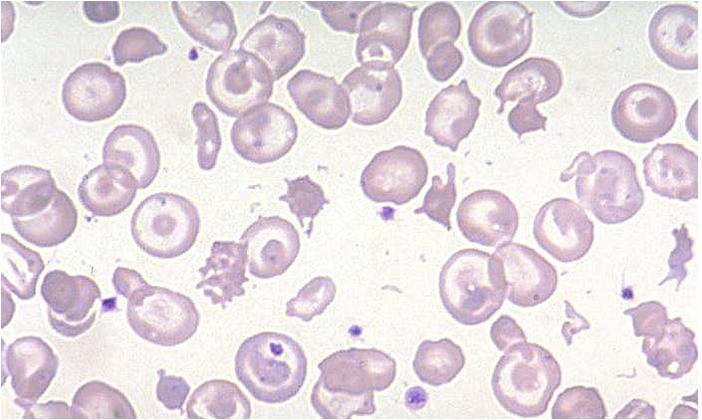 Acanthocytes
 -
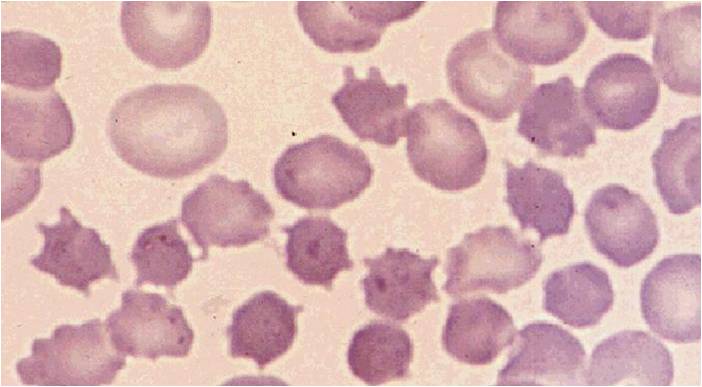 Acanthocytes


References
References
- ↑ Hong Luo, Xuan Li, Guohong Li, Yanbo Pan, and Keqin Zhang (2006). “Acanthocytes of Stropharia rugosoannulata Function as a Nematode-Attacking Device”. Appl. Environ. Microbiol. 72 (4): 2982–2987. doi:10.1128/AEM.72.4.2982-2987.2006. Check
|doi=value (help).
External links
External links
- Acanthocyte: Presented by the University of Virginia
- Template:MeshNumber
- Slide at marist.edu
Editor-In-Chief: C. Michael Gibson, M.S., M.D. [1]