

Health Dictionary
Reliable, easy-to-read patient information on common medical conditions — written in plain language, free of jargon, and grounded in current evidence. Browse the most frequent diagnoses, understand what they mean for everyday life, and learn which steps and questions help you have a focused conversation with your doctor.
Anaplastic thyroid cancer pathophysiology
Introduction
Overview
Overview
Anaplastic thyroid cancer arises from cells of the thyroid, which are normally involved in production and secretion of thyroid hormones, thyroxine (T4) and triiodothyronine (T3). Anaplastic thyroid tumor is always considered as stage IV. Genes involved in the pathogenesis of follicular thyroid cancer include P53 and BRAF.
Pathogenesis
Pathogenesis
- Anaplastic tumors have a high mitotic rate and lymphovascular invasion. It rapidly invades surrounding tissues (such as the trachea).
- Most patients with anaplastic thyroid cancer have distant metastasis at the time of diagnosis because of the rapid growth and aggressive nature of this type of cancer.
- Common sites of metastasis include the lungs, pleura, bones, and brain.
Genetics
Genetics
Associated Conditions
Associated Conditions
- Anaplastic thyroid cancer may be associated with the following conditions:
Gross Pathology
Gross Pathology
- Macroscopic features of anaplastic thyroid cancer include:
- Unencapsulated, fleshy, tan-white tumor
- Soft-tissue infiltration of the neck
Microscopic Pathology
Microscopic Pathology
- Three types of histologic variety will be expected in anaplastic thyroid cancer:
- Spindle cell
- Giant cell
- Squamoid cell
- Features include:
- Cytologically malignant:
- Huge nuclear-cytoplasmic ratio
- Mitoses
- Presence or absence of necrosis
Immunohistochemistry
Immunohistochemistry
- Anaplastic thyroid cancer may be positive for the following markers:
- Pankeratin (AE1/AE3)
- High molecular weight keratins
- TTF-1
- PAX8
- P53
- B-catenin
-
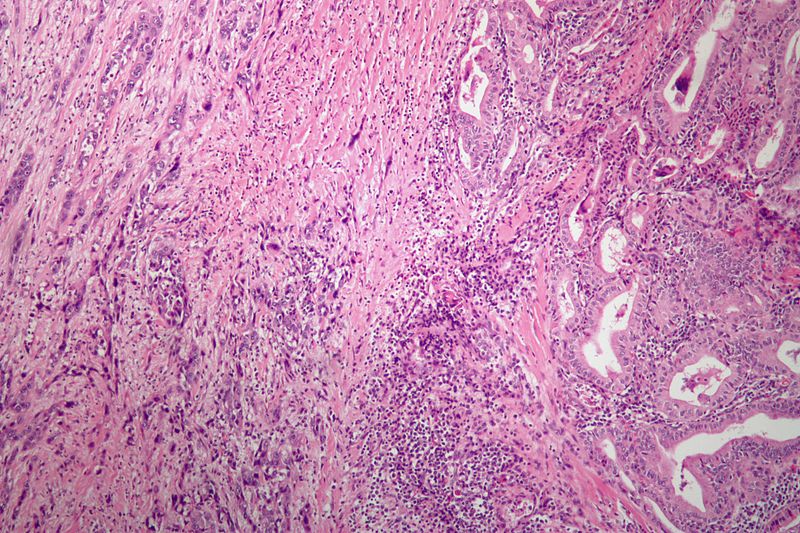 Anaplastic thyroid carcinoma with a component of PTC. (WC)

References
References
- ↑ Patel KN, Shaha AR (2006). “Poorly differentiated and anaplastic thyroid cancer”. Cancer Control. 13 (2): 119–28. PMID 16735986.
- ↑ Quiros RM, Ding HG, Gattuso P, Prinz RA, Xu X (June 2005). “Evidence that one subset of anaplastic thyroid carcinomas are derived from papillary carcinomas due to BRAF and p53 mutations”. Cancer. 103 (11): 2261–8. doi:10.1002/cncr.21073. PMID 15880523.
Editor-In-Chief: C. Michael Gibson, M.S., M.D. [1]; Associate Editor(s)-in-Chief: Ammu Susheela, M.D. [2]