

Health Dictionary
Reliable, easy-to-read patient information on common medical conditions — written in plain language, free of jargon, and grounded in current evidence. Browse the most frequent diagnoses, understand what they mean for everyday life, and learn which steps and questions help you have a focused conversation with your doctor.
Anatomy of the heart the pericardium
Introduction
Overview
Overview
The pericardium is a double-walled sac containing the heart and the roots of the great vessels.
The Pericardium
The Pericardium
- The pericardium is a sac that embeds the heart. It is pierced by the great vessels. Morphologically, it is a conical-shaped, double-walled fibro-serous membrane.
- The pericardial sac rests posteriorly to the sternum at the level of second to sixth costal cartilages and T5-T8 vertebrae.
- The pericardium is made of two layers:
- Fibrous pericardium
- Hard protective external layer
- Attached to sternum anteriorly by sterno-pericardial ligaments and fused with the central tendon of the diaphragm and great vessels to allow mobility of the pericardial sac against sudden cardiac overfilling.
- Serous Pericardium
- Smooth internal layer made of 2 components:
- Parietal: reflects onto fibrous pericardium
- Visceral: reflects onto heart and great vessels and forms the epicardium, the external layer of the heart wall.
- Smooth internal layer made of 2 components:
- Fibrous pericardium
- Pericardial cavity: Potential space between parietal and visceral layers. It contains a serous fluid film that occupies the cavity and functions as lubricant against friction by all chest movements.
Pericardial Sinuses
- Pericardial sinuses are channels or chambers between the visceral and parietal pericardia.
- Transverse sinus:
- Located posterior to the pulmonary trunk and ascending aorta at the level between the superior vena cava and aortic arch.
- Formed after dorsal mesocardium rupture embryonically
- Functional role is to allow the unhindered expansion of great arteries posteriorly during cardiac systole.
- Utilized surgically to pass surgical clamps or place ligatures around great arteries.
- Oblique sinus:
- A blind recess (cul-de-sac) posterior to the left atrium between superior vena cava, right and left pulmonary veins inferior to the transverse sinus.
- Formed embryonically by the incorporation of the pulmonary vein tributaries into the left atrium.
- Functional role believed to be the expansion of the left atrium upon normal collapse of the thorax.[1][2][3]
- Below are images showing the pericardium and pericardial sinuses.
-
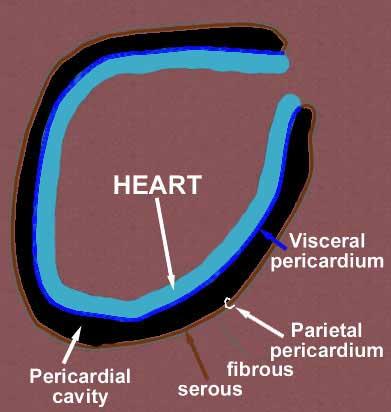 The pericardium
 -
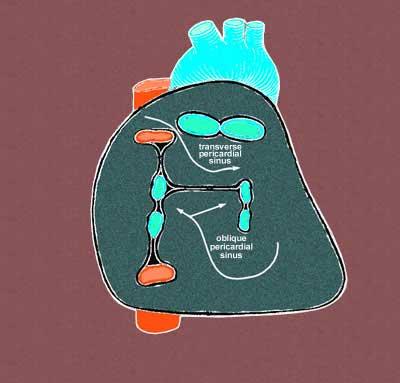 The pericardial sinuses


References
References
- ↑ Kishore, K. (2003). The Heart of Structural Development: The Functional Basis of the Location and Morphology of the Human Vascular Pump. J Postgrad Med, 49:282-4.
- ↑ Moore, K. L., Agur, A. M., & Dalley, A. F. (2011). Essential Clinical Anatomy – Fourth Edition. Lippincott Williams & Wilkins.
- ↑ Tank, P. W. (2009). Grant’s Dissector – Fourteenth Edition. Lippincott Williams & Wilkins.
Editor-In-Chief: C. Michael Gibson, M.S., M.D. [1]; Assistant Editor(s)-in-Chief: Rim Halaby, Yazan Daaboul