

Health Dictionary
Reliable, easy-to-read patient information on common medical conditions — written in plain language, free of jargon, and grounded in current evidence. Browse the most frequent diagnoses, understand what they mean for everyday life, and learn which steps and questions help you have a focused conversation with your doctor.
Ankle dislocation
Introduction
Contributors: Cafer Zorkun M.D., PhD.
Overview
Overview
- Common problem that occurs secondary to a chronic or an acute injury or degenerative disease.
- Ankle sprains are the most common cause of ankle pain.
- Ankle sprain are generally a traumatic inversion injury
- Bilateral ankle swelling can be indicative of cardiac or vascular etiologies rather than intrinsic foot/ankle disease
Differential Diagnosis
Differential Diagnosis
- Avulsion fracture of the distal fibula
- Bimalleolar fracture
- Degenerative joint disease
- Diabetic arthropathy (Charcot’s)
- Inversion sprain
- Inversion/eversion injury of subtalar joint
- Neoplasm
- Peroneal nerve entrapment
- Poor shoe alignment
- Repetitive injury with disruption of the ankle retinaculum
- Syndesmosis injury
- Trimalleolar fracture
Physical Examination
Physical Examination
- Complete physical including ankle, foot, lower leg examination
- Pulses
- Neurovascular status
- Color
- Capillary refill
X-Ray
- Ottawa ankle rules determine necessity of ankle x-ray following trauma
- Tender proximal fifth metatarsal
- Tenderness of distal 6 cm of the fibula or tibia
- Tender navicular area
- Cannot bear weight (at least 4 steps)
- Lateral x-rays if needed
- Three-view ankle x-rays
- Stress views
- Foot series
- Lower leg series
-
 Normal ankle; Lateral
 -
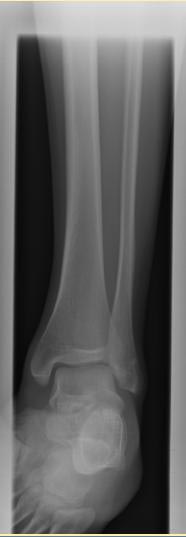 Normal ankle; Oblique
 -
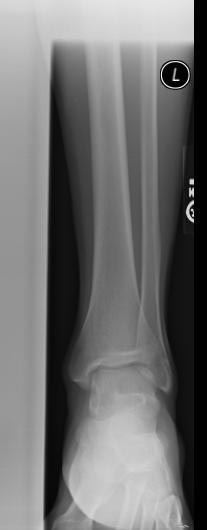 Normal ankle; AP


MRI and CT
- CT and MRI if indicated
Other Diagnostic Studies
- Anterior/posterior drawer test
- Range of motion and muscle strength
Treatment
Treatment
Mnemonics for treatment of ancle pain and swelling.
- PRINCE
- Protection
- Rest
- Ice
- NSAIDs (nonsteriodal anti-inflammatory drugs)
- Compression
- Elevation
- Casting if necessary
- To improve range of motion and muscle strength, physical therapy is often recommended
Surgery and Device Based Therapy
Surgery and Device Based Therapy
- Bracing ankle/foot may prevent reinjury
- Surgery may be necessary for certain fractures
References
References
Acknowledgements
Acknowledgements
Editor-In-Chief: C. Michael Gibson, M.S., M.D. [1] The content on this page was first contributed by C. Michael Gibson, M.S., M.D. [2]