

Health Dictionary
Reliable, easy-to-read patient information on common medical conditions — written in plain language, free of jargon, and grounded in current evidence. Browse the most frequent diagnoses, understand what they mean for everyday life, and learn which steps and questions help you have a focused conversation with your doctor.
Axillary vein
Introduction
In human anatomy, the axillary vein is a large blood vessel that conveys blood from the lateral aspect of the thorax, axilla (armpit) and upper limb toward the heart. There is one axillary vein on each side of the body.
Its origin is at the lower margin of the teres major muscle and a continuation of the brachial vein.
Its tributaries include the basilic vein and cephalic vein, which are both superficial veins. It terminates at the lateral margin of the first rib, at which it becomes the subclavian vein.
It is accompanied along its course by a similarly named artery, the axillary artery.
Additional images
Additional images
-
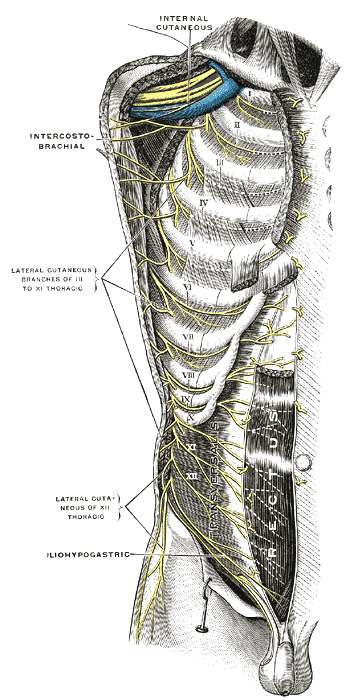 Intercostal nerves, the superficial muscles having been removed.

Editor-In-Chief: C. Michael Gibson, M.S., M.D. [1]