

Health Dictionary
Reliable, easy-to-read patient information on common medical conditions — written in plain language, free of jargon, and grounded in current evidence. Browse the most frequent diagnoses, understand what they mean for everyday life, and learn which steps and questions help you have a focused conversation with your doctor.
Boil pathophysiology
Introduction
Overview
Overview
Boils (furuncles) are a localized deep suppurative necrotizing form of folliculitis which involve the dermis and the subcutaneous tissue. Staphylococcus aureus is the most common causative agent. Following an abrasion or cut, the pathogen uses the wound site to invade and colonize the hair follicle. This leads to the formation of tender, erythematous, perifollicular nodule. The boil later becomes painful and fluctuant leading to discharge of pus and formation of necrotic plugs, which may leave a scar.[1]
Pathophysiology
Pathophysiology
Pathogenesis
- Boil (furuncle) is a localized deep suppurative necrotizing form of folliculitis which involves the dermis and the subcutaneous tissue. Staphylococcus aureus is the most common causative agent.
- Following abrasion or cut the pathogen uses the wound site to invade and colonize the hair follicle. This leads to the formation of a tender erythematous perifollicular nodule.
- Boils may become painful and fluctuant, leading to the discharge of pus and formation of necrotic plugs, which may leave a scar.[1]
- Furunculosis is the acute or chronic appearance of a number of boils (furuncles) at multiple skin sites. Recurrent furunculosis is defined as three or more attacks within a 12 month period.[1]
- It is a contagious condition, which usually develops in moist or sweaty areas such as the scalp, face, buttocks, axillae, and areas that are subject to friction and perspiration.
- A group of furuncles coalesce to form a carbuncle.
Schematic of Pathogenesis
-
 Boil(furuncle)pathogenesis

Associated Conditions
Gross Pathology
On gross pathology, characteristic findings of boils include firm, tender, red, dome shaped nodules, which progress to fluctuant, pus-filled, and painful lesions. Boils may vary in size.
Microscopic histopathological analysis
On microscopic histopathological analysis, characteristic findings of boils include:
- Infiltrate predominantly consists of neutrophils within the wall and ostia of hair follicles
- Lesions may subsequently be infiltrated with lymphocytes and macrophages creating a central focus of necrosis.
- Inflammation of hair follicle may be:
- Superficial (primarily involving the infandibulum)
- Deep
Examples of Gross Pathology
The following are images associated with boil:
-
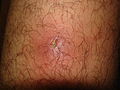 Boil(furuncle) on Anterior leg: Dome shaped pus filled boil(furuncle) with erythema of skin – By The original uploader was Mahdouch at French Wikipedia – Transferred from fr.wikipedia to Commons., CC BY 1.0, https://commons.wikimedia.org/w/index.php?curid=3123389

References
References
- ↑ 1.0 1.1 1.2 Ibler KS, Kromann CB (2014). “Recurrent furunculosis – challenges and management: a review”. Clin Cosmet Investig Dermatol. 7: 59–64. doi:10.2147/CCID.S35302. PMC 3934592. PMID 24591845.
Editor-In-Chief: C. Michael Gibson, M.S., M.D. [1]; Associate Editor(s)-in-Chief: Yamuna Kondapally, M.B.B.S[2]