

Health Dictionary
Reliable, easy-to-read patient information on common medical conditions — written in plain language, free of jargon, and grounded in current evidence. Browse the most frequent diagnoses, understand what they mean for everyday life, and learn which steps and questions help you have a focused conversation with your doctor.
Cardiac cirrhosis
Introduction
Synonyms and keywords: Cardiac cirrhosis
Overview
Overview
Nutmeg liver is the pathological appearance of the liver caused by chronic passive congestion of the liver secondary to right heart failure. The liver appears “speckled” like a grated nutmeg kernel, from the dilated, congested central veins (dark spots) and paler, unaffected surrounding liver tissue. When severe and longstanding, hepatic congestion can lead to cirrhosis, a state described as cardiac cirrhosis.[1]
Pathophysiology
Pathophysiology
Increased pressure in the sublobular branches of the hepatic veins causes an engorgement of venous blood, and is most frequently due to chronic cardiac lesions, especially those affecting the right heart, the blood being dammed back in the inferior vena cava and hepatic veins.
Gross Pathology
Central regions of the hepatic lobes are red/brown and stand out against the non-congested tan colored liver. Centrilobular necrosis occurs. Macroscopically liver has a pale and spotty appearance in affected areas as stasis of the blood causes pericentral hepatocytes (liver cells surrounding the periportal venules of the liver) to become deoxygenated compared to the relatively better oxygenated periportal hepatocytes adjacent to the hepatic arterioles. This retardation of the blood also occurs in pulmonary lesions, such as chronic interstitial pneumonia, pleural effusions, and intrathoracic tumors.
Pathological Findings
Images shown below are courtesy of Professor Peter Anderson DVM PhD and published with permission. © PEIR, University of Alabama at Birmingham, Department of Pathology
-
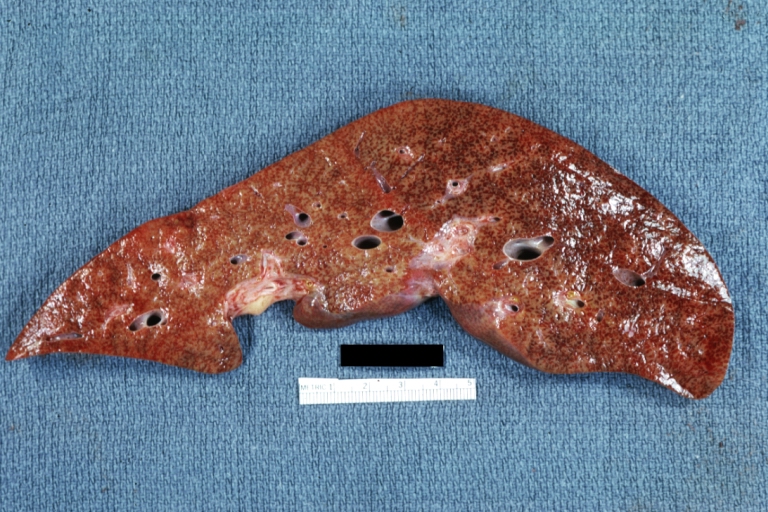 Passive Congestion: Gross natural color typical nutmeg liver
 -
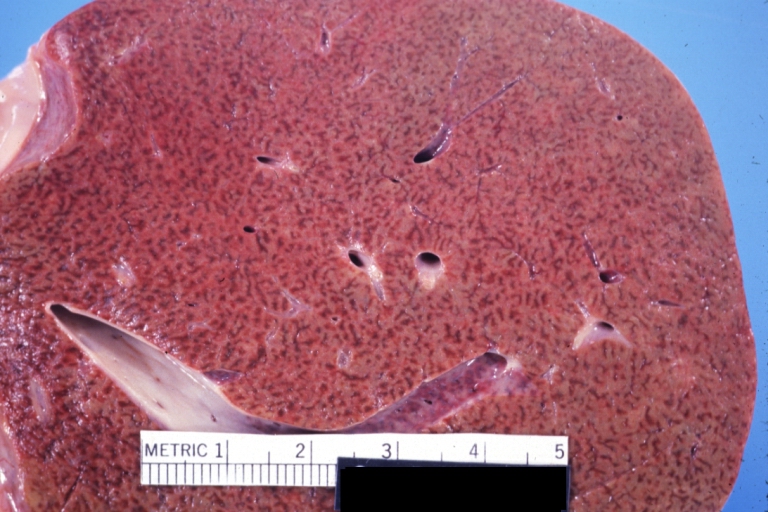 Chronic Passive Congestion: Gross looks like natural color classical nutmeg liver


-
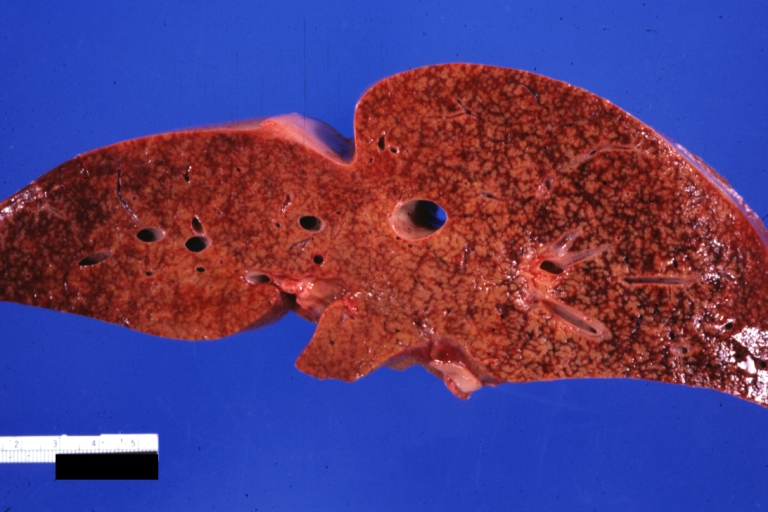 Chronic Passive Congestion: Gross natural color frontal section nutmeg liver really a shock liver
 -
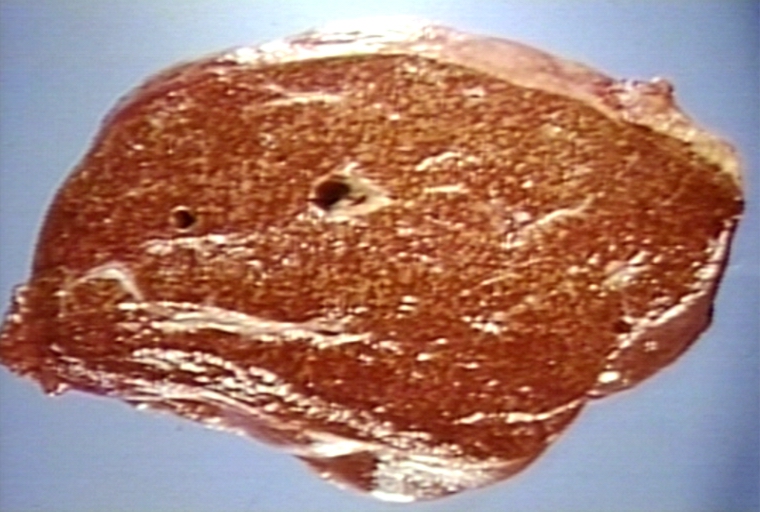 Liver: Congestive heart failure, liver fibrosis; Central hepatic veins are pale spots, nutmeg liver
 -
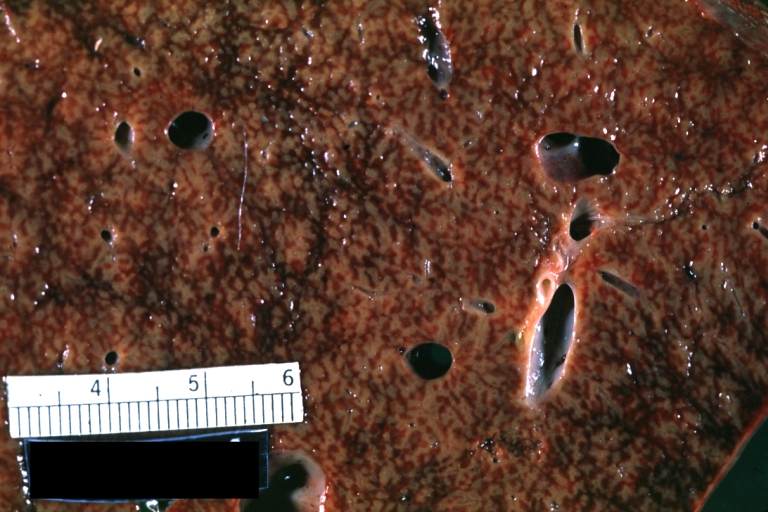 Liver: Passive Congestion: Gross close-up excellent nutmeg appearance


-
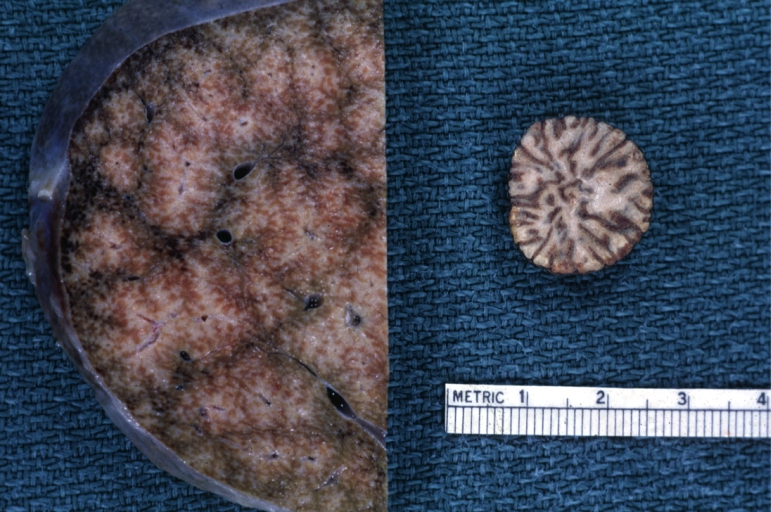 Passive Congestion: Gross split picture with liver on one side and a polished nutmeg on the other (very good demonstration)
 -
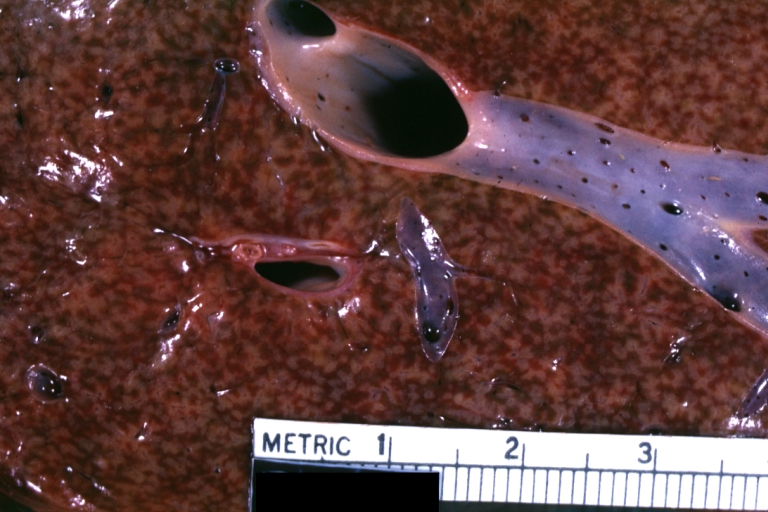 Passive Congestion: Gross close-up of cut surface natural color looks almost exactly like a nutmeg


Symptoms
Symptoms
These depend largely upon the primary lesions giving rise to it. In addition to the cardiac or pulmonary symptoms, there will be a sense of fullness and tenderness in the right hypochondriac region. Gastro-intestinal catarrh is usually present, and hematemesis may occur. There is usually more or less jaundice. Owing to portal obstruction, ascites occurs, followed later by general dropsy. The stools are light or clay colored, and the urine is colored by bile. On palpation, the liver is found enlarged and tender, sometimes extending several inches below the costal margin of the ribs.
Treatment
Treatment
This is directed largely to removing the cause, or, where that is impossible, to modifying its effects. Thus hygienic and dietary measures must be carried out, even although it is due to valvular lesions.
References
References
- ↑ Giallourakis CC, Rosenberg PM, Friedman LS (2002). “The liver in heart failure”. Clin Liver Dis. 6 (4): 947–67, viii–ix. doi:10.1016/S1089-3261(02)00056-9. PMID 12516201.
Editor-In-Chief: C. Michael Gibson, M.S., M.D. [1]; Associate Editor: Cafer Zorkun, M.D., Ph.D. [2]