

Health Dictionary
Reliable, easy-to-read patient information on common medical conditions — written in plain language, free of jargon, and grounded in current evidence. Browse the most frequent diagnoses, understand what they mean for everyday life, and learn which steps and questions help you have a focused conversation with your doctor.
Cardiac tumors pathophysiology
Introduction
Overview
Overview
The precise pathophysiology of cardiac tumors is unknown. Some cardiac tumors are associated with genetic predispositions or are components of genetic disorders.
- Cardiac rhabdomyomas are associated with Tuberous sclerosis, an autosomal dominant condition characterized by the development of various organ hamartomas.
- Cardiac fibromas may be associated with Gorlin syndrome, an autosomal dominant condition marked by congenital abnormalities and a propensity for neoplasia.
- Cardiac myxomas may be associated with the autosomal dominant condition Carney complex.
- Histiocytoid cardiomyopathy is sometimes inherited, however the underlying genetic disorders remain unknown.
- Most cardiac undifferentiated sarcomas share the same genetic profile as pulmonary artery intimal sarcomas, characterized by recurrent mutations in the MDM2, PDGFRA, and CDKN2A genes.
- There have been reports of papillary fibroelastomas following cardiac instrumentation and thoracic irradiation.
Pathophysiology
Pathophysiology
| Tumor | Macroscopic appearance | Microscopic appearance | Remarks |
|---|---|---|---|
| Myxoma(Images B, C) | Two Types Solid(round with a smooth, lustrous, undulating surface)/Villous(frequently fragile papillary surfaces) | Cells have eosinophilic cytoplasm and an oval or round nucleus. | Embolization is frequent.[1] |
| Cardiac Lipoma | Isolated lumps that are yellow, soft, smooth, well-circumscribed, and encapsulated | Fat cells exhibit minimal to no atypia, fibrous capsule | They can cause arrhythmias or conduction system disorders and heart failure symptoms.[2] |
| Papillary fibroelastoma(Images F,G) | Round, whitish appearance and soft consistency, sea anemone-like” appearance[3] | Thin avascular papillary fronds that frequently display complicated branching | Embolization is frequent.
|
| Rhabdomyomas | Nodular, unencapsulated, whitish, or grey, range in size from millimeters to several centimeters | Large vacuolated cells with transparent cytoplasm due to glycogen deposition, spider cells also present | Heart block or ventricular tachyarrhythmias, ventricular tachyarrhythmias may develop[4]
|
| Cardiac Fibromas(Image D) | Solitary well-defined formation, | Monomorphic fibroblasts exhibiting minimal or no atypia *Resembles fibromatosis or uterine leiomyomas | May manifest like heart failure, ventricular tachyarrhythmia, Can present as Sudden Cardiac Death[5]
|
| Angiosarcoma | Darkish brown or black hemorrhagic aggregates with invading margins | Vascular conduits, infiltrating cardiac muscle, anastomosing, uneven, *Pleomorphic lining cells displaying numerous mitotic figures[6] | Most commonly involves right atrium |
| Secondary Cardiac Tumors(Image A) | Direct tumor infiltration from the mediastinum or hematogenous spread[7] | Same as underlying Malignancy | Pericardial effusion is one of the most frequent findings in individuals with secondary tumors.
|
Papillary fibroelastoma
- Primary tumor of the heart that typically involves one of the valves of the heart
- Papillary fibroelastoma is generally considered benign, and represents 10% of all primary tumors of the heart
- Papillary fibroelastoma are the third most common type of primary tumor of the heart, behind cardiac myxomas and cardiac fibromas.[8]
- The pathogenesis of papillary fibroelastoma is characterised by the mechanical effects of the tumor and the transient occlusion of the left main coronary artery (by the tumor), while a heart attack or sudden cardiac death may be due to embolisation of a portion of the tumor into a coronary artery.[9]
Gross Pathology
Image shown below is courtesy of Professor Peter Anderson DVM PhD and published with permission. © PEIR, University of Alabama at Birmingham, Department of Pathology
-
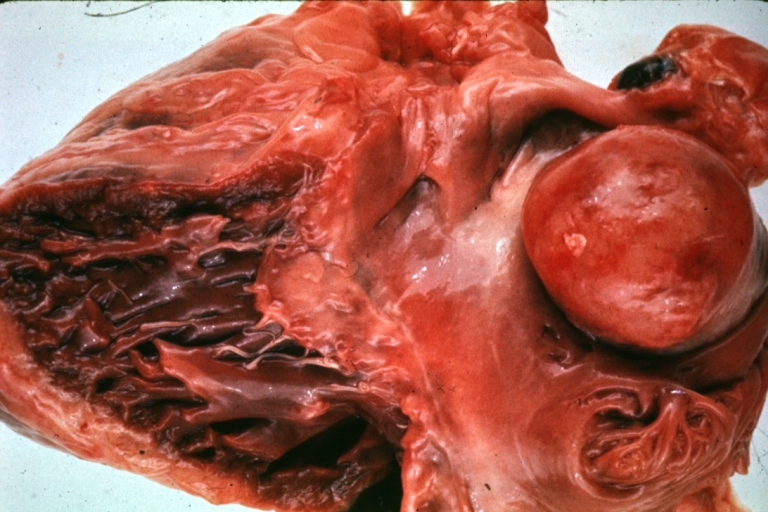 Image A HEART: Metastatic Tumor: Gross very unusual large metastatic carcinoid in right atrium
 -
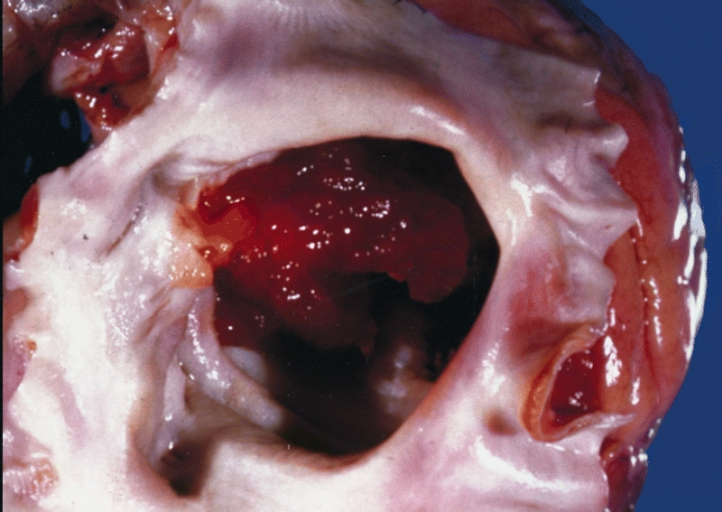 Image B Cardiac Myxoma A gelatinous tumor is attached by a narrow pedicle to the atrial septum. The myxoma has an irregular surface and nearly fills the left atrium.


-
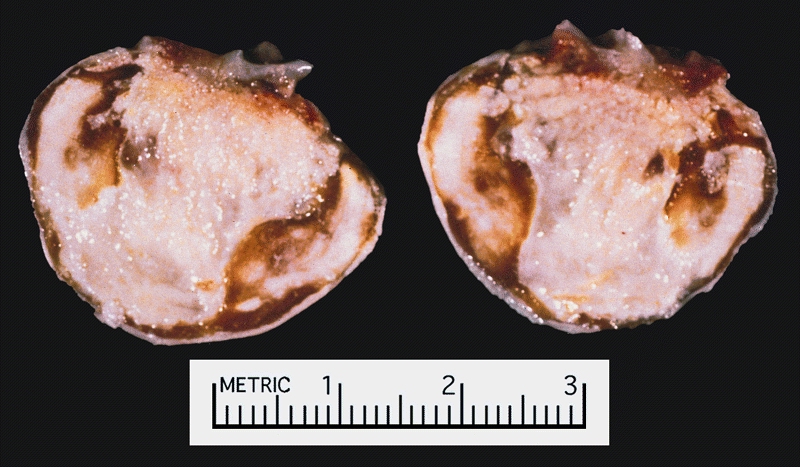 Image C Cardiac Myxoma There was a calcified right atrial mass on the X ray of a 47-year-old man. Resection demonstrated a smooth-surfaced tumor. The gritty material seen microscopically on cut section was calcified and ossified myxoma.
 -
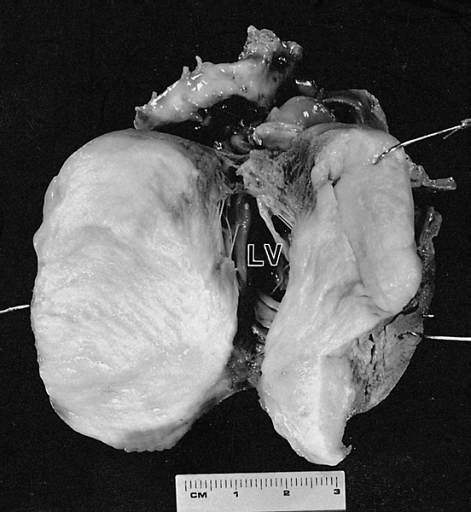 Image D Cardiac Fibroma Cut surface of the tumor shown in figure 6-2. The left ventricular (LV) cavity is present behind the mass. The patient was a 4-month-old child who died suddenly without a previous medical history.


-
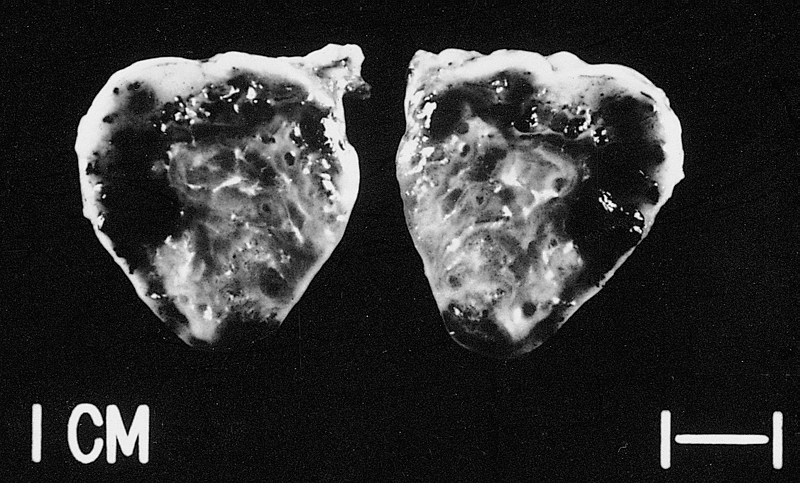 Image E This tumor was resected from the right atrium of a 1-year-old boy with pericardial effusions. Note areas of hemorrhage and dilated vessels. The patient was well 49 months postoperatively.
 -
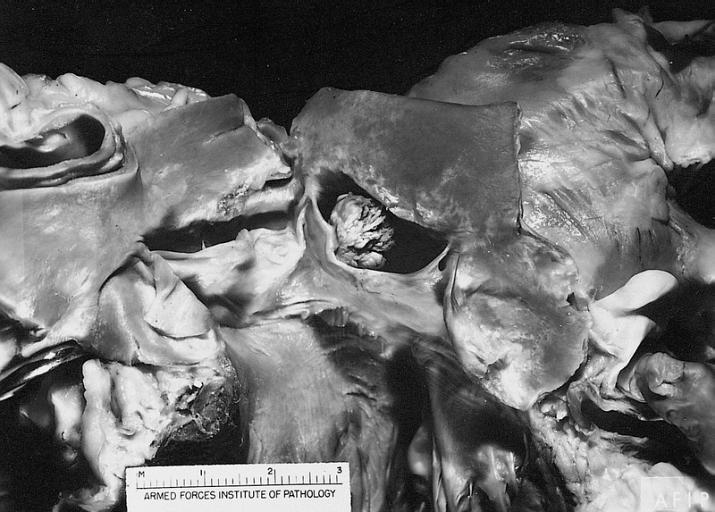 Image F Papillary fibroelastomas are often on the arterial surface and may project into the coronary ostium, causing ostial occlusion. This tumor is in the noncoronary sinus.
 -
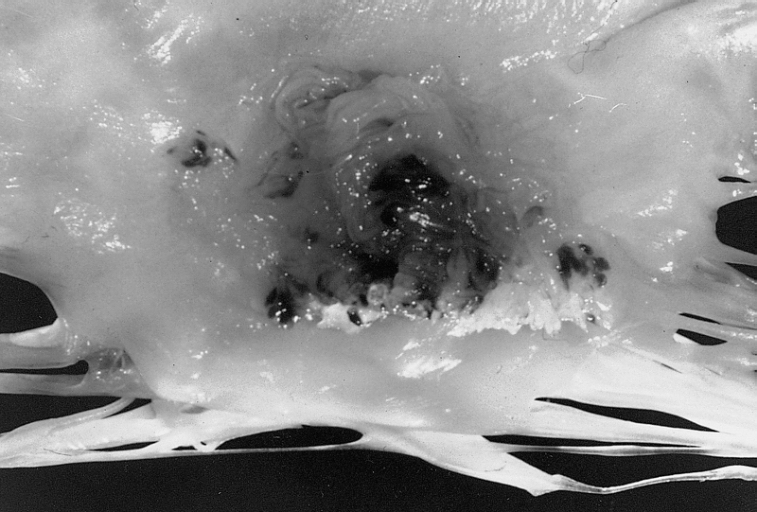 Image G Papillary Fibroelastoma: When located on the mitral valve, these tumors are usually on the anterior leaflet of the atrial surface.


References
References
- ↑ Pinede L, Duhaut P, Loire R (2001). “Clinical presentation of left atrial cardiac myxoma. A series of 112 consecutive cases”. Medicine (Baltimore). 80 (3): 159–72. doi:10.1097/00005792-200105000-00002. PMID 11388092.
- ↑ Benvenuti LA, Mansur AJ, Lopes DO, Campos RV (1996). “Primary lipomatous tumors of the cardiac valves”. South Med J. 89 (10): 1018–20. doi:10.1097/00007611-199610000-00020. PMID 8865802.
- ↑ Burke A, Tavora F (2016). “The 2015 WHO Classification of Tumors of the Heart and Pericardium”. J Thorac Oncol. 11 (4): 441–52. doi:10.1016/j.jtho.2015.11.009. PMID 26725181.
- ↑ Basso C, Valente M, Poletti A, Casarotto D, Thiene G (1997). “Surgical pathology of primary cardiac and pericardial tumors”. Eur J Cardiothorac Surg. 12 (5): 730–7, discussion 737-8. doi:10.1016/s1010-7940(97)00246-7. PMID 9458144.
- ↑ Pacini D, Careddu L, Pantaleo A, Berretta P, Leone O, Marinelli G; et al. (2012). “Primary benign cardiac tumours: long-term results”. Eur J Cardiothorac Surg. 41 (4): 812–9. doi:10.1093/ejcts/ezr067. PMID 22219403.
- ↑ Orlandi A, Ferlosio A, Roselli M, Chiariello L, Spagnoli LG (2010). “Cardiac sarcomas: an update”. J Thorac Oncol. 5 (9): 1483–9. doi:10.1097/JTO.0b013e3181e59a91. PMID 20651614.
- ↑ Fred HL, van Dijk HA (2017). “Cardiac Metastases from Malignant Melanoma: The “Charcoal Heart““. Methodist Debakey Cardiovasc J. 13 (4): 254–255. doi:10.14797/mdcj-13-4-254. PMC 5935287. PMID 29744020.
- ↑ Matsumoto N, Sato Y, Kusama J, Matsuo S, Kinukawa N, Kunimasa T, Ichiyama I, Takahashi H, Kimura S, Orime Y, Saito S. (2007). “Multiple papillary fibroelastomas of the aortic valve: case report”. Int J Cardiol. 122 (1): e1–3. PMID 17196273.
- ↑ Takada A, Saito K, Ro A, Tokudome S, Murai T. (2000). “Papillary fibroelastoma of the aortic valve: a sudden death case of coronary embolism with myocardial infarction”. Forensic Sci Int. 113 (1–3): 209–14. PMID 10978627.
Editor-In-Chief: C. Michael Gibson, M.S., M.D. [1]; Associate Editor(s)-In-Chief: Cafer Zorkun, M.D., Ph.D. [2]; Varun Kumar, M.B.B.S. Dheeraj Makkar, M.D.[3]