

Health Dictionary
Reliable, easy-to-read patient information on common medical conditions — written in plain language, free of jargon, and grounded in current evidence. Browse the most frequent diagnoses, understand what they mean for everyday life, and learn which steps and questions help you have a focused conversation with your doctor.
Chi-square test
Introduction
Overview
Overview
A chi-square test is any statistical hypothesis test in which the test statistic has a chi-square distribution when the null hypothesis is true, or any in which the probability distribution of the test statistic (assuming the null hypothesis is true) can be made to approximate a chi-square distribution as closely as desired by making the sample size large enough.
Specifically, a chi-square test for independence evaluates statistically significant differences between proportions for two or more groups in a data set.
- Pearson’s chi-square test, also known as the Chi-square goodness-of-fit test, commonly referred to as the chi-square test
- Yates’ chi-square test also known as Yates’ correction for continuity
- Mantel-Haenszel chi-square test
- Linear-by-linear association chi-square test
Significance and effect size
Significance and effect size
In the social sciences, the significance of the chi-square statistic is often given in terms of a p value (e.g., p = 0.05). It is an indication of the likelihood of obtaining a result (0.05 = 5%). As such, it is relatively uninformative. A more helpful accompanying statistic is phi (or Cramer’s phi, or Cramer’s V).[1] Phi is a measure of association that reports a value for the correlation between the two dichotomous variables compared in a chi-square test (2 × 2). This value gives you an indication of the extent of the relationship between the two variables. Cramer’s phi can be used for even larger comparisons. It is a more meaningful measure of the practical significance of the chi-square test and is reported as the effect size.
Chi-square test for contingency table
Chi-square test for contingency table
A chi-square test may be applied on a contingency table for testing a null hypothesis of independence of rows and columns.
Chi Square Calculator
Click here for the chi square calculator.
Chi Square Calculator
The following file contains a 2×2 contingency table for chi square calculation.
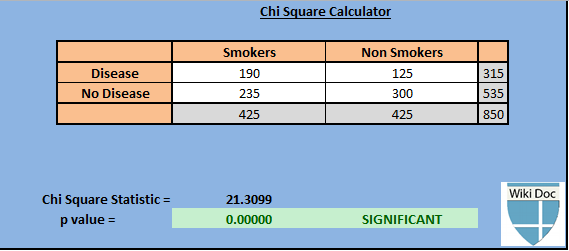
How to use it?
- Click on the link above to download the spreadsheet.
- In the white boxes, you should enter the number of individuals for each group.
- You may also enter the name of the groups (rows) and categories (columns).
Editor-In-Chief: C. Michael Gibson, M.S., M.D. [1]; Associate Editor(s)-in-Chief: Alejandro Lemor, M.D. [2]
See also
See also
- General likelihood-ratio tests, which are approximately chi-square tests
- McNemar’s test, related to a chi-square test
- The Wald test, which can be evaluated against a chi-square distribution
References
References
- ↑ Aaron, B., Kromrey, J. D., & Ferron, J. M. (1998, November). Equating r-based and d-based effect-size indices: Problems with a commonly recommended formula. Paper presented at the annual meeting of the Florida Educational Research Association, Orlando, FL. (ERIC Document Reproduction Service No. ED433353)
Template:Jb1
de:Chi-Quadrat-Test
it:Test chi quadrato
lv:Hī kvadrāta kritērijs
nl:Chi-kwadraattoets
su:Tes chi-kuadrat
fi:Khii toiseen -testi