

Health Dictionary
Reliable, easy-to-read patient information on common medical conditions — written in plain language, free of jargon, and grounded in current evidence. Browse the most frequent diagnoses, understand what they mean for everyday life, and learn which steps and questions help you have a focused conversation with your doctor.
Dorsal scapular artery
Introduction
The dorsal scapular artery (or descending scapular artery[1]) is a blood vessel which supplies the latissimus dorsi, levator scapulae, rhomboids, and trapezius.
It most frequently arises from the subclavian artery (the second or third part)[1], but a quarter of the time it arises from the transverse cervical artery.[2] In that case, the artery is also known as the deep branch of the transverse cervical artery.
It passes beneath the levator scapulae to the medial angle of the scapula, and then descends under the rhomboid muscles along the vertebral border of that bone as far as the inferior angle.
Additional images
Additional images
-
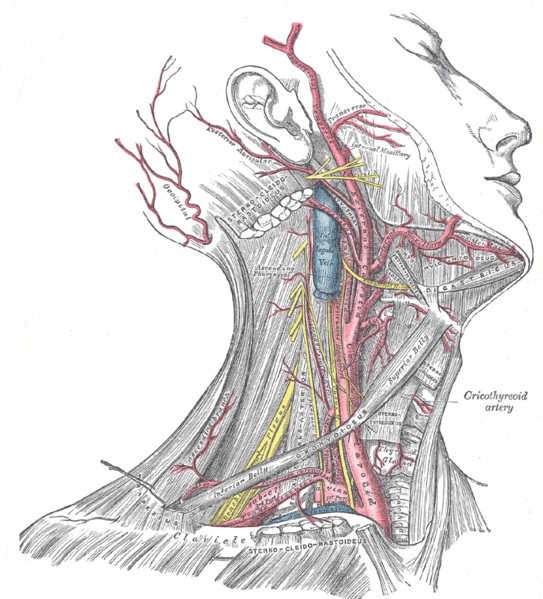 Superficial dissection of the right side of the neck, showing the carotid and subclavian arteries.

References
References
- ↑ 1.0 1.1 Template:Medcyclopaedia
- ↑ Reiner A, Kasser R (1996). “Relative frequency of a subclavian vs. a transverse cervical origin for the dorsal scapular artery in humans”. Anat Rec. 244 (2): 265–8. PMID 8808401.
External links
External links
- Template:NormanAnatomy
- Template:EMedicineDictionary
- Huelke D (1962). “The dorsal scapular artery–a proposed term for the artery to the rhomboid muscles”. Anat Rec. 142: 57–61. PMID 14449723.
Editor-In-Chief: C. Michael Gibson, M.S., M.D. [1]