

Health Dictionary
Reliable, easy-to-read patient information on common medical conditions — written in plain language, free of jargon, and grounded in current evidence. Browse the most frequent diagnoses, understand what they mean for everyday life, and learn which steps and questions help you have a focused conversation with your doctor.
Erector pili
Introduction

Erectores pilorum (singular Erector pili) are tiny muscle fibers attached to each hair follicle, which contract to make the hairs stand on end, causing goose bumps. They exist in most mammals including humans.
Erectores pilorum are smooth muscle, not skeletal muscle, which explains why humans cannot voluntarily give themselves goose bumps. In other animals with more hair than humans, they serve an important function — they raise the hairs so air gets trapped between them, providing a layer of insulation to keep the animal warm. Some animals also contract their erectores pilorum when they are cornered, in order to appear larger and more threatening. A prominent example of this function is the porcupine which uses erectores pilorum to raise its quills when threatened. Although humans’ erectores pilorum also contract in response to cold or arousal, they are vestigial because humans do not have enough hair to make them effective.
The erectores pilorum are controlled by the sympathetic nervous system which is in general responsible for many fight-or-flight responses.
Additional images
-
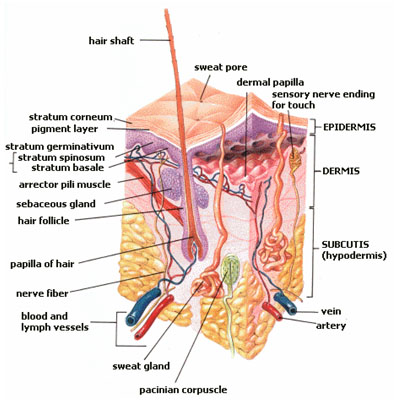 Cross-section of all skin layers.

Editor-In-Chief: C. Michael Gibson, M.S., M.D. [1]