

Health Dictionary
Reliable, easy-to-read patient information on common medical conditions — written in plain language, free of jargon, and grounded in current evidence. Browse the most frequent diagnoses, understand what they mean for everyday life, and learn which steps and questions help you have a focused conversation with your doctor.
Facial vein
Introduction
The anterior facial vein (facial vein) commences at the side of the root of the nose, and is a direct continuation of the angular vein. It lies behind the facial artery and follows a less tortuous course. It usually either joins the anterior branch of the retromandibular vein to form the common facial vein, or drains directly into the internal jugular vein.
Path
Path
From its origin it runs obliquely downward and backward, beneath the Zygomaticus and zygomatic head of the Quadratus labii superioris, descends along the anterior border and then on the superficial surface of the Masseter, crosses over the body of the mandible, and passes obliquely backward, beneath the Platysma and cervical fascia, superficial to the submaxillary gland, the Digastricus and Stylohyoideus.
The facial vein has no valves, and its walls are not so flaccid as most superficial veins.
Additional images
Additional images
-
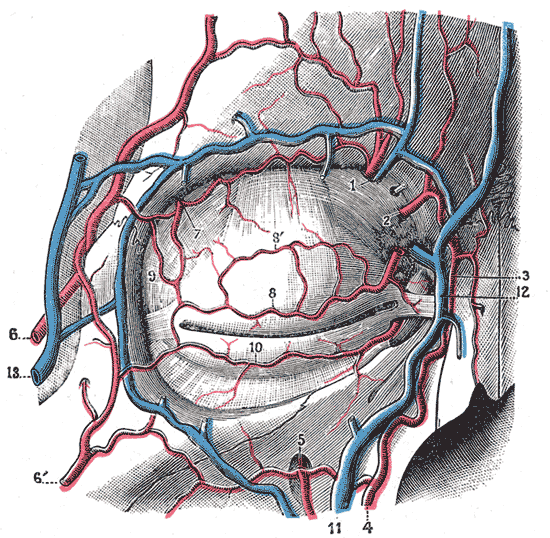 Bloodvessels of the eyelids, front view.

Editor-In-Chief: C. Michael Gibson, M.S., M.D. [1]