

Health Dictionary
Reliable, easy-to-read patient information on common medical conditions — written in plain language, free of jargon, and grounded in current evidence. Browse the most frequent diagnoses, understand what they mean for everyday life, and learn which steps and questions help you have a focused conversation with your doctor.
Galea aponeurotica
Introduction
The galea aponeurotica (epicranial aponeurosis) covers the upper part of the cranium; behind, it is attached, in the interval between its union with the Occipitales, to the external occipital protuberance and highest nuchal lines of the occipital bone; in front, it forms a short and narrow prolongation between its union with the Frontales.
On either side it gives origin to the Auriculares anterior and superior; in this situation it loses its aponeurotic character, and is continued over the temporal fascia to the zygomatic arch as a layer of laminated areolar tissue.
It is closely connected to the integument by the firm, dense, fibro-fatty layer which forms the superficial fascia of the scalp: it is attached to the pericranium by loose cellular tissue, which allows the aponeurosis, carrying with it the integument to move through a considerable distance.
Additional images
Additional images
-
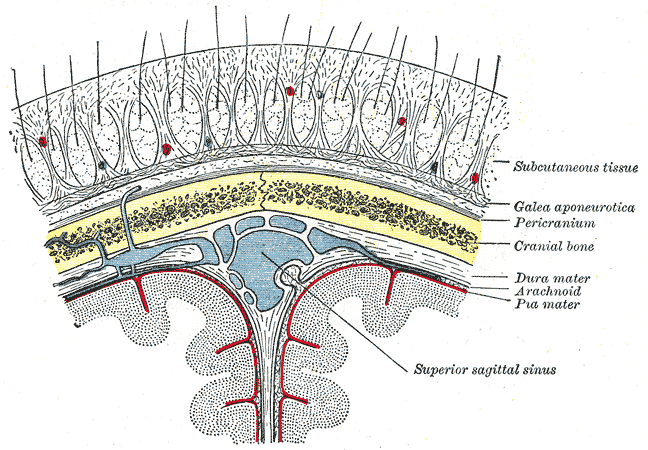 Diagrammatic section of scalp.

External links
External links
- Template:SUNYAnatomyLabs – “Cranial Fossae: Layers of the scalp”
- Template:EMedicineDictionary
Template:Gray’s
Template:Head and neck general
de:Galea aponeurotica
fa:نیام کلاهخودی
it:Galea aponeurotica
Template:WikiDoc Sources
Editor-In-Chief: Template:Infobox Anatomy C. Michael Gibson, M.S., M.D. [1]