

Health Dictionary
Reliable, easy-to-read patient information on common medical conditions — written in plain language, free of jargon, and grounded in current evidence. Browse the most frequent diagnoses, understand what they mean for everyday life, and learn which steps and questions help you have a focused conversation with your doctor.
Glossopharyngeal nerve
Introduction
The glossopharyngeal nerve is the ninth of twelve pairs of cranial nerves. It exits the brainstem out from the sides of the upper medulla, just rostral (closer to the nose) to the vagus nerve.
Functions
Functions
There are a number of functions of the glossopharyngeal nerve:
- It receives sensory fibres from the posterior one-third of the tongue, the tonsils, the pharynx, the middle ear and the carotid body.
- It supplies parasympathetic fibres to the parotid gland via the otic ganglion.
- It supplies motor fibres to stylopharyngeus muscle, the only motor component of this cranial nerve.
- It contributes to the pharyngeal plexus.
Brainstem connections
Brainstem connections
The glossopharyngeal nerve, being mostly sensory, does not have a cranial nerve nucleus of its own. Instead it must project into many different structures in the brainstem:
- Solitary nucleus: Taste from the posterior one-third of the tongue and information from carotid baroreceptors and carotid body chemoreceptors
- Spinal nucleus of the trigeminal nerve: Visceral pain as well as somatic sensory fibers from the skin of the outer ear.
- Nucleus ambiguus: The lower motor neurons for the stylopharyngeus muscle.
- Inferior salivatory nucleus: Parasympathetic input to the parotid and mucous glands.
Path
Path
From the medulla oblongata, the glossopharyngeal nerve passes laterally across the flocculus, and leaves the skull through the central part of the jugular foramen, in a separate sheath of the dura mater, lateral to and in front of the vagus and accessory nerves. Within the jugular foramen, the glossopharyngeal nerve forms the superior ganglion (the glossopharyngeal neve is also associated with an inferior ganglion).
In its passage through the jugular foramen, it grooves the lower border of the petrous part of the temporal bone; and, at its exit from the skull, passes forward between the internal jugular vein and internal carotid artery. It descends in front of the latter vessel, and beneath the styloid process and the muscles connected with it, to the lower border of the stylopharyngeus. It then curves forward, forming an arch on the side of the neck and lying upon the stylopharyngeus and middle pharyngeal constrictor muscle. From there it passes under cover of the hyoglossus muscle, and is finally distributed to the palatine tonsil, the mucous membrane of the fauces and base of the tongue, and the mucous glands of the mouth.
Branches
Branches
1. Tympanic
2. Stylopharyngeal
3. Tonsillar
4. Nerve to carotid sinus
5. Branches to the posterior third of tongue
6. Lingual branches
7. A communicating branch to the Vagus nerve
Note: The glossopharyneal nerve contributes in the formation of the pharyngeal plexus along with the vagus nerve.
Testing the glossopharyngeal nerve
Testing the glossopharyngeal nerve
The gag reflex is absent in patients with damage to the glossopharyngeal nerve as it is responsible for the afferent limb of the reflex.
Additional images
Additional images
-
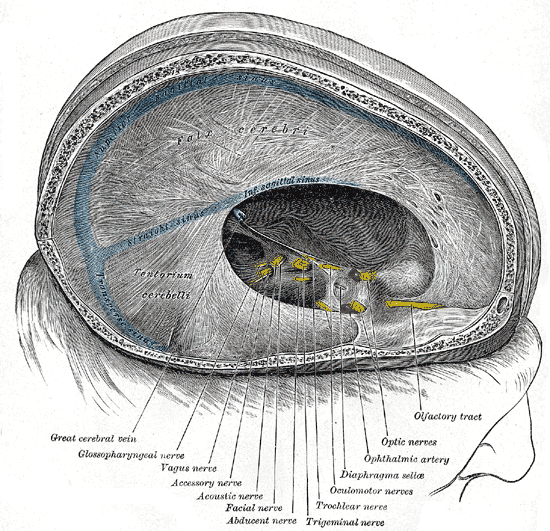 Dura mater and its processes exposed by removing part of the right half of the skull, and the brain.
 -
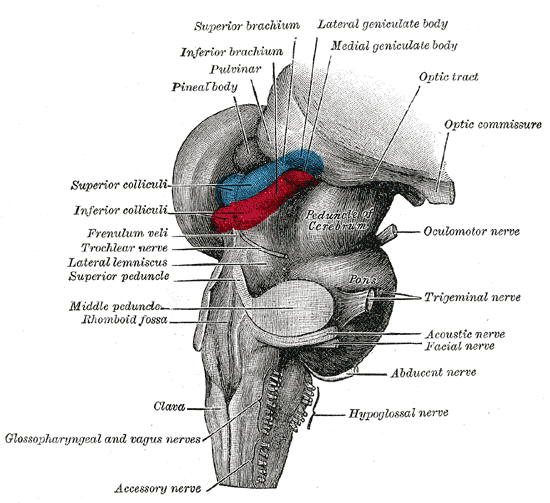 Hind- and mid-brains; postero-lateral view.
 -
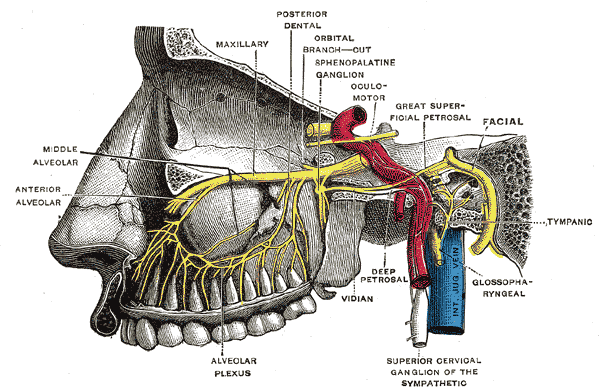 Alveolar branches of superior maxillary nerve and sphenopalatine ganglion.
 -
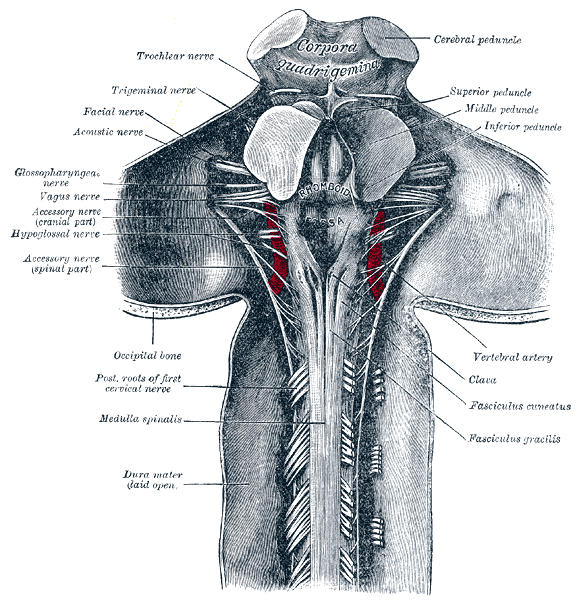 Upper part of medulla spinalis and hind- and mid-brains; posterior aspect, exposed in situ.
 -
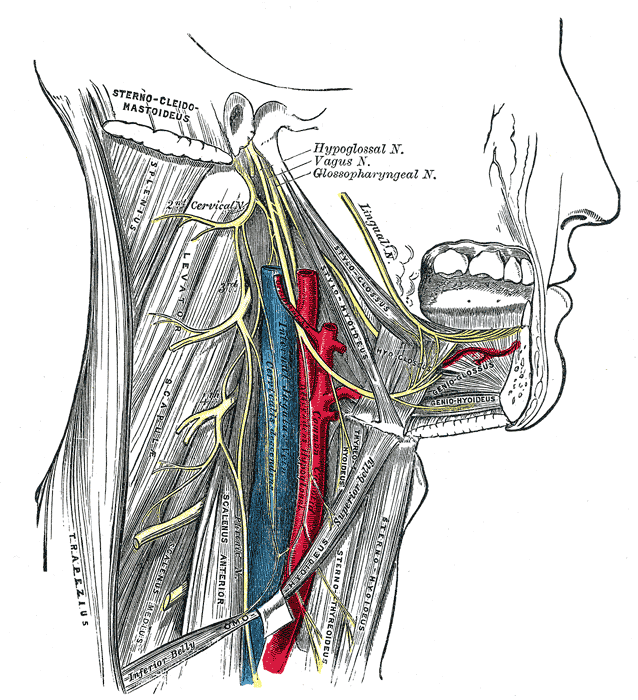 Hypoglossal nerve, cervical plexus, and their branches.


Editor-In-Chief: C. Michael Gibson, M.S., M.D. [1]