

Health Dictionary
Reliable, easy-to-read patient information on common medical conditions — written in plain language, free of jargon, and grounded in current evidence. Browse the most frequent diagnoses, understand what they mean for everyday life, and learn which steps and questions help you have a focused conversation with your doctor.
Glucagonoma other imaging findings
Introduction
Overview
Overview
Other imaging studies for glucagonoma include positron emission tomography scan and somatostatin receptor scintigraphy. Scintigraphy is less sensitive than PET scan but still useful.
Other Imaging Findings
Other Imaging Findings
Positron Emission Tomography
- When performing a PET scan, a small amount of a radioactive medium is injected into the body and absorbed by the organs or tissues.
- This radioactive substance gives off energy which in turn is used to produce the images.
- Positron emission tomography can provide more helpful information than either CT or MRI scans. It is useful to see if cancer has spread to the lymph nodes and it is also useful to locate where cancer has spread.
Octreoscan
- Many glucagonoma’s express high levels of somatostatin receptors and can be imaged with a radiolabeled form of the somatostatin analog octreotide.[1]
- It is less sensitive than Ga DOTATATE PET scan with gadolinium but still useful if Ga DOTATATE is not available.
-
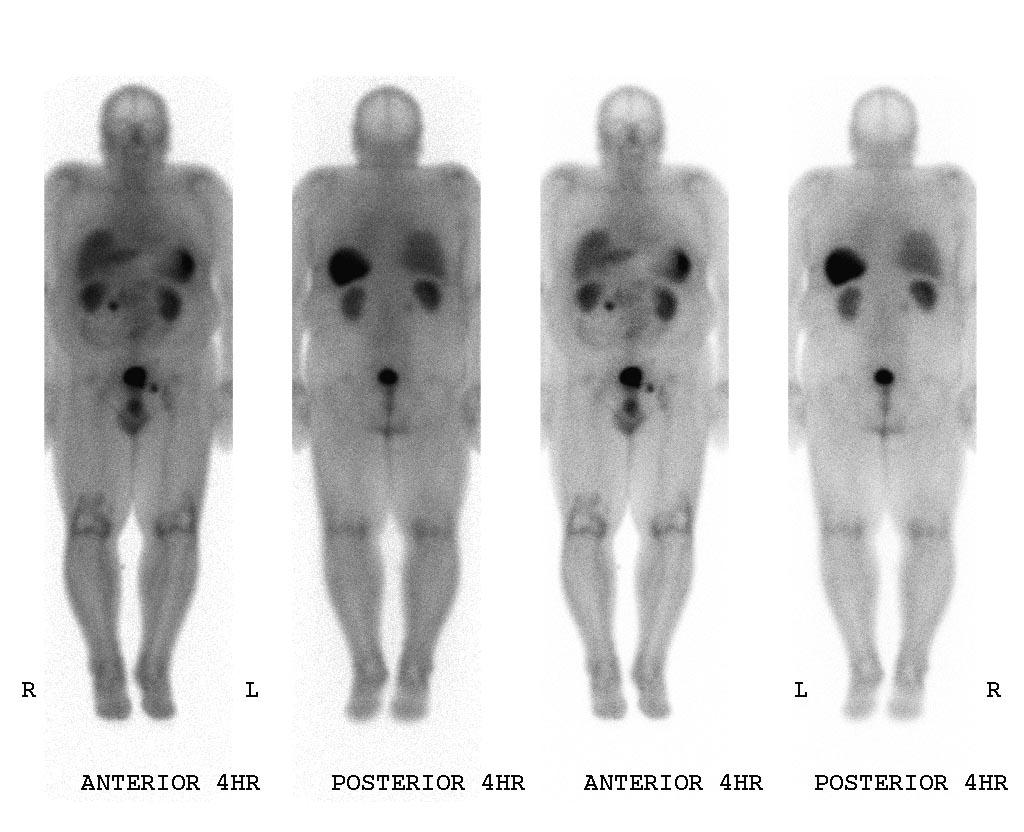 Octreoscan.Case courtesy of Radswiki rID: 11670

References
References
- ↑ Papotti M, Bongiovanni M, Volante M, Allìa E, Landolfi S, Helboe L; et al. (2002). “Expression of somatostatin receptor types 1-5 in 81 cases of gastrointestinal and pancreatic endocrine tumors. A correlative immunohistochemical and reverse-transcriptase polymerase chain reaction analysis”. Virchows Arch. 440 (5): 461–75. doi:10.1007/s00428-002-0609-x. PMID 12021920.
Editor-In-Chief: C. Michael Gibson, M.S., M.D. [1]; Associate Editor(s)-in-Chief: Parminder Dhingra, M.D. [2], Mohammed Abdelwahed M.D[3]