

Health Dictionary
Reliable, easy-to-read patient information on common medical conditions — written in plain language, free of jargon, and grounded in current evidence. Browse the most frequent diagnoses, understand what they mean for everyday life, and learn which steps and questions help you have a focused conversation with your doctor.
Gogte synthesis
Introduction
Overview
Overview
2-Pyrone (α-pyrone or pyran-2-one) is an unsaturated cyclic chemical compound with the molecular formula C5H4O2. It is isomeric with 4-pyrone.
2-Pyrone is used in organic synthesis as a building block for more complex chemical structures because it may participate in a variety of cycloaddition reactions to form bicyclic lactones. For example, it readily undergoes Diels-Alder reactions with alkynes producing, upon loss of carbon dioxide, substituted benzenes.[1]. The Gogte Synthesis (1938) is a method for the alkylation of certain pyrones with acid chlorides.
2-Pyrone also forms the the core structure of a variety of natural organic compounds. For example, the coumarins are an important class of compounds which are benzo-fused derivatives of 2-pyrone.
-
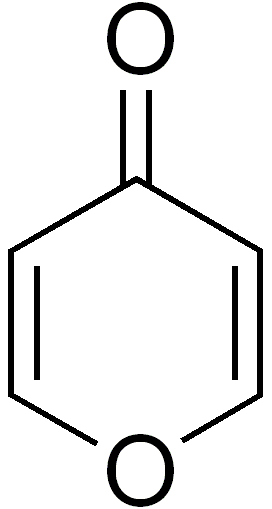 4-Pyrone
 -
 Coumarin


References
References
- ↑ Woodard BT, Posner G H. “Recent Advances in Diels-Alder Cycloadditions Using 2-Pyrones.” Advances in Cycloaddition. 1999, 5, 47-83.
Editor-In-Chief: Template:Chembox new C. Michael Gibson, M.S., M.D. [1]