

Health Dictionary
Reliable, easy-to-read patient information on common medical conditions — written in plain language, free of jargon, and grounded in current evidence. Browse the most frequent diagnoses, understand what they mean for everyday life, and learn which steps and questions help you have a focused conversation with your doctor.
Heberden's nodes
Introduction
Overview
Overview
Heberden’s nodes – Named for William Heberden (1710-1801)[1] – are hard or bony swellings which can develop in the distal interphalangeal joints (the furthest joints before the tips of the fingers or toes.) They are a sign of osteoarthritis, and are caused by formation of calcific spurs of the articular (joint) cartilage.
Epidemiology and Demographics
Epidemiology and Demographics
Heberden’s nodes are more common in women than in men, and there seems to be a genetic component involved in predisposition to the condition.
Natural History, Complications and Prognosis
Natural History, Complications and Prognosis
Heberden’s nodes typically develop in middle age, beginning either with a chronic swelling of the affected joints or the sudden painful onset of redness, numbness, and loss of manual dexterity.
This initial inflammation and pain eventually subsides, and the patient is left with a permanent bony outgrowth that often skews the fingertip sideways. Bouchard’s nodes may also be present; these are similar bony growths in the middle joints of the fingers, and are also associated with osteoarthritis.
Physical Examination
Physical Examination
Extremities
-
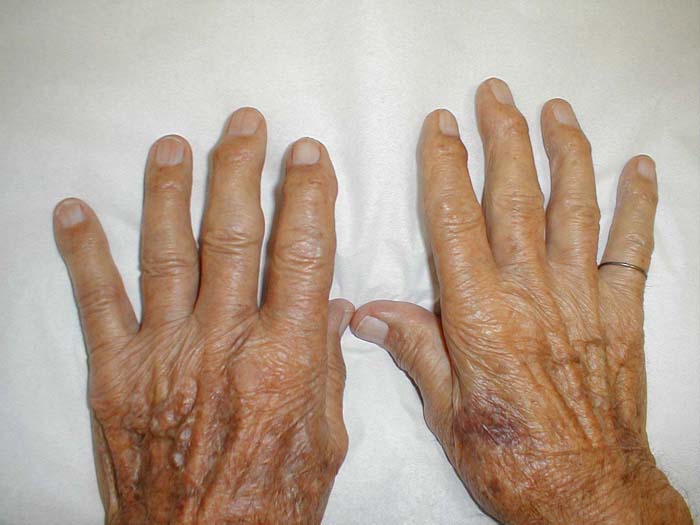 Heberden’s nodes: Bony prominences at distal interphalangeal joints, seen in some patients with osteoarthritis.

Editor-In-Chief: C. Michael Gibson, M.S., M.D. [1]; Cafer Zorkun, M.D., Ph.D. [2]