

Health Dictionary
Reliable, easy-to-read patient information on common medical conditions — written in plain language, free of jargon, and grounded in current evidence. Browse the most frequent diagnoses, understand what they mean for everyday life, and learn which steps and questions help you have a focused conversation with your doctor.
Herpetic whitlow
Introduction
Overview
Overview
A herpetic whitlow is a lesion on a finger or thumb caused by the herpes simplex virus. In children the primary source of infection is the orofacial area, and it is commonly inferred that the virus (in this case commonly HSV-1) is transferred by the chewing or sucking of fingers or thumbs. In adults it is more common for the primary source to be the genital region, with a corresponding preponderance of HSV-2. It is also seen in adult health care workers such as dentists because increased exposure to the herpes virus.
Pathophysiology
Pathophysiology
Transmission
It is typically contracted by healthcare workers that come in contact with the virus; it is most commonly contracted by dental workers and medical workers exposed to oral secretions.[1][2] Again, the HSV seronegative person is at highest risk of acquiring this condition. It is often observed in thumb-sucking children with primary HSV-1 infection, and in adults aged 20 to 30 following contact with by HSV-2-infected genitals.[3]
Causes
Causes
- Herpes whitlow is a painful infection that typically manifest itself on fingers or thumbs and occasionally on the toes, or on the nail cuticle, and is caused by HSV-1 or HSV-2.[4]
- Herpes whitlow is also caused by autoinoculation of HSV into broken skin prior to an infected person developing antibodies against the virus (e.g. during primary infection before seroconversion).[4]
- If someone has a cold sore and puts their finger in their mouth then a herpes infection whitlow may appear. Herpes whitlows are frequently found among dentists and dental hygienists.[5]
Natural History, Complications and Prognosis
Natural History, Complications and Prognosis
The herpes whitlow lesion usually heals in two to three weeks.[6]
Diagnosis
Diagnosis
History and Symptoms
Symptoms of herpetic whitlow include swelling, reddening, and tenderness of the skin of infected finger. This may be accompanied by fever and swollen lymph nodes.
Physical Examination
Extremities
Small, clear vesicles initially form that merge and becomes cloudy. Associated pain often seems large relative to the physical symptoms.
-
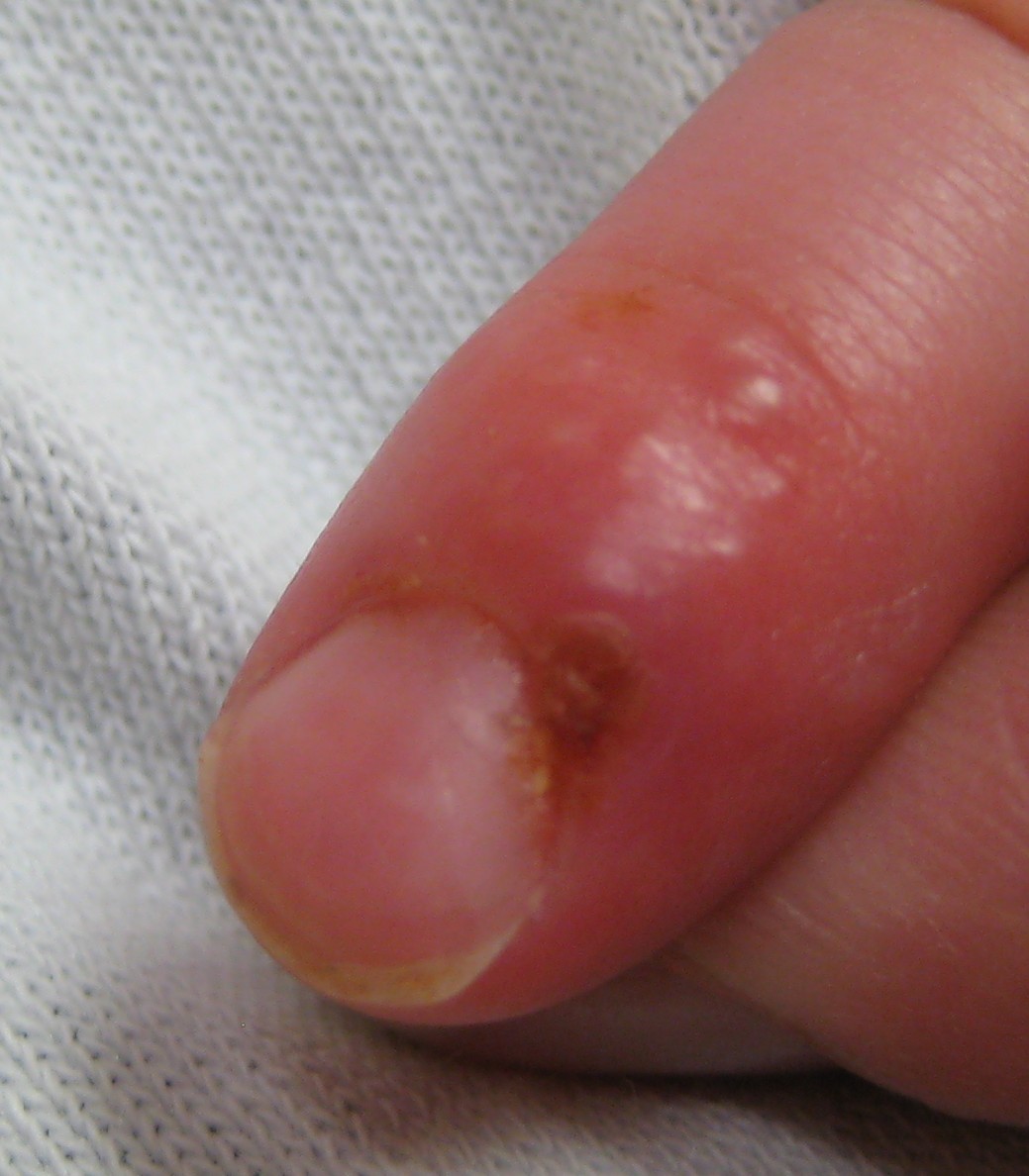 Herpetic whitlow in a young child who had earlier developed herpes gingivostomatitis
 -
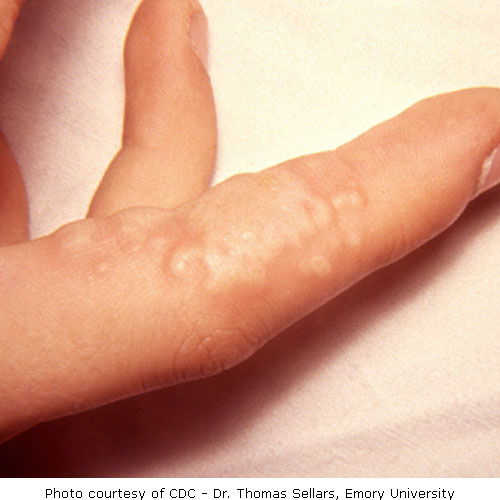 Vesiculobullous lesions of the fingers of a patient with Herpetic Whitlow


Treatment
Treatment
Medical Therapy
Although it is a self-limited illness, topical antivirals, particularly topical acyclovir, have been shown to be effective in decreasing the duration of symptoms. One should never try to lance or surgically debride the lesion, as it may make it worse (cause a superinfection or cause encephalitis).
References
References
- ↑ Lewis MA (2004). “Herpes simplex virus: an occupational hazard in dentistry”. Int Dent J. 54 (2): 103–11. PMID 15119801.
- ↑ Avitzur Y, Amir J (2002). “Herpetic whitlow infection in a general pediatrician–an occupational hazard”. Infection. 30 (4): 234–6. PMID 12236568.
- ↑ Wu IB, Schwartz RA (2007). “Herpetic whitlow”. Cutis. 79 (3): 193–6. PMID 17674583.
- ↑ 4.0 4.1 Clark DC (2003). “Common acute hand infections”. Am Fam Physician. 68 (11): 2167–76. PMID 14677662.
- ↑ Lewis, M.A. (April 2004). “Herpes simplex virus: an occupational hazard in dentistry”. International Dental Journal (2): 103–111. doi:10.2956/indj.2004.54.2.103. Unknown parameter
|vol=ignored (|volume=suggested) (help) - ↑ Anonymous (1971). “Herpetic whitlow: a medical risk”. Br Med J. 4 (5785): 444. PMID 5125276.
Editor-In-Chief: C. Michael Gibson, M.S., M.D. [1]