

Health Dictionary
Reliable, easy-to-read patient information on common medical conditions — written in plain language, free of jargon, and grounded in current evidence. Browse the most frequent diagnoses, understand what they mean for everyday life, and learn which steps and questions help you have a focused conversation with your doctor.
Human papillomavirus historical perspective
Introduction
Overview
Overview
Warts as a cutaneous manifestation of HPV infection were first described by Hippocrates. Dr. Harald Zur Hausen (father of HPV virology) in 1975 described the relationship between HPV and cervical cancer.
Historical Perspective
Historical Perspective
- Genital warts were first described by Hippocrates (460–377 B.C.). Since those days, the term condyloma (a word of Greek origin) has been used for genital warts meaning “a round swelling around the anus”.[1]
- In 1891 Infectious nature of common warts was noticed by Payne and Jadassohn.
- In 1943, Parson and Kidd published their milestone study where they showed that oral papillomatosis of rabbits is a viral disease and the oral papillomavirus was distinct from the skin papillomavirus
- In 1956, The concept of koilocytosis in PAP smears and cervical biopsies described by Koss & Durfee.
- EM demonstration of HPV particles in genital warts was shown by Dunn & Ogilvie in 1968 and Almeida et al in 1969.
- In 1975, Zur Hausen German physician presented the hypothesis on HPV as a potential cause of cervical cancer.[2]
- Nobel prize in medicine went to Dr. Harald Zur Hausen in 2008 regarding his discoveries in HPV relation to cervical cancer.
-
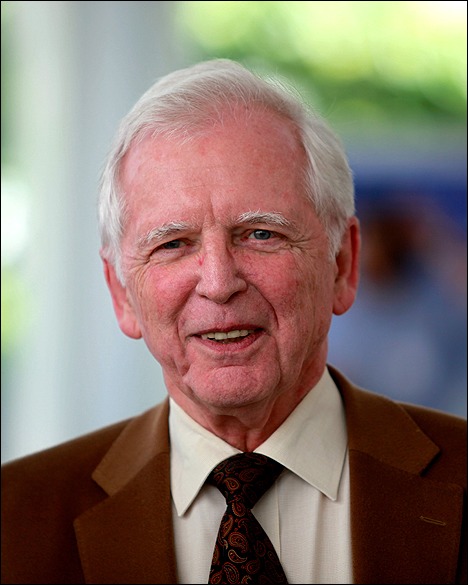 Dr. Herald zur Hausen

References
References
- ↑ Gasparini R, Panatto D (2009). “Cervical cancer: from Hippocrates through Rigoni-Stern to Zur Hausen”. Vaccine. 27 Suppl 1: A4–5. doi:10.1016/j.vaccine.2008.11.069. PMID 19480961.
- ↑ zur Hausen H (2009). “Papillomaviruses in the causation of human cancers – a brief historical account”. Virology. 384 (2): 260–5. doi:10.1016/j.virol.2008.11.046. PMID 19135222.
Editor-In-Chief: C. Michael Gibson, M.S., M.D. [1];Associate Editor(s)-in-Chief: Seyedmahdi Pahlavani, M.D. [2]