

Health Dictionary
Reliable, easy-to-read patient information on common medical conditions — written in plain language, free of jargon, and grounded in current evidence. Browse the most frequent diagnoses, understand what they mean for everyday life, and learn which steps and questions help you have a focused conversation with your doctor.
Hypoglossal canal
Introduction
Template:Infobox Bone The hypoglossal canal is a bony canal in the occipital bone of the skull that transmits the hypoglossal nerve from its point of entry near the medulla oblongata to its exit from the base of the skull near the jugular foramen. It lies in the epiphyseal junction between the basiocciput and the jugular process of the occipital bone.
The Hypoglossal canal has recently been used to try to determine the antiquity of human speech. Researchers have found that hominids who lived as long as 2 million years ago had the same size canal as that of modern day chimpanzees, some scientists thus assume they were incapable of speech. However, archaric H. sapiens 400,000 years ago had the same size canal as that of modern humans, meaning they could have been capable of speech. Some Neanderthals also had the same size hypoglossal canal as archaic H. sapiens. However recent studies involving several primate species have given inconclusive results as to whether there is any association between its size and speech [1].
Additional images
Additional images
-
 Base of the skull. Upper surface.
 -
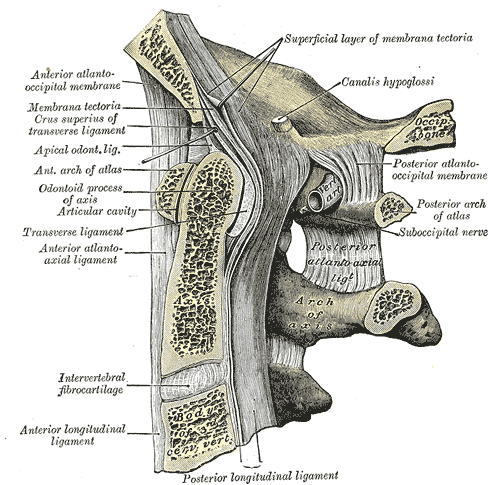 Median sagittal section through the occipital bone and first three cervical vertebræ.

