

Health Dictionary
Reliable, easy-to-read patient information on common medical conditions — written in plain language, free of jargon, and grounded in current evidence. Browse the most frequent diagnoses, understand what they mean for everyday life, and learn which steps and questions help you have a focused conversation with your doctor.
Inner cell mass
Introduction
Overview
Overview
In early embryogenesis of most eutherian mammals, the inner cell mass (abbreviated ICM and also known as the embryoblast or pluriblast (the latter term being applicable to all mammals)) is the mass of cells inside the primordial embryo that will eventually give rise to the definitive structures of the fetus. This structure forms in the earliest steps of development, before implantation into the endometrium of the uterus has occurred. The ICM lies within the blastocoele (more correctly termed “blastocyst cavity”, as it is not strictly homologous to the blastocoele of anamniote vertebrates) and is entirely surrounded by the single layer of cells called trophoblast.
Further development
Further development
The ICM differentiates into two types of cells, epiblast and hypoblast.
Only the cells of the epiblast give rise to cells inside the embryo, while hypoblast cells form only extraembryonic tissue (extraembryonic endoderm). All three germ layers of the definitive embryo, as well as extraembryonic mesoderm, arise from the epiblast.
Stem cells
Stem cells
It is the source of early stem cells.[1]
It can form all tissues except trophoblast.[2]
Additional images
Additional images
-
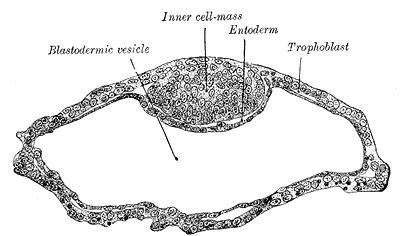 Blastodermic vesicle of Vespertilio murinus.
 -
 Section through embryonic disk of Vespertilio murinus.


References
References
- ↑ “Stem Cell Research Basics: Early Stem Cells”. Retrieved 2007-10-11.
- ↑ “Definition: inner cell mass from Online Medical Dictionary”. Retrieved 2007-10-11.