

Health Dictionary
Reliable, easy-to-read patient information on common medical conditions — written in plain language, free of jargon, and grounded in current evidence. Browse the most frequent diagnoses, understand what they mean for everyday life, and learn which steps and questions help you have a focused conversation with your doctor.
Internal pudendal artery
Introduction
The internal pudendal artery is an artery that branches off the internal iliac artery, providing blood to the external genitalia.
The internal pudendal artery is the terminal branch of the anterior trunk of the internal iliac artery. It is smaller in the female than in the male.
Path
Path
It exits the pelvic cavity through the greater sciatic foramen to enter the gluteal region.
It then curves around the sacrospinous ligament to enter the perineum through the lesser sciatic foramen.
It travels through the pudendal canal with the internal pudendal veins and the pudendal nerve.
Branches
Branches
The internal pudendal artery gives off the following branches:
Some sources consider the urethral artery a direct branch of the internal pudendal artery[1], while others consider it a branch of the perineal artery.[2]
In males, the internal pudendal artery also gives rise to the perforating arteries of the penis.
Additional images
Additional images
-
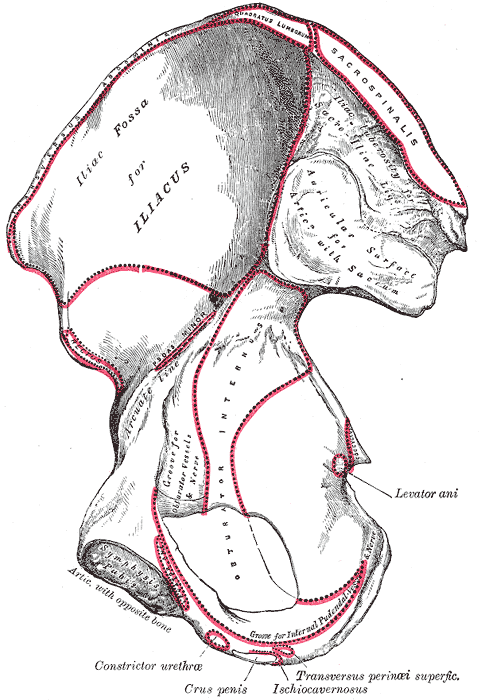 Right hip bone. Internal surface.
 -
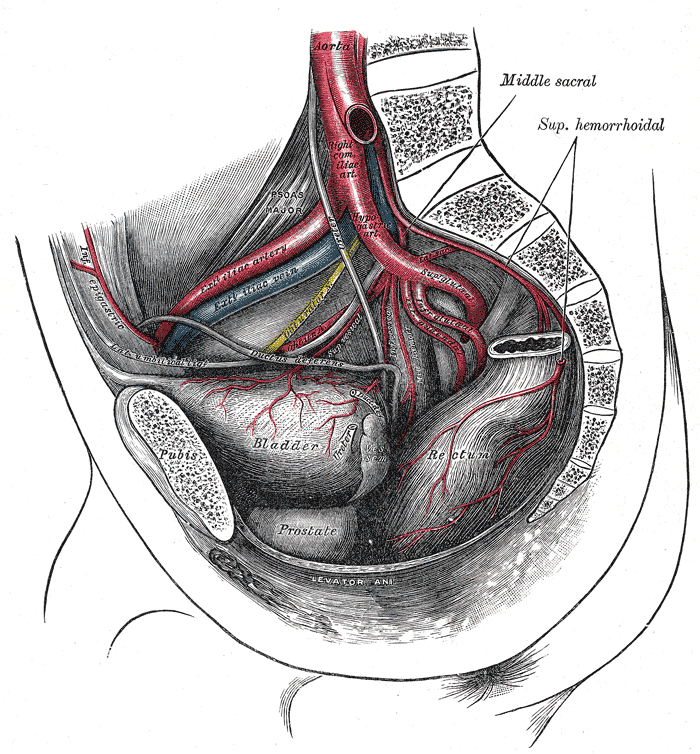 The arteries of the pelvis.
 -
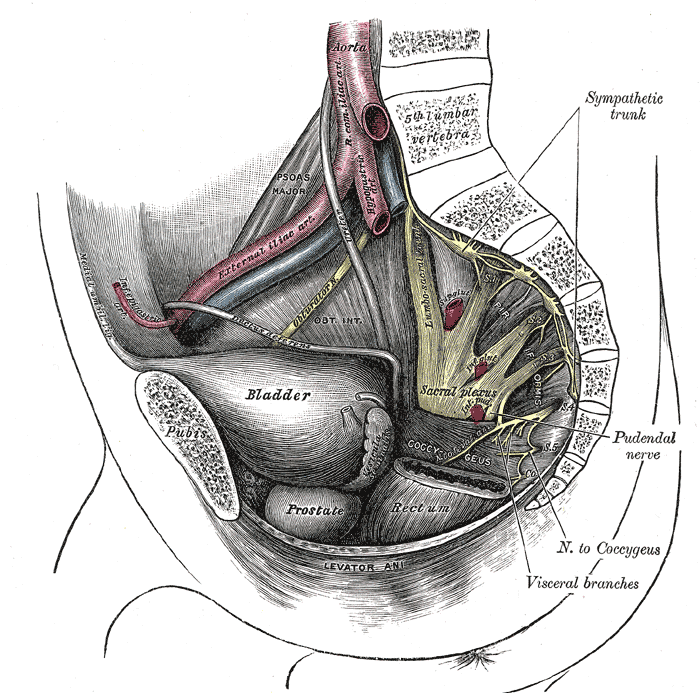 Dissection of side wall of pelvis showing sacral and pudendal plexuses.
 -
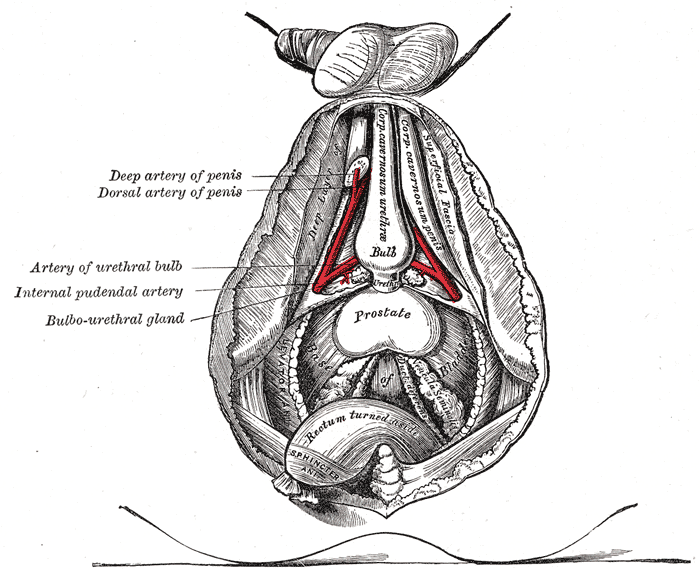 The deeper branches of the internal pudendal artery.
 -
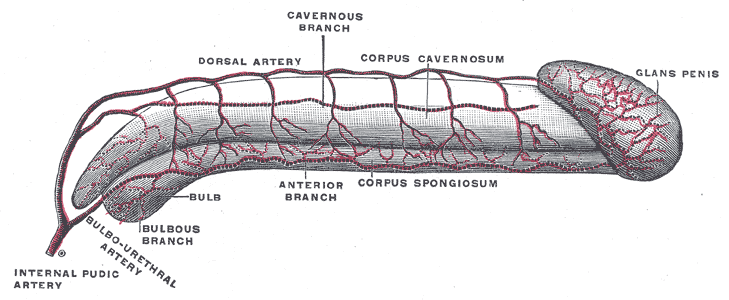 Diagram of the arteries of the penis.
 -
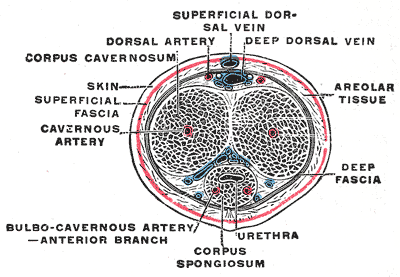 The penis in transverse section, showing the bloodvessels.


External links
External links
- Template:SUNYAnatomyFigs – “Inferior view of female perineum, branches of the internal pudendal artery.”
- Template:SUNYAnatomyFigs – “Branches of internal pudendal artery in the male perineum.”
- Template:SUNYAnatomyFigs – “Sagittal view of the internal iliac artery and its branches in the female pelvis. “
- Template:SUNYAnatomyFigs – “Sagittal view of the internal iliac artery and its branches in the male pelvis. “
- Template:SUNYAnatomyImage
- Template:MedicalMnemonics
- Template:NormanAnatomy (Template:NormanAnatomyFig)
- Template:DartmouthHumanAnatomy
- Template:DartmouthHumanAnatomy
- Diagram at MSU
Editor-In-Chief: Template:WikiDoc Cardiology News C. Michael Gibson, M.S., M.D. [1]