

Health Dictionary
Reliable, easy-to-read patient information on common medical conditions — written in plain language, free of jargon, and grounded in current evidence. Browse the most frequent diagnoses, understand what they mean for everyday life, and learn which steps and questions help you have a focused conversation with your doctor.
Jejunum
Introduction
Overview
Overview
In anatomy of the digestive system, the jejunum is the central of the three divisions of the small intestine and lies between the duodenum and the ileum. The change from the duodenum to the jejunum is usually defined as the ligament of Treitz.
In adult humans, the small intestine is usually between 5.5-6m long, 2.5m of which is the jejunum.
The pH in the jejunum is usually between 7 and 8 (neutral or slightly alkaline).
The jejunum and the ileum are suspended by mesentery which gives the bowel great mobility within the abdomen. It also contains muscles to help move the food along.
Internal structure
Internal structure
The inner surface of the jejunum, its mucous membrane, is covered in projections called villi, which increase the surface area of tissue available to absorb nutrients from the gut contents. The villi in the jejunum are much longer than in the duodenum or ileum.
The jejunum contains very few Brunner’s glands (found in the duodenum) or Peyer’s patches (found in the ileum). Instead, it has many large circular folds in its submucosa called plicae circulares which increase the surface area for nutrient absorption.
Etymology
Etymology
Jejunum is derived from the adjective jejune, which means “fasting” or “hungry” in Early Modern English. It was so called because this portion of the intestine was found “empty” following death [Latin: jejunus, fasting; barren]
Additional images
Additional images
-
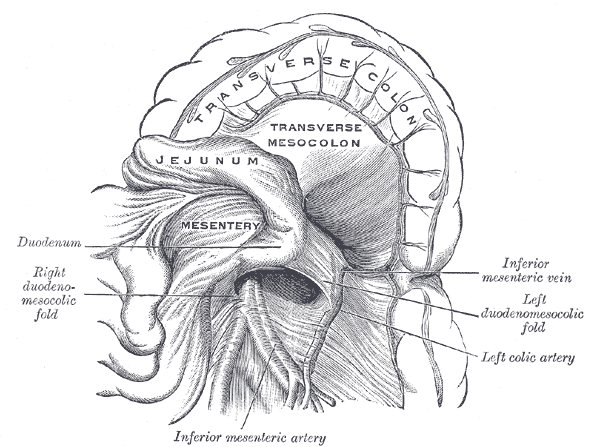 Duodenojejunal fossa.
 -
 Transmission electron microscope (TEM) of Human Jejunum
 -
 TEM of Mouse Jejunum x14000


References
References
External links
External links
- Gastrolab.net:The Jejunum
- Peyer’s patches
- Template:SUNYAnatomyLabs – “Abdominal Cavity: The Jejunum and the Ileum”
- Template:SUNYAnatomyImage
de:Jejunum eo:Jejuno fa:تهیروده id:Usus kosong it:Digiuno (anatomia) lt:Tuščioji žarna hu:Jejunum nl:Nuchtere darm sk:Lačník sl:Tešče črevo