

Health Dictionary
Reliable, easy-to-read patient information on common medical conditions — written in plain language, free of jargon, and grounded in current evidence. Browse the most frequent diagnoses, understand what they mean for everyday life, and learn which steps and questions help you have a focused conversation with your doctor.
Lymph vessels
Introduction
Overview
Overview
In anatomy, lymph vessels are thin walled, valved structures that carry lymph. As part of the lymphatic system, lymph vessels are complimentary with the vascular system. In contrast to the vascular system, which carries blood under pressure to the entire body, lymph is not under pressure and is propelled in a passive fashion, assisted by the aforementioned valves. Fluid that leaks from the vascular system is returned to general circulation via lymphatic vessels.
Generally, lymph flows away from the tissues to lymph nodes and eventually to either the right lymphatic duct or the largest lymph vessel in the body, the thoracic duct. These vessels drain into the right and left subclavian veins respectively.
Function
Function
Lymph vessels act as a reservoir from plasma and other substances including cells that leaked from the vascular system and transport lymph fluid back from the tissues to the circulatory system. Without functioning lymph vessels, lymph cannot be effectively drained and edema typically results.
Additional images
Additional images
-
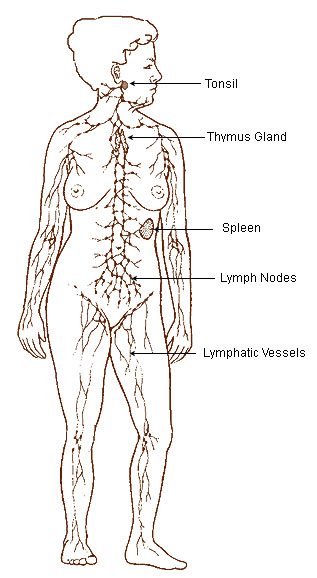 Lymphatic system
 -
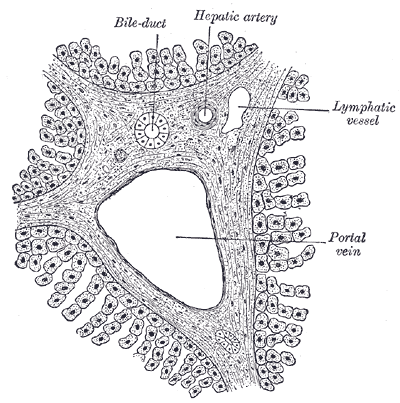 Section across portal canal of pig. X 250.


External links
External links
- Lymphatic+Vessels at the US National Library of Medicine Medical Subject Headings (MeSH)
- Template:BiowebUW
- Essentials of Human Physiology by Thomas M. Nosek. Section 3/3ch9/s3ch9_5.
Editor-In-Chief: C. Michael Gibson, M.S., M.D. [1]