

Health Dictionary
Reliable, easy-to-read patient information on common medical conditions — written in plain language, free of jargon, and grounded in current evidence. Browse the most frequent diagnoses, understand what they mean for everyday life, and learn which steps and questions help you have a focused conversation with your doctor.
Medial longitudinal fasciculus
Introduction
Overview
Overview
The medial longitudinal fasciculus (MLF) is a pair of crossed fiber tracts (group of axons), one on each side of the brainstem.
Function
Function
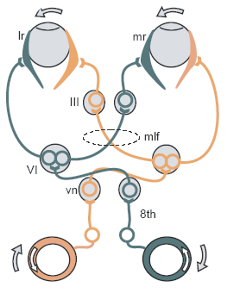
The MLF carries information about the direction that the eyes should move.
It yokes the cranial nerve nuclei III, IV and VI together, as well as the gaze centres and information about head movement (from cranial nerve VIII).
It also descends into the cervical spinal cord, and innervates some muscles of the neck.
Inputs
Inputs
The MLF arises from the Vestibular nucleus (VN) and is thought to be involved in the maintenance of gaze. This is achieved by inputs to the VN from
- the Vestibulocochlear (8th cranial) nerve about head movements,
- gain adjustments from the flocculus of the cerebellum,
- head and neck propioceptors and foot and ankle muscle spindle, via the fastigial nucleus.
Pathology
Pathology
Lesions of the MLF produce internuclear ophthalmoplegia. Lesions to the MLF are very common manifestations of the disease multiple sclerosis.where it most commonly presents as diplopia. These lesions cause damage to the ipsilateral (same side) eye.
History
History
In 1846 neurologist Benedict Stilling first referred to what is now known as the MLF as the acusticus, followed by Theodor Meynert in 1872 calling it posterior. But in 1891, Heinrich Schutz chose the name dorsal to describe the longitudinal bundle, “for brevity’s sake”. This name stuck despite other authors attempting further renaming (Ramon y Cajal’s periependymal in 1904, Theodor Ziehen‘s nubecula dorsalis in 1913). But finally, it was Wilhelm His, Sr. who changed the name to medial for the sake of the Basle nomenclature to end the confusion.
Additional images
Additional images
-
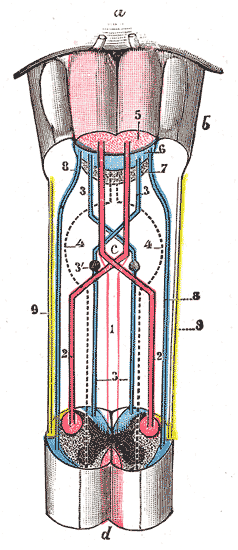 Decussation of pyramids.
 -
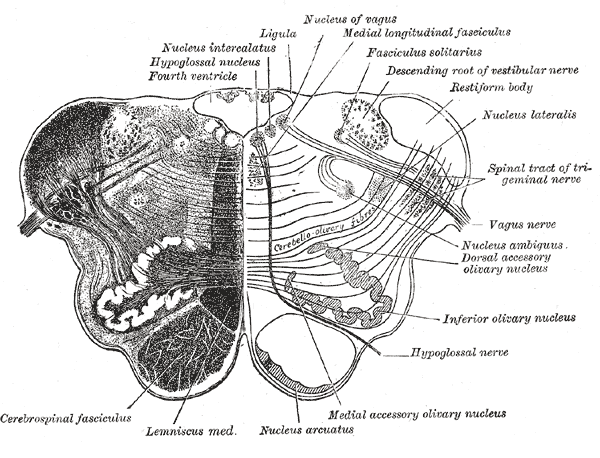 Transverse section of medulla oblongata below the middle of the olive.
 -


External links
External links
- Template:EMedicineDictionary
- Template:UMichAtlas – “Brainstem, Cranial Nerve Nuclei, Sagittal Section, Medial View”
Template:Mesencephalon Template:Rhombencephalon Template:Eye-stub Template:Neuroscience-stub