

Health Dictionary
Reliable, easy-to-read patient information on common medical conditions — written in plain language, free of jargon, and grounded in current evidence. Browse the most frequent diagnoses, understand what they mean for everyday life, and learn which steps and questions help you have a focused conversation with your doctor.
Mee's lines
Introduction
Template:DiseaseDisorder infobox
Synonyms and keywords: Mee’s lines; Aldrich-Mees’ lines
Overview
Overview
Mees’ lines are lines of discoloration across the nails of the fingers and toes after an episode of poisoning with arsenic or thallium or other heavy metals.[1] They are typically white bands traversing the width of the nail. As the nail grows they move towards the end, and finally disappear when trimmed.
Historical Perspective
Historical Perspective
Although the phenomenon is named after the Dutch physician R.A. Mees, earlier descriptions of the same abnormality were made by the Englishman E.S. Reynolds and the American C.J. Aldrich in 1901 and 1904, respectively.[2]
Diagnosis
Diagnosis
Physical Examination
The following image shows an example of the white bands present on the nails of a person with Mees’ lines.
-
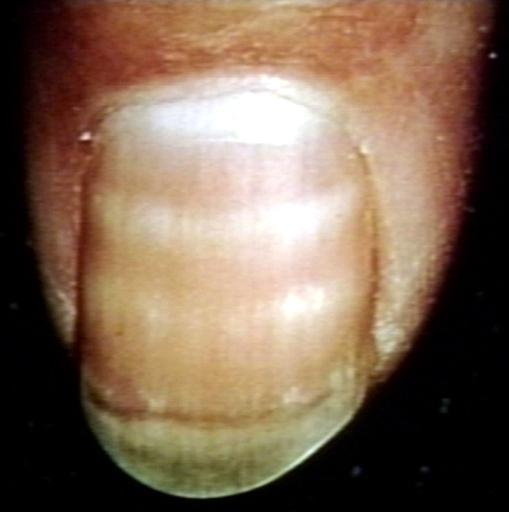 Nail disease; white banding

References
References
- ↑ Hall AH (2002). “Chronic arsenic poisoning”. Toxicology Letters. 128 (1–3): 69–72. PMID 11869818. Retrieved 2012-08-07. Unknown parameter
|month=ignored (help) - ↑ “LEUCONYCHIA STRIATA ARSENICALIS TRANSVERSUS.: with report of… : The American Journal of the Medical Sciences”. Retrieved 2012-08-07.
Editor-In-Chief: C. Michael Gibson, M.S., M.D. [1]