

Health Dictionary
Reliable, easy-to-read patient information on common medical conditions — written in plain language, free of jargon, and grounded in current evidence. Browse the most frequent diagnoses, understand what they mean for everyday life, and learn which steps and questions help you have a focused conversation with your doctor.
Mesoderm
Introduction

* Chordamesoderm: yellow, at the notochord.
* Paraxial mesoderm: red, comprising the somites.
* Intermediate mesoderm: purple, which includes the Wolffian duct.
* Lateral plate mesoderm: purple, comprising somatic and splanchic mesoderm.
Overview
Overview
The germ layer mesoderm forms in the embryos of animals more complex than cnidarians, making them triploblastic. Mesoderm forms during gastrulation when some of the cells migrating inward to form the endoderm form an additional layer between the endoderm and the ectoderm.
This key innovation evolved hundreds of millions of years ago and led to the evolution of nearly all large, complex animals. The formation of a mesoderm led to the formation of a coelom. Organs formed inside a coelom (body cavity) can freely move, grow, and develop independently of the body wall while fluid cushions and protects them from shocks.
Categorizing animals
Categorizing animals
Not all triploblastic animals have a coelom, like the simplest animals with organs that form from three tissue layers: flatworms. Three different configurations of mesoderm in relation to ectoderm form a method of categorizing animals.
- Acoelomates
- no coelom
- tissues and organs packed between gut and body wall
- Pseudocoelomates
- false coelom
- unlined or partially lined body cavity between gut and body wall
- Coelomates
- proper coelom
- lined cavity between gut and body wall
Derivatives
Derivatives
General
Note: Not all triploblasts produce all of the items listed.
- bones
- most of the circulatory system, including the heart and major blood vessels
- connective tissues of the gut and integuments
- mesenchyme
- mesothelium
- muscles
- peritoneum (lining of the coelom)
- reproductive system
- urinary system, including the kidneys
Vertebrates
In addition to the general list, the mesoderm of a developing vertebrate differentiates into the following:
Additional images
Additional images
-
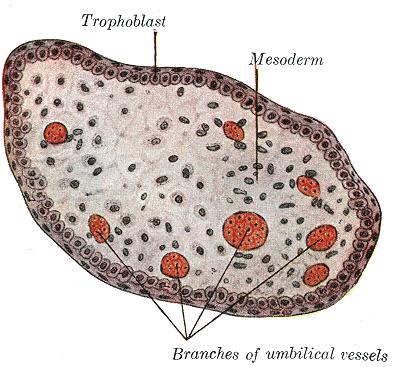 Transverse section of a chorionic villus.

References
References
- Evers, Christine A., Lisa Starr. Biology:Concepts and Applications. 6th ed. United States:Thomson, 2006. ISBN 0-534-46224-3.
Editor-In-Chief: C. Michael Gibson, M.S., M.D. [1]