

Health Dictionary
Reliable, easy-to-read patient information on common medical conditions — written in plain language, free of jargon, and grounded in current evidence. Browse the most frequent diagnoses, understand what they mean for everyday life, and learn which steps and questions help you have a focused conversation with your doctor.
Multifidus spinae
Introduction
Overview
Overview
The multifidus (multifidus spinae : pl. multifidi ) muscle consists of a number of fleshy and tendinous fasciculi, which fill up the groove on either side of the spinous processes of the vertebrae, from the sacrum to the axis.
Deep in the spine, it spans three joint segments, and works to stabilize the joints at each segmental level.
The stiffness and stability makes each vertebra work more effectively, and reduces the degeneration of the joint structures.
These fasciculi arise:
- in the sacral region: from the back of the sacrum, as low as the fourth sacral foramen, from the aponeurosis of origin of the Sacrospinalis, from the medial surface of the posterior superior iliac spine, and from the posterior sacroiliac ligaments.
- in the lumbar region: from all the mamillary processes.
- in the thoracic region: from all the transverse processes.
- in the cervical region: from the articular processes of the lower four vertebrae.
Each fasciculus, passing obliquely upward and medialward, is inserted into the whole length of the spinous process of one of the vertebræ above.
These fasciculi vary in length: the most superficial, the longest, pass from one vertebra to the third or fourth above; those next in order run from one vertebra to the second or third above; while the deepest connect two contiguous vertebrae.
Additional images
Additional images
-
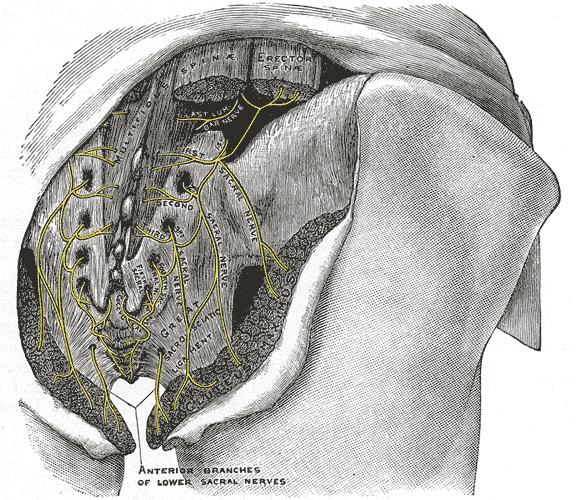 The posterior divisions of the sacral nerves.
