

Health Dictionary
Reliable, easy-to-read patient information on common medical conditions — written in plain language, free of jargon, and grounded in current evidence. Browse the most frequent diagnoses, understand what they mean for everyday life, and learn which steps and questions help you have a focused conversation with your doctor.
Myxoma pathophysiology
Introduction
Overview
Overview
Cardiac myxoma is a benign intracavitary endocardial mass that represents the most common primary tumor of the heart. Myxoma cells are characterized by undifferentiated mesenchymal cells, which potentially differentiate into many tissues such as blood vessels, glandular structures, and bones. The primary distribution of cardiac myxoma is the left atrium (75%) of the heart; regularly, they tend to be located in the fossa ovalis and endocardium of the atrial septum.
Pathogenesis
Pathogenesis
Pathogenesis
- Cardiac myxoma arises from remnants of subendocardial vasoformative reserve cells, which are primitive mesenchymal cells that are normally involved in the supportive structure of the endocardium.[1][2][3][4][5]
- The exact pathogenesis of cardiac myxoma is not fully understood.[5]
- It is thought that cardiac myxoma is produced by the neoplastic theory, dysembryoplastic theory, histopathogenesis of glandular cells in myxoma or the thrombotic theory.[6][7]
- The site of tumor attachment, normally the foramen ovale, is considered to be consistent with an origin from multipotent mesenchymal cells or from embryonic rests.[8]
Genetics
Genetics
- Sporadic cardiac myxomas and familial forms are related with several chromosome and gene alterations which involve cardiac development.[9]
- Inherited myxomas are usually present in Carney complex.[9]
- The development of Carney complex is a result of PRKAR1A gene inactivation mutation that is associated with chromosome 17q24.2-q24.3.[9]
- The gene 17q24.2-q24.3 plays an important role in cardiac development and myxomagenesis. The expression of PRKAR1A causes myxomatous changes in the endocardium.[9]
- The encoded protein of PRKAR1A is a type 1A regulatory subunit of protein kinase A.Inactivating germline mutations of this gene are found in 70% of people with Carney complex.[10]
- Less commonly, the molecular pathogenesis of Carney complex is a variety of genetic changes at chromosome 2p16.[11]
- Both types of Carney complex are autosomal dominant.
- Despite dissimilar genetics, there appears to be no phenotypic difference between PRKAR1A and chromosome 2p16 mutations.[12]
Associated Conditions
Associated Conditions
- The Carney complex is characterized by myxomatous neoplasms (cardiac, endocrine, cutaneous, and neural), and a host of pigmented lesions of the skin and mucosae, including the rarely occurring epitheloid blue nevus.[13][14][15]
- Approximately 7% of all cardiac myxomas are associated with Carney complex.[16]
Gross Pathology
Gross Pathology
- On gross pathology, external appearance, consistency size, and weight are extremely variable findings of cardiac myxoma.[17]
- Tumor consistency depends on the quantity and distribution of fibrous tissue and calcification (it can be smooth, lobulated, friable or gelatinous).
- Myxomas are usually described as having a gelatinous, irregular surface.
- Myxomas that have an irregular consistency are more likely to form surface thrombi and embolize.[18]
- Morphologically, these lesions tend to be attached to the endocardium by a broad-based pedunculated stalk.[8]
- In some cases, the attachment to the endocardium can also be without a clear stalk, or sessile.[8]
- Cardiac myxomas are non-invasive tumors, thus there is no infiltration to underlying tissues.[19]
- Cardiac myxomas are intracavitary tumors.
- The distribution is normally within the interatrial septum or adjacent to foramen ovale (75%).
- However, they can also be found in other cardiac chambers, such as right atrium (15%), ventricles (2%) or cardiac valves (rare).
- Large cardiac myxomas are usually located in fossa ovalis.[5]
- The size of the tumor varies from 0.6 to 12 cm, with a mean weight of 40 g.
- Images shown below are courtesy of Professor Peter Anderson DVM PhD and published with permission © PEIR, University of Alabama at Birmingham, Department of Pathology
-
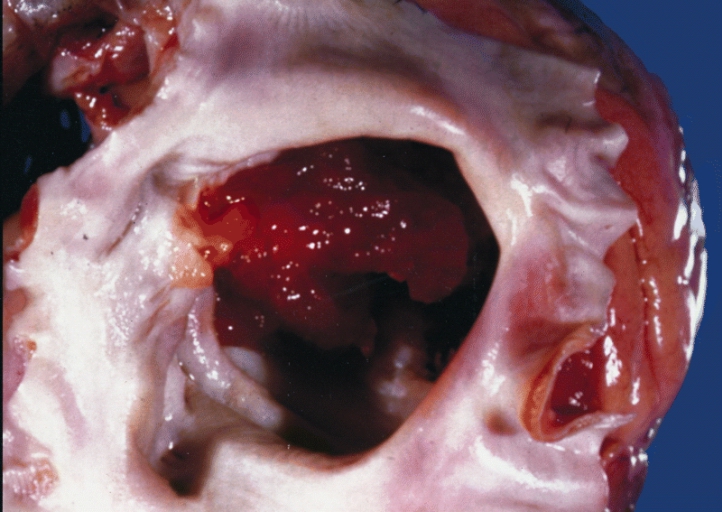 A gelatinous tumor is attached by a narrow pedicle to the atrial septum. The myxoma has an irregular surface and nearly fills the left atrium
 -
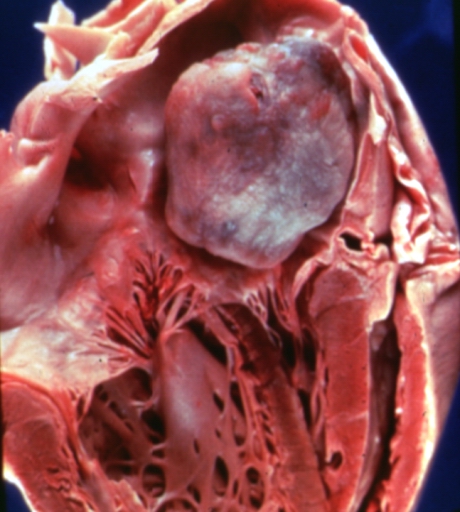 Left atrial myxoma
 -
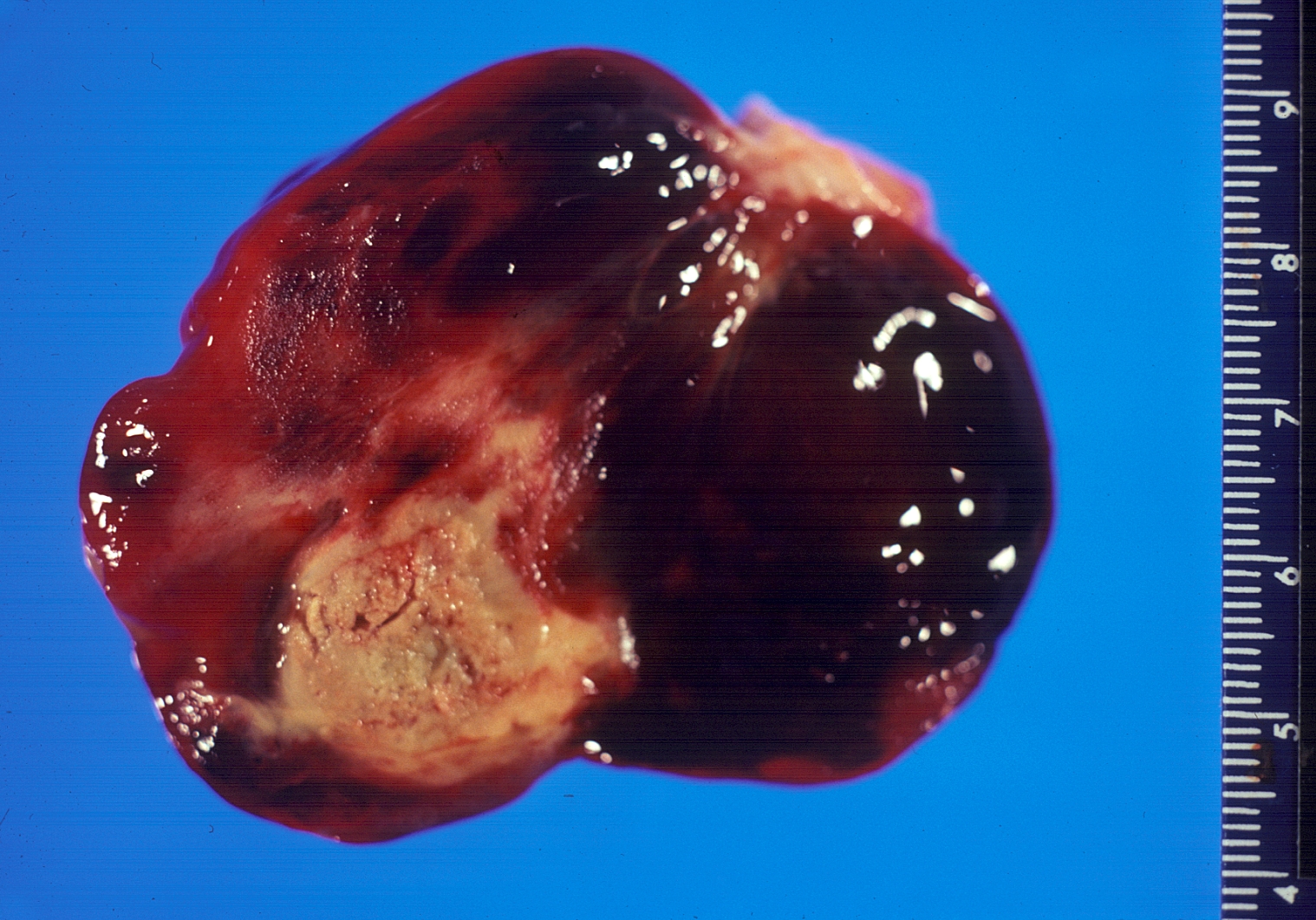 Gross pathology atrial myxoma: myxomas are brownish or white and are frequently covered with thrombus


Microscopic Pathology
Microscopic Pathology
- On microscopic histopathological analysis, myxoma cells have an ovoid nucleus with large nucleoli, abundant eosinophilic cytoplasm, and indistinct cell borders.[20]
- They are usually arranged in perivascular ring structures (typically, infiltrated by lymphocytes and macrophages).[17]
- The Gamna-Bodies which consist of fibrosis and deposition of iron pigments are a characteristic finding of myxoma tumors.[17]
- Other frequent histological findings, are hemosiderin within the histiocytes, thrombosis, fibrosis and calcifications.[17]
- In some cases, extramedullary hematopoiesis is present and mucin-producing glands can be also seen in the base of the tumor.[17]
- The extracellular matrix forms an alcian blue-positive myxoid stroma, composed of variable amounts of proteoglycans, elastin and collagen.[17]
 |
 |
 |
 |
 |
Immunohistochemistry
Immunohistochemistry
- Cardiac myxoma cells exhibit immuno-reactivity mainly for calretinin (75–100%) followed by vimentin (>50%), NOTCH1, alpha-1 antichymotrypsin and plakophilin- 2.[21]
- Calretinin plays an important role in the discrimination of mural thrombi and papillary fibroelastoma.[21]
- Another immunohistochemical marker, survivin (an apoptosis inhibitor) has been detected to play an important role in the development and growth of cardiac myxomas.[22]
| Features | Description |
|---|---|
| General aspects | |
| Genetics | |
| Gross Pathology |
|
| Micropathology |
|
| Inmunohistochemistry |
|
References
References
- ↑ Bulkley BH, Hutchins GM (1979). “Atrial myxomas: a fifty year review”. Am. Heart J. 97 (5): 639–43. PMID 433739.
- ↑ Grebenc ML, Rosado de Christenson ML, Burke AP, Green CE, Galvin JR (2000). “Primary cardiac and pericardial neoplasms: radiologic-pathologic correlation”. Radiographics. 20 (4): 1073–103, quiz 1110–1, 1112. doi:10.1148/radiographics.20.4.g00jl081073. PMID 10903697.
- ↑ Roscher AA, Kato NS, Quan H, Padmanabhan M (1996). “Intra-atrial myxomas, clinical-pathologic correlation based on two case studies including historical review”. J Cardiovasc Surg (Torino). 37 (6 Suppl 1): 131–7. PMID 10064365.
- ↑ Acebo E, Val-Bernal JF, Gómez-Román JJ (2001). “Prichard’s structures of the fossa ovalis are not histogenetically related to cardiac myxoma”. Histopathology. 39 (5): 529–35. PMID 11737312.
- ↑ 5.0 5.1 5.2 Grebenc ML, Rosado de Christenson ML, Burke AP, Green CE, Galvin JR (2000). “Primary cardiac and pericardial neoplasms: radiologic-pathologic correlation”. Radiographics. 20 (4): 1073–103, quiz 1110–1, 1112. doi:10.1148/radiographics.20.4.g00jl081073. PMID 10903697.
- ↑ Orlandi A, Ciucci A, Ferlosio A, Genta R, Spagnoli LG, Gabbiani G (2006). “Cardiac myxoma cells exhibit embryonic endocardial stem cell features”. J. Pathol. 209 (2): 231–9. doi:10.1002/path.1959. PMID 16508920.
- ↑ Amano J, Kono T, Wada Y, Zhang T, Koide N, Fujimori M, Ito K (2003). “Cardiac myxoma: its origin and tumor characteristics”. Ann Thorac Cardiovasc Surg. 9 (4): 215–21. PMID 13129418.
- ↑ 8.0 8.1 8.2 Reynen K (1995). “Cardiac myxomas”. N. Engl. J. Med. 333 (24): 1610–7. doi:10.1056/NEJM199512143332407. PMID 7477198.
- ↑ 9.0 9.1 9.2 9.3 Sun Y, Chen X, Sun J, Wen X, Liu X, Zhang Y, Hoffman AR, Hu JF, Gao Y (2015). “A Novel Inherited Mutation in PRKAR1A Abrogates PreRNA Splicing in a Carney Complex Family”. Can J Cardiol. 31 (11): 1393–401. doi:10.1016/j.cjca.2015.05.018. PMID 26416542.
- ↑ Correa R, Salpea P, Stratakis CA (October 2015). “Carney complex: an update”. Eur. J. Endocrinol. 173 (4): M85–97. doi:10.1530/EJE-15-0209. PMC 4553126. PMID 26130139.
- ↑ Stratakis, Constantine A.; Kirschner, Lawrence S.; Carney, J. Aidan (2001). “Clinical and Molecular Features of the Carney Complex: Diagnostic Criteria and Recommendations for Patient Evaluation”. The Journal of Clinical Endocrinology & Metabolism. 86 (9): 4041–4046. doi:10.1210/jcem.86.9.7903. ISSN 0021-972X.
- ↑ Stratakis, Constantine A.; Kirschner, Lawrence S.; Carney, J. Aidan (2001). “Clinical and Molecular Features of the Carney Complex: Diagnostic Criteria and Recommendations for Patient Evaluation”. The Journal of Clinical Endocrinology & Metabolism. 86 (9): 4041–4046. doi:10.1210/jcem.86.9.7903. ISSN 0021-972X.
- ↑ Carney JA, Gordon H, Carpenter PC, Shenoy BV, Go VL. The complex of myxomas, spotty pigmentation, and endocrine overactivity. Medicine (Baltimore). 1985;64(4):270-83.
- ↑ Iglesias C, Torrelo A, Colmenero I, Mediero IG, Zambrano A, Requenca L. Isolated multiple congential epithelioid blue naevus. British Journal of Dermatology 2005;152:391-393.
- ↑ Gaissmaier et al. (letter and response) Carney Complex. Circulation 1999;100 (25); e150 http://circ.ahajournals.org/cgi/reprint/100/25/e150
- ↑ Reynen, K. (1995). “Cardiac Myxomas”. New England Journal of Medicine. 333 (24): 1610–1617. doi:10.1056/NEJM199512143332407. PMID 7477198.
- ↑ 17.0 17.1 17.2 17.3 17.4 17.5 Di Vito A, Mignogna C, Donato G (2015). “The mysterious pathways of cardiac myxomas: a review of histogenesis, pathogenesis and pathology”. Histopathology. 66 (3): 321–32. doi:10.1111/his.12531. PMID 25297937.
- ↑ He DK, Zhang YF, Liang Y, Ye SX, Wang C, Kang B; et al. (2015). “Risk factors for embolism in cardiac myxoma: a retrospective analysis”. Med Sci Monit. 21: 1146–54. doi:10.12659/MSM.893855. PMC 4418206. PMID 25900256.
- ↑ Yoon DH, Roberts W (2002). “Sex distribution in cardiac myxomas”. Am. J. Cardiol. 90 (5): 563–5. PMID 12208428.
- ↑ Vaideeswar P, Butany JW (2008). “Benign cardiac tumors of the pluripotent mesenchyme”. Semin Diagn Pathol. 25 (1): 20–8. PMID 18350919.
- ↑ 21.0 21.1 Acebo E, Val-Bernal JF, Gómez-Roman JJ (2001). “Thrombomodulin, calretinin and c-kit (CD117) expression in cardiac myxoma”. Histol. Histopathol. 16 (4): 1031–6. PMID 11642722.
- ↑ Lin YS, Jung SM, Wu HH, Shiu TF, Tzai FC, Chu JJ, Lin PJ, Chu PH (2011). “Survivin expression in cardiac myxoma”. Chang Gung Med J. 34 (4): 360–6. PMID 21880190.
Editor-In-Chief: C. Michael Gibson, M.S., M.D. [1] Associate Editor(s)-in-Chief: Sogand Goudarzi, MD [2] Maria Fernanda Villarreal, M.D. [3]Cafer Zorkun, M.D., Ph.D. [4]Ahmad Al Maradni, M.D. [5]