

Health Dictionary
Reliable, easy-to-read patient information on common medical conditions — written in plain language, free of jargon, and grounded in current evidence. Browse the most frequent diagnoses, understand what they mean for everyday life, and learn which steps and questions help you have a focused conversation with your doctor.
NADPH
Introduction
Overview
Overview
Nicotinamide adenine dinucleotide phosphate (NADP+, in older notation TPN) is used in anabolic reactions, such as fatty acid and nucleic acid synthesis, which require NADPH as a reducing agent.
NADPH is the reduced form of NADP+, and NADP+ is the oxidized form of NADPH.
In plants
In plants
In chloroplasts, NADP is reduced by ferredoxin-NADP+ reductase in last step of the electron chain of the light reactions of photosynthesis. The NADPH produced is then used as reducing power for the biosynthetic reactions in the Calvin cycle of photosynthesis.
NADP ions in photosynthesis may be seen as ‘dragging’ hydrogen ions along with them (in the light-dependent cycles), which are used by the light-independent (Calvin) cycles to produce carbohydrates.
In animals
In animals
The oxidative phase of the pentose phosphate pathway is the major source of NADPH in cells.
NADPH provides the reducing equivalents for biosynthetic reactions and for oxidation-reduction involved in protection against the toxicity of ROS (reactive oxygen species).
NADPH is also used for anabolic pathways, such as fatty acid synthesis, cholesterol synthesis and fatty acid chain elongation.
It is the source of reducing equivalents for cytochrome 450 hydroxylation of aromatic compounds, steroids, alcohols, and drugs.
-
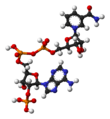
Ball-and-stick model of NADP+ -
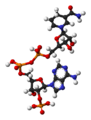
Ball-and-stick model of NADPH


Editor-In-Chief: Template:Chembox new C. Michael Gibson, M.S., M.D. [1]