

Health Dictionary
Reliable, easy-to-read patient information on common medical conditions — written in plain language, free of jargon, and grounded in current evidence. Browse the most frequent diagnoses, understand what they mean for everyday life, and learn which steps and questions help you have a focused conversation with your doctor.
Nasopharyngeal carcinoma pathophysiology
Introduction
Overview
Overview
On microscopic histopathological analysis, abundant dense eosinophilic cytoplasm and prominent lymphoid component are characteristic findings of nasopharyngeal carcinoma.
Pathophysiology
Pathophysiology
Genetics
Genes involved in the pathogenesis of nasopharyngeal carcinoma include:
Pathology
Pathology
Gross Pathology
- Nasal cavity involvement – common in early disease[1]
The tumor arises from epithelial cells on the surface of the nasopharynx.
Microscopic Pathology
Features:[2]
- Prominent lymphoid component (Lymphoepithelioma) – key feature
- Features of squamous cell carcinoma:

Nasopharyngeal carcinoma may be classified according to microscopic features into 3 subtypes:[3]
- Well-differentiated (keratinizing type)
- Moderately-differentiated (nonkeratinizing type)
- Undifferentiated (most strongly associated with Epstein-Barr virus infection)
-
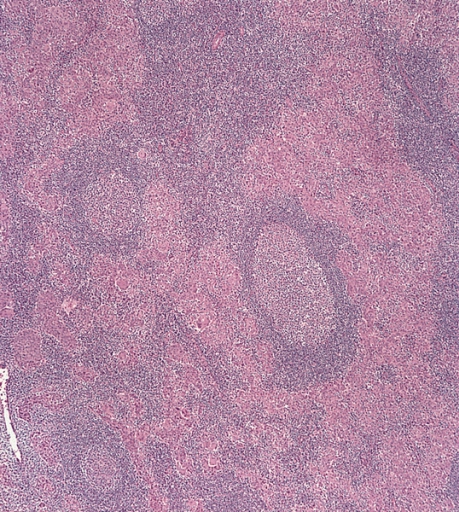 Undifferentiated nasopharyngeal carcinoma – low power
 -
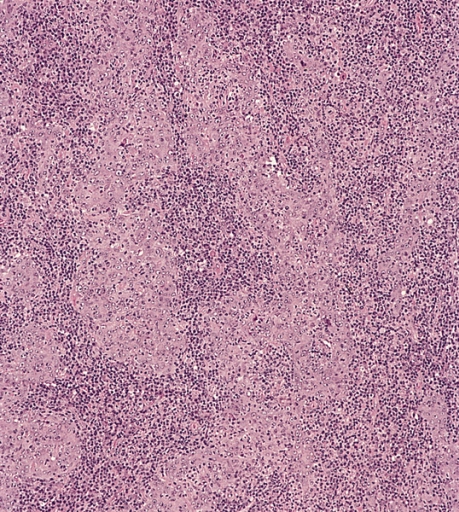 Undifferentiated nasopharyngeal carcinoma – med. power
 -
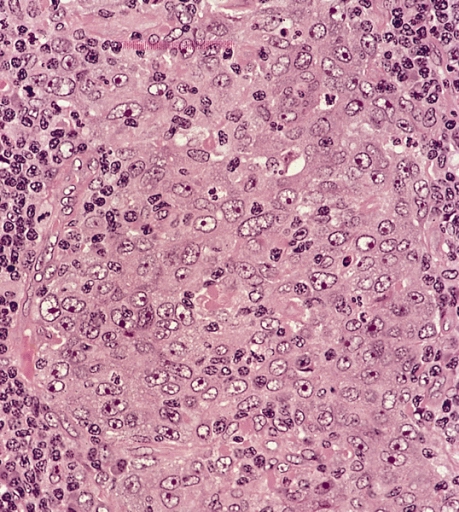 Undifferentiated nasopharyngeal carcinoma – high power


Immunohistochemistry
Immunohistochemistry stains for nasopharyngeal carcinoma include:
- EBER positive
- p16 negative[4]
References
References
- ↑ Abdel Khalek Abdel Razek, A.; King, A. (2012). “MRI and CT of nasopharyngeal carcinoma”. AJR Am J Roentgenol. 198 (1): 11–8. doi:10.2214/AJR.11.6954. PMID 22194474. Unknown parameter
|month=ignored (help) - ↑ Nasopharyngeal carcinoma http://librepathology.org/wiki/index.php/Nasopharyngeal_carcinoma
- ↑ Richard Cote, Saul Suster, Lawrence Weiss, Noel Weidner (Editor). Modern Surgical Pathology (2 Volume Set). London: W B Saunders. ISBN 0-7216-7253-1.
- ↑ Gulley ML, Nicholls JM, Schneider BG, Amin MB, Ro JY, Geradts J (1998). “Nasopharyngeal carcinomas frequently lack the p16/MTS1 tumor suppressor protein but consistently express the retinoblastoma gene product”. Am. J. Pathol. 152 (4): 865–9. PMC 1858242. PMID 9546345. Unknown parameter
|month=ignored (help)
Editor-In-Chief: C. Michael Gibson, M.S., M.D. [1] Associate Editor(s)-in-Chief: Homa Najafi, M.D.[2]Faizan Sheraz, M.D. [3]