

Health Dictionary
Reliable, easy-to-read patient information on common medical conditions — written in plain language, free of jargon, and grounded in current evidence. Browse the most frequent diagnoses, understand what they mean for everyday life, and learn which steps and questions help you have a focused conversation with your doctor.
Nodose
Introduction
The nodose ganglion (ganglion of the trunk; inferior ganglion of vagus nerve) is cylindrical in form, of a reddish color, and 2.5 cm. in length.
Passing through it is the cranial portion of the accessory nerve, which blends with the vagus below the ganglion.
As opposed to the jugular ganglion of the vagus nerve, the inferior or nodose ganglion is larger.
It is chiefly visceral afferent in function concerning sensation of heart, larynx, lungs and alimentary tract from the pharynx to the transverse colon.
Both ganglia are traversed by parasympathetic, and perhaps some sympathetic fibres.
Preganglionic motor fibres (ganglionic branches) from the dorsal vagal nucleus and the special visceral efferents from the nucleus ambiguus, which descend to the inferior vagal ganglion form a band skirting the ganglion.
Additional images
Additional images
-
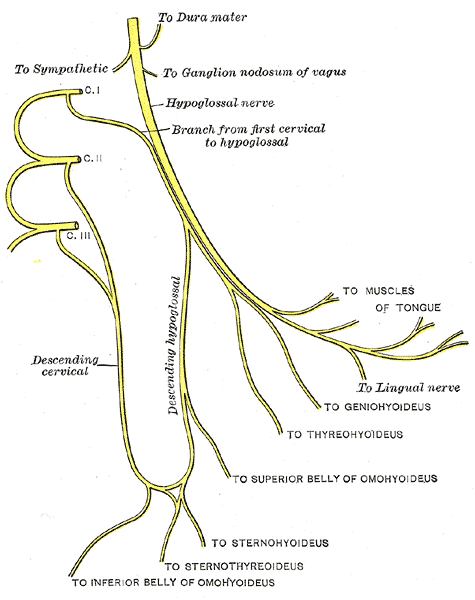 Plan of hypoglossal nerve.

Editor-In-Chief: Template:Infobox Nerve C. Michael Gibson, M.S., M.D. [1]