

Health Dictionary
Reliable, easy-to-read patient information on common medical conditions — written in plain language, free of jargon, and grounded in current evidence. Browse the most frequent diagnoses, understand what they mean for everyday life, and learn which steps and questions help you have a focused conversation with your doctor.
Omphalocele
Introduction
Overview
Overview
An omphalocele is a type of abdominal wall defect in which the intestines, liver, and occasionally other organs remain outside of the abdomen in a sac because of a defect in the development of the muscles of the abdominal wall.
Causes
Causes
Some cases of omphalocele are believed to be due to an underlying genetic disorder.[1][2]
Congenital conditions
- Pentalogy of Cantrell
Chromosomal abnormalities
- Wiedemann-Beckwith syndrome
Mendelian inherited conditions
- Opitz-Frias syndrome
- Osteodysplasty (Melnick-Needles)
Autosomal recessive conditions
- Donnai-Barrow syndrome
- Manitoba oculotrichoanal syndrome
Presentation
Presentation
The sac protrudes in the midline, through the umbilicus (navel).
It is normal for the intestines to protrude from the abdomen, into the umbilical cord, until about the tenth week of pregnancy, after which they return to inside the fetal abdomen.
The omphalocele can be mild, with only a small loop of intestines present outside the abdomen, or severe, containing most of the abdominal organs. In severe cases surgical treatment is made more difficult because the infant’s abdomen is abnormally small because it had no need to expand to accommodate the developing organs.
Screening
Screening
An omphalocele is often detected through AFP screening or a detailed fetal ultrasound. Genetic counseling and genetic testing such as amniocentesis is usually offered during the pregnancy. Some cases of omphalocele are due to an underlying genetic disorder.
Related conditions
Related conditions
Gastroschisis is a similar birth defect, but the umbilical cord is not involved, and parts of organs may be in the amniotic fluid, and not enclosed in a membranous sac.
Examples
Examples
-
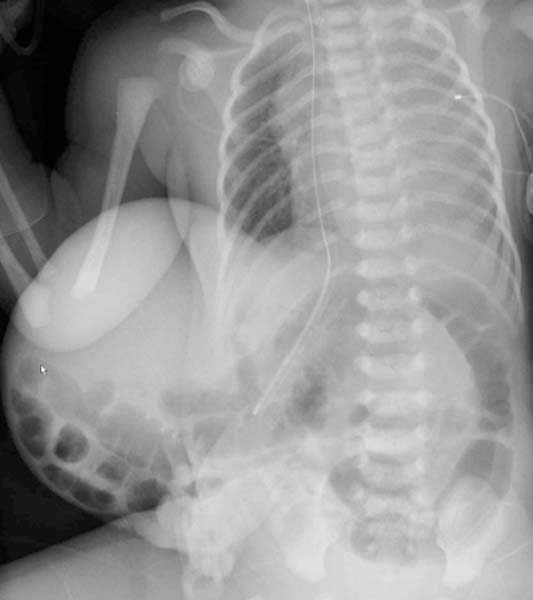 Omphalocele

References
References
- ↑ Kanagawa SL, Begleiter ML, Ostlie DJ, Holcomb G, Drake W, Butler MG (2002). “Omphalocele in three generations with autosomal dominant transmission”. J. Med. Genet. 39 (3): 184–5. doi:10.1136/jmg.39.3.184. PMID 11897819.
- ↑ Yatsenko SA, Mendoza-Londono R, Belmont JW, Shaffer LG (2003). “Omphalocele in trisomy 3q: further delineation of phenotype”. Clin. Genet. 64 (5): 404–13. doi:10.1034/j.1399-0004.2003.00159.x. PMID 14616763.
Editor-In-Chief: C. Michael Gibson, M.S., M.D. [1]