

Health Dictionary
Reliable, easy-to-read patient information on common medical conditions — written in plain language, free of jargon, and grounded in current evidence. Browse the most frequent diagnoses, understand what they mean for everyday life, and learn which steps and questions help you have a focused conversation with your doctor.
Ophthalmic artery
Introduction
Overview
Overview
The ophthalmic artery is a branch of the internal carotid artery which supplies branches to supply the eye and other structures in the orbit.
Branches
Branches
The branches of the ophthalmic artery are often subdivided into an orbital group and an ocular group [2].
Orbital group
The orbital group, distributing vessels to the orbit and surrounding parts, includes:
- Lacrimal artery
- Supraorbital artery
- Posterior ethmoidal artery
- Anterior ethmoidal artery
- Internal palpebral artery
- Supratrochlear artery, also known as the frontal artery
- Dorsal nasal artery
Ocular group
The ocular group, distributing vessels to the eye and its muscles, includes:
Blood supply
Blood supply
Branches of the ophthalmic artery supply:
Occlusion
Occlusion
As with central retinal artery occlusions, ophthalmic artery occlusions may result from systemic cardiovascular diseases; however, a cherry red spot is typically absent and the vision is usually worse. Amaurosis fugax is a temporary loss of vision that occurs in two conditions which cause a temporary reduction in ophthalmic artery pressure: orthostatic hypotension and positive acceleration.[1]
Additional images
Additional images
-
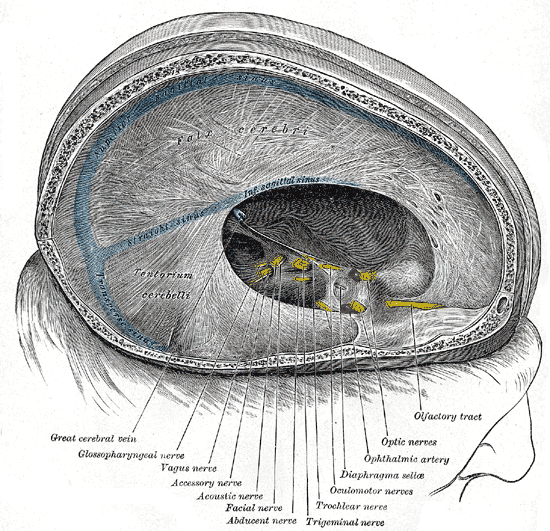 Dura mater and its processes exposed by removing part of the right half of the skull, and the brain.

References
References
- ↑ Phelps GK, Phelps CD. “Blood pressure and pressure amaurosis.” Invest Ophthalmol. 1975 Mar;14(3):237-40. PMID 1116922.
Editor-In-Chief: C. Michael Gibson, M.S., M.D. [1]