

Health Dictionary
Reliable, easy-to-read patient information on common medical conditions — written in plain language, free of jargon, and grounded in current evidence. Browse the most frequent diagnoses, understand what they mean for everyday life, and learn which steps and questions help you have a focused conversation with your doctor.
Pachyonychia
Introduction
Synonyms and keywords: Pachyonychia; thickened nails; nail thickness increased; pachyonychia congenita syndrome
Pathophysiology
Pathophysiology
The condition is caused by genetic mutations in one of four genes that encode keratin proteins specific to the epithelial tissues affected in the two forms of the disorder. Pachyonychia congenita type 1 (PC1) is caused by mutations in keratin 6A (protein name K6A; gene name KRT6A) or keratin 16 (protein K16; gene KRT16). The PC2 form is due to mutations in the genes encoding keratin 6B (protein name K6B; gene name KRT6B) or keratin 17 (protein K17; gene KRT17). Three of the genes causing PC were identified in 1995[1][2] with the fourth gene following in 1998.[3]
Genetics
-
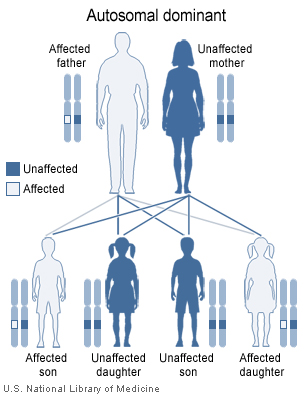 Pachyonychia congenita has an autosomal dominant pattern of inheritance.

Pachyonychia congenita follows an autosomal dominant pattern of inheritance, which means the defective gene is located on an autosome, and only one copy of the gene is required to inherit the disorder from a parent who has the disorder.
On average, 50% of the offspring of an affected person will inherit the disorder, regardless of gender.
Occasionally, however, a solitary case can emerge in a family with no prior history of the disorder due to the occurrence of a new mutation (often referred to as a sporadic or spontaneous mutation).
Causes
Causes
Causes in Alphabetical Order
Diagnosis
Diagnosis
Symptoms
Common symptoms include:
- Excess keratin in nail beds and thickening of the nails
- Hyperkeratosis on hands and feet
- Oral lesions that look like thick white plaques
References
References
- ↑ McLean WH, Rugg EL, Lunny DP; et al. (1995). “Keratin 16 and keratin 17 mutations cause pachyonychia congenita”. Nat. Genet. 9 (3): 273–8. doi:10.1038/ng0395-273. PMID 7539673.
- ↑ Bowden PE, Haley JL, Kansky A, Rothnagel JA, Jones DO, Turner RJ (1995). “Mutation of a type II keratin gene (K6a) in pachyonychia congenita”. Nat. Genet. 10 (3): 363–5. doi:10.1038/ng0795-363. PMID 7545493.
- ↑ Smith FJ, Jonkman MF, van Goor H; et al. (1998). “A mutation in human keratin K6b produces a phenocopy of the K17 disorder pachyonychia congenita type 2”. Hum. Mol. Genet. 7 (7): 1143–8. PMID 9618173.
External links
External links
- OMIM: 167200 Template:RareDiseases
- OMIM: 167210 Template:RareDiseases
- OMIM: 260130 Template:RareDiseases
Template:Congenital malformations and deformations of integument
Editor-In-Chief: C. Michael Gibson, M.S., M.D. [1]