

Health Dictionary
Reliable, easy-to-read patient information on common medical conditions — written in plain language, free of jargon, and grounded in current evidence. Browse the most frequent diagnoses, understand what they mean for everyday life, and learn which steps and questions help you have a focused conversation with your doctor.
Pancreatic trauma
Introduction
Contributors: Cafer Zorkun M.D., PhD.
Overview
Overview
- In the acute setting, pancreatic injuries may result in death due to associated vascular injuries.
- Delayed morbidity and mortality are usually caused by complications resulting from disruption of the pancreatic duct.
- Duct injury may lead to complications such as abscess, pancreatic pseudocyst, fistula, and pancreatitis.
- The pancreas is vulnerable to crushing injury in blunt trauma due to impact against the adjacent vertebral column.
- Two-thirds of pancreatic injuries occur in the pancreatic body, and the remainder occur equally in the head, neck, and tail.
- Isolated pancreatic injuries are rare, and associated injuries, especially to the liver, stomach, duodenum, and spleen, occur in over 90% of cases.
- In adults, over 75% of blunt injuries to the pancreas are due to motor vehicle collisions.
- In children, bicycle injuries are common, and child abuse may result in pancreatic injuries in infants.
Diagnosis
Diagnosis
- Pancreatic injuries may be difficult to diagnose clinically.
Diagnostic Findings
Computed Tomography
- Direct signs of pancreatic injury include pancreatic laceration, transection, and comminution. [1]
- Fluid collections, such as hematomas, pseudocysts, and abscesses, are often seen communicating with the pancreas at the site of fracture or transection.
- Focal enlargement of the pancreas and peripancreatic fluid are suggestive of pancreatic injury.
- Peripancreatic fat stranding, hemorrhage, and fluid between the splenic vein and pancreas are useful secondary signs.
-
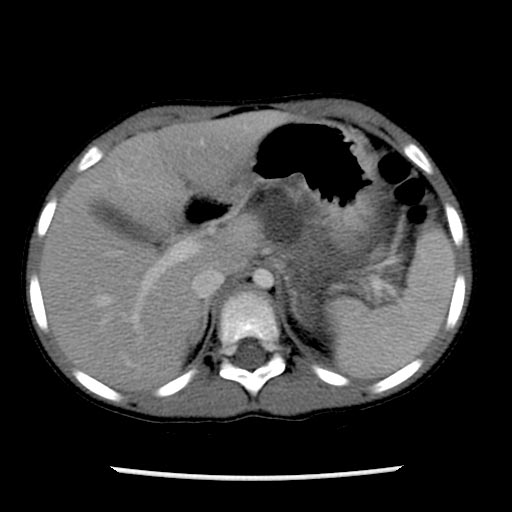 Computed Tomography, Pancreatic laceration: A patient with pancreatic transection and pseudocyst formation from motor vehicle accident
 -
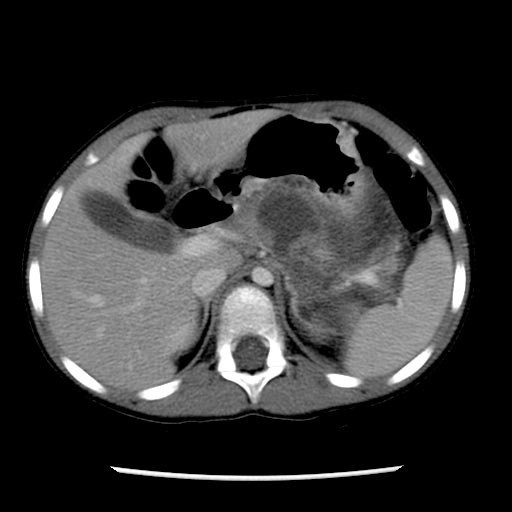 Computed Tomography, Pancreatic laceration: A patient with pancreatic transection and pseudocyst formation from motor vehicle accident
 -
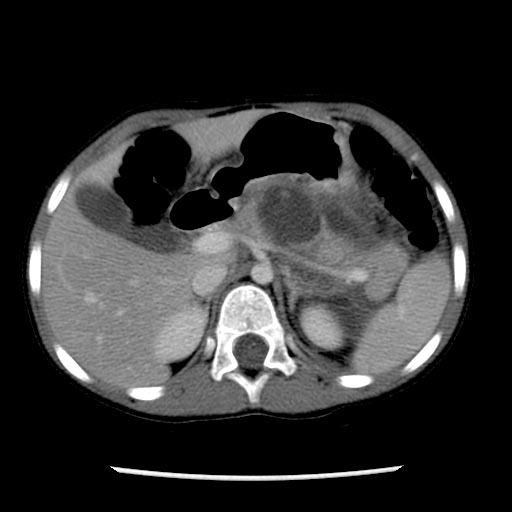 Computed Tomography, Pancreatic laceration: A patient with pancreatic transection and pseudocyst formation from motor vehicle accident
 -
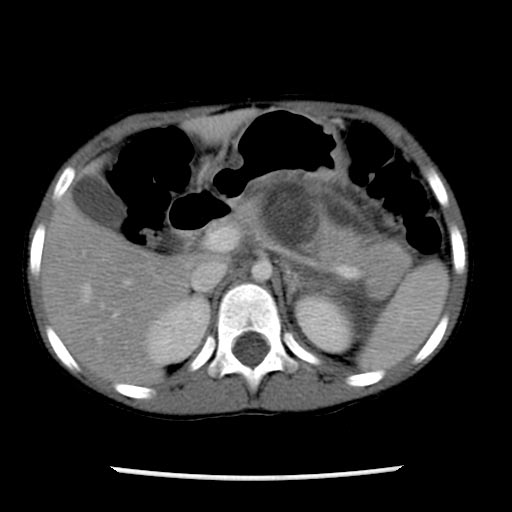 Computed Tomography, Pancreatic laceration: A patient with pancreatic transection and pseudocyst formation from motor vehicle accident
 -
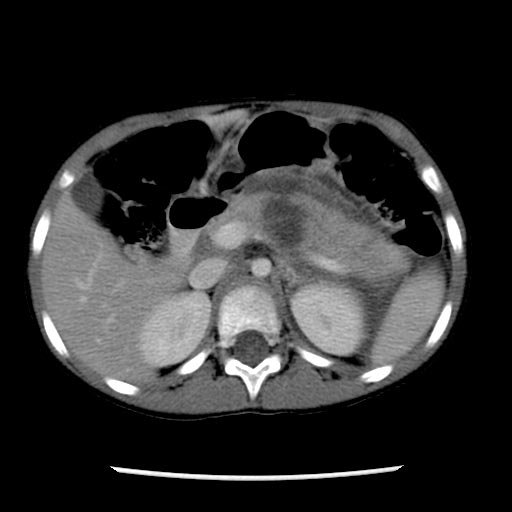 Computed Tomography, Pancreatic laceration: A patient with pancreatic transection and pseudocyst formation from motor vehicle accident
 -
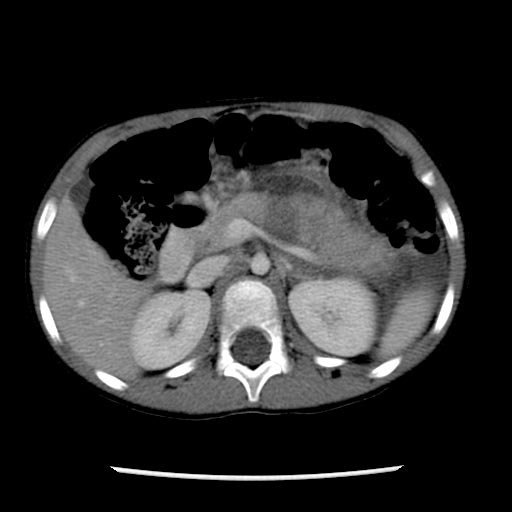 Computed Tomography, Pancreatic laceration: A patient with pancreatic transection and pseudocyst formation from motor vehicle accident


Treatment
Treatment
Disruption of the pancreatic duct is treated surgically or by therapeutic endoscopy with stent placement, while injuries without duct involvement are usually treated nonsurgically.
Prognosis
Prognosis
- Although uncommon, early diagnosis is crucial, since delayed complications such as fistula, abscess, sepsis, and hemorrhage may lead to significant mortality, occurring in up to 20% of cases.
- Death due to delayed complications is usually due to sepsis and multiorgan failure.
- The main source of delayed morbidity and mortality from pancreatic trauma is disruption of the pancreatic duct. Injuries that spare the pancreatic duct rarely result in morbidity or death.
References
References
- ↑ Avneesh Gupta, Joshua W. Stuhlfaut, Keith W. Fleming, Brian C. Lucey, and Jorge A. Soto. Blunt Trauma of the Pancreas and Biliary Tract: A Multimodality Imaging Approach to Diagnosis. RadioGraphics 2004 24: 1381-1395.
External Links
External Links
Template:Skin and subcutaneous tissue symptoms and signs Template:Nervous and musculoskeletal system symptoms and signs Template:Urinary system symptoms and signs Template:Cognition, perception, emotional state and behaviour symptoms and signs Template:Speech and voice symptoms and signs Template:General symptoms and signs
Editor-In-Chief: C. Michael Gibson, M.S., M.D. [1]