

Health Dictionary
Reliable, easy-to-read patient information on common medical conditions — written in plain language, free of jargon, and grounded in current evidence. Browse the most frequent diagnoses, understand what they mean for everyday life, and learn which steps and questions help you have a focused conversation with your doctor.
Pelvic inflammatory disease epidemiology and demographics
Introduction
Overview
Overview
It is difficult to have an accurate estimate of PID incidence and prevalence because most of this patients are sub-clinical.[1] PID is the most common reason for hospitalization among women. It is more common among young sexually active woman aged 15-29.
Epidemiology
Epidemiology
Incidence
- It is estimated that between 750,000 and 1.2 million women are affected by PID each year in the United States.[2][3]
- Incidence and prevalence are decreasing since 1985 because of widespread chlamydia screening and treatment.[4]
- PID is the most common gynecologic reason for hospital admission in the United States, accounting for 18 per 10,000 recorded hospital discharges.[5][6]
- Approximately 50,000 women become infertile in the US each year as a consequence of PID.
- N. gonorrhoea is isolated in only 40-60% of women with acute salpingitis.[7] C. trachomatis was estimated to be the cause in about 60% of cases of salpingitis, which may lead to PID.
-
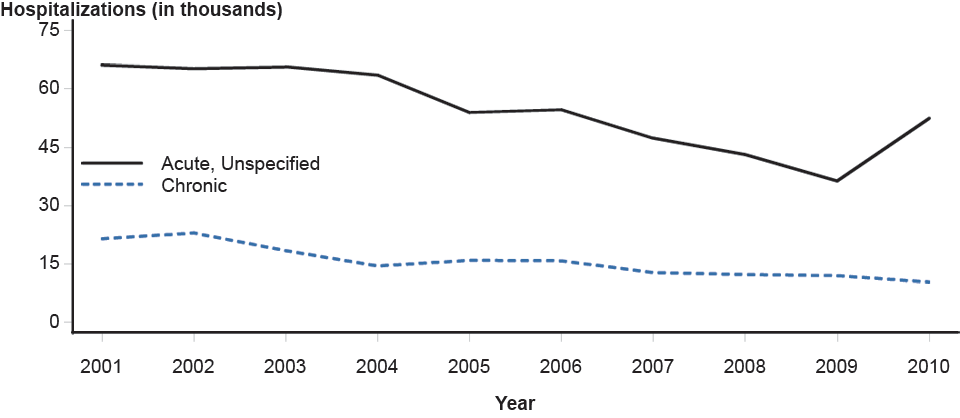 Pelvic Inflammatory Disease—Hospitalizations of Women Aged 15–44 Years, United States, 2001–2010
 -
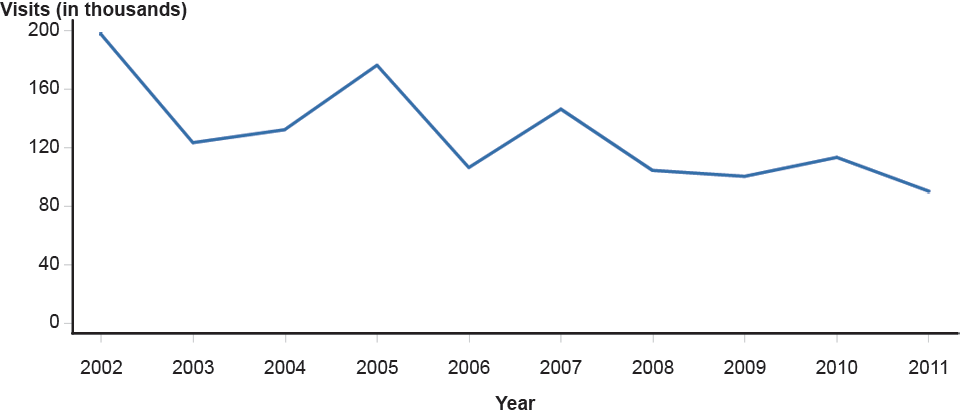 Pelvic Inflammatory Disease—Initial Visits to Physicians’ Offices by Women Aged 15–44 Years, United States, 2002–2011


Graphs adapted from https://www.cdc.gov/
Demographics
Demographics
Age
PID is a common disease that tends to affect young women between the ages of 15 and 29 years.[2]
Race
In the United States, African-American or Black-Caribbean ethnicity has been associated with a higher risk of PID.[8]
References
References
- ↑ Grodstein F, Rothman KJ (1994). “Epidemiology of pelvic inflammatory disease”. Epidemiology. 5 (2): 234–42. PMID 8172999.
- ↑ 2.0 2.1 Ford GW, Decker CF (2016). “Pelvic inflammatory disease”. Dis Mon. 62 (8): 301–5. doi:10.1016/j.disamonth.2016.03.015. PMID 27107781.
- ↑ Rein DB, Kassler WJ, Irwin KL, Rabiee L (2000). “Direct medical cost of pelvic inflammatory disease and its sequelae: decreasing, but still substantial”. Obstet Gynecol. 95 (3): 397–402. PMID 10711551.
- ↑ Owusu-Edusei K, Bohm MK, Chesson HW, Kent CK (2010). “Chlamydia screening and pelvic inflammatory disease: Insights from exploratory time-series analyses”. Am J Prev Med. 38 (6): 652–7. doi:10.1016/j.amepre.2010.02.008. PMID 20494242.
- ↑ Gradison M (2012). “Pelvic inflammatory disease”. Am Fam Physician. 85 (8): 791–6. PMID 22534388.
- ↑ Sutton MY, Sternberg M, Zaidi A, St Louis ME, Markowitz LE (2005). “Trends in pelvic inflammatory disease hospital discharges and ambulatory visits, United States, 1985-2001”. Sex Transm Dis. 32 (12): 778–84. PMID 16314776.
- ↑ Lauren Nathan; DeCherney, Alan H.; Pernoll, Martin L. (2003). Current obstetric & gynecologic diagnosis & treatment. New York: Lange Medical Books/McGraw-Hill. ISBN 0-8385-1401-4.
- ↑ Leichliter JS, Chandra A, Aral SO (2013). “Correlates of self-reported pelvic inflammatory disease treatment in sexually experienced reproductive-aged women in the United States, 1995 and 2006-2010”. Sex Transm Dis. 40 (5): 413–8. doi:10.1097/OLQ.0b013e318285ce46. PMID 23588132.
Editor-In-Chief: C. Michael Gibson, M.S., M.D. [1]; Associate Editor(s)-in-Chief: Seyedmahdi Pahlavani, M.D. [2]