

Health Dictionary
Reliable, easy-to-read patient information on common medical conditions — written in plain language, free of jargon, and grounded in current evidence. Browse the most frequent diagnoses, understand what they mean for everyday life, and learn which steps and questions help you have a focused conversation with your doctor.
Posterior interosseous artery
Introduction
The posterior interosseous artery (dorsal interosseous artery) is an artery of the forearm.
It passes backward between the oblique cord and the upper border of the interosseous membrane. It appears between the contiguous borders of the supinator and the abductor pollicis longus, and runs down the back of the forearm between the superficial and deep layers of muscles, to both of which it distributes branches.
Where it lies upon the abductor pollicis longus and the extensor pollicis brevis, it is accompanied by the dorsal interosseous nerve.
At the lower part of the forearm it anastomoses with the termination of the volar interosseous artery, and with the dorsal carpal network.
It gives off, near its origin, the interosseous recurrent artery, which ascends to the interval between the lateral epicondyle and olecranon, on or through the fibers of the Supinator, but beneath the anconeus, and anastomoses with the radial collateral branch of the profunda brachii, the posterior ulnar recurrent and the inferior ulnar collateral.
Additional images
Additional images
-
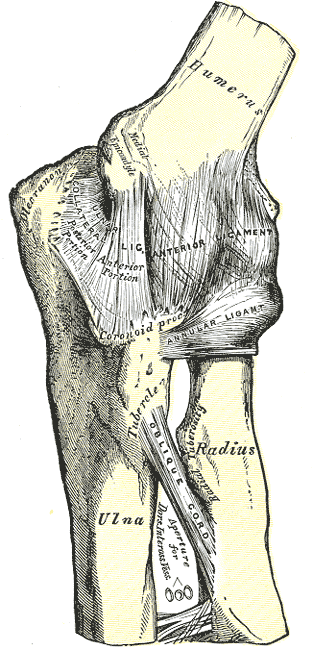 Left elbow-joint, showing anterior and ulnar collateral ligaments.
 -
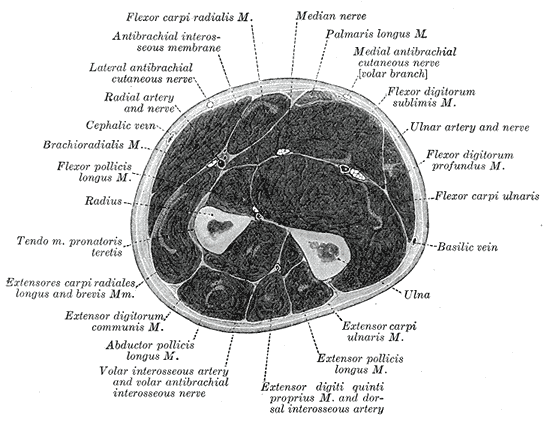 Cross-section through the middle of the forearm.


Editor-In-Chief: C. Michael Gibson, M.S., M.D. [1] There can be one or more than one Editor-In-Chief. You may also apply to be an Associate Editor-In-Chief of one of the subtopics below. Please mail us [2] to indicate your interest in serving either as an Editor-In-Chief of the entire topic or as an Associate Editor-In-Chief for a subtopic. Please be sure to attach your CV and or biographical sketch.