

Health Dictionary
Reliable, easy-to-read patient information on common medical conditions — written in plain language, free of jargon, and grounded in current evidence. Browse the most frequent diagnoses, understand what they mean for everyday life, and learn which steps and questions help you have a focused conversation with your doctor.
Psoriasis physical examination
Introduction
Overview
Overview
Common physical examination findings of psoriasis include erythematous, scaling papules, and plaques.
Physical Examination
Physical Examination
Appearance of the patient
- Patient may appear distressed and anxious
Vital signs
- High-grade fever with generalized pustular psoriasis[1]
- Tachycardia with regular pulse[1]
- Tachypnea
- Kussmaul respirations may be present in patients with comorbid diabetes and DKA
Skin
- Papulosquamous disease with variable morphology, distribution, severity, and course
- Scaly papules and plaques
- Koebner phenomenon: Appearance of new psoriatic lesions at the site of skin injury
- Woronoff’s ring: Ring of peripheral blanching skin around a psoriatic plaque
- Auspitz’s sign: Small bleeding points seen upon disruption of a psoriatic scale
-
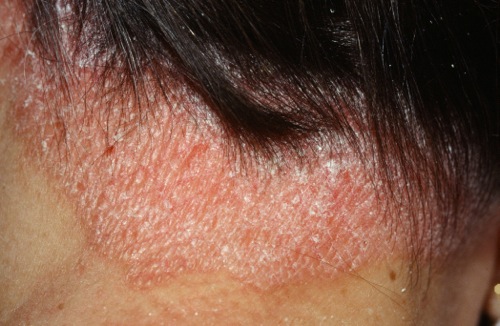 Scalp psoriasis, courtesy of regionalderm.net
 -
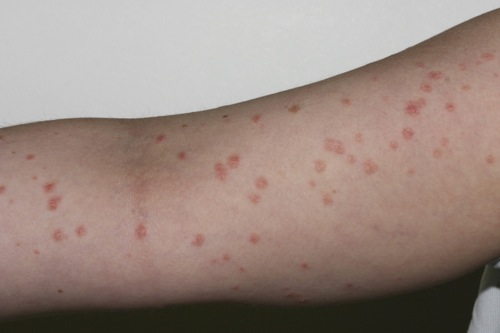 Extremity psoriasis(guttate variety), courtesy of regionalderm.net
 -
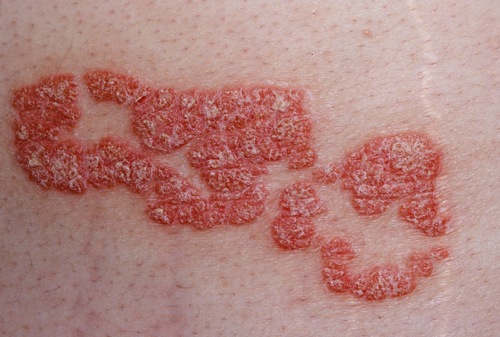 Trunk psoriasis, courtesy of regionalderm.net
 -
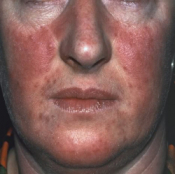 Face psoriasis, courtesy of https://aloeworldnorfolk.wordpress.com/tag/psoriasis/
 -
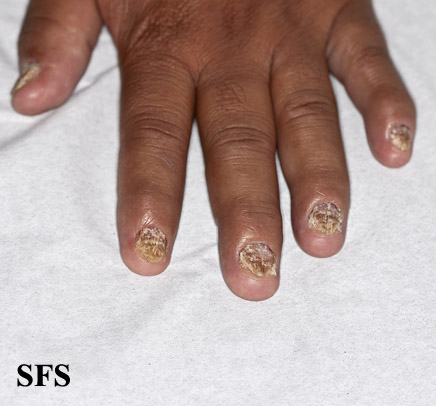 Nails showing pitting, crumbling and brittleness, courtesy of http://www.atlasdermatologico.com.br/
 -
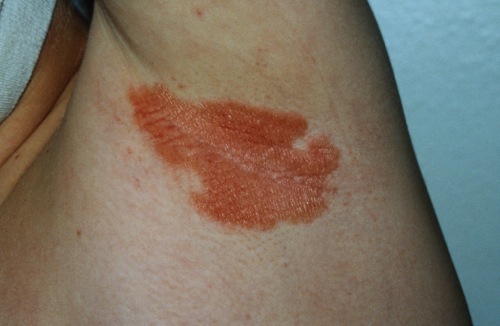 Inverse psoriasis, courtesy of regionalderm.net


HEENT
- Scalp psoriasis may manifest as raised, reddish, often scaly patches
- Ophthalmoscopic exam in psoriasis may show uveitis, most commonly in patients with arthropathy or pustular psoriasis[2]
- Sensorineural hearing loss associated with psoriatic arthritis
- Rinne test may be negative (abnormal)
- Weber test may show a quieter sound in the ear with the sensorineural hearing loss
Neck
Lungs
- Psoriasis has been known to be associated with COPD[3]
- Expanded/barrel shaped chest secondary to COPD
- Bilateral decreased breath sounds
- Bilateral wheezes
- Reduced tactile fremitus
Heart
- The risk of arterial and venous vascular diseases (e.g. myocardial infarction, thrombophlebitis, pulmonary embolization) is higher in severe psoriasis involving multiple areas of the body.[4]
- There may be a chance of high output cardiac failure due to erythroderma.[4]
Abdomen
- No abdominal distention
- No abdominal tenderness
- No hepatomegaly/splenomegaly/hepatosplenomegaly
References
References
- ↑ 1.0 1.1 Iizuka H, Takahashi H, Ishida-Yamamoto A (2003). “Pathophysiology of generalized pustular psoriasis”. Arch. Dermatol. Res. 295 Suppl 1: S55–9. doi:10.1007/s00403-002-0372-5. PMID 12677433.
- ↑ Fraga NA, Oliveira Mde F, Follador I, Rocha Bde O, Rêgo VR (2012). “Psoriasis and uveitis: a literature review”. An Bras Dermatol. 87 (6): 877–83. PMC 3699904. PMID 23197207.
- ↑ Dreiher J, Weitzman D, Shapiro J, Davidovici B, Cohen AD (2008). “Psoriasis and chronic obstructive pulmonary disease: a case-control study”. Br. J. Dermatol. 159 (4): 956–60. doi:10.1111/j.1365-2133.2008.08749.x. PMID 18637897.
- ↑ 4.0 4.1 Kremers HM, McEvoy MT, Dann FJ, Gabriel SE (2007). “Heart disease in psoriasis”. J. Am. Acad. Dermatol. 57 (2): 347–54. doi:10.1016/j.jaad.2007.02.007. PMID 17433490.
Editor-In-Chief: C. Michael Gibson, M.S., M.D. [1]; Associate Editor(s)-in-Chief: Syed Hassan A. Kazmi BSc, MD [2], Kiran Singh, M.D. [3]